

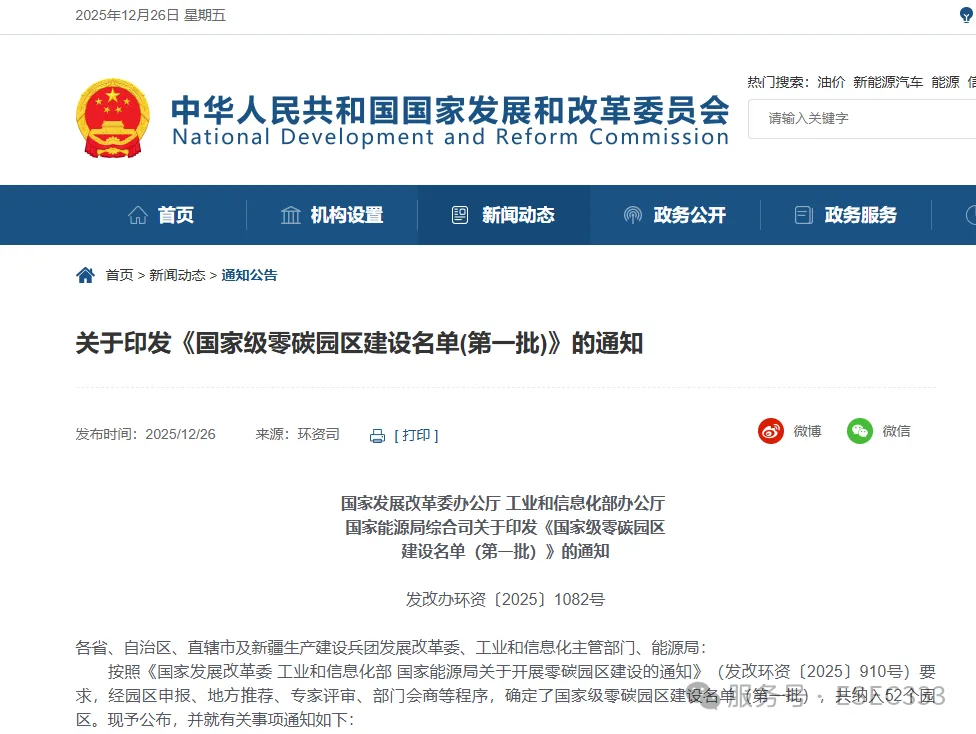
As the “smallest execution unit” for precise carbon emission governance, zero-carbon parks are a key vehicle for turning the dual carbon goals from concept into practice. The release of the first batch of national-level zero-carbon parks is a milestone on multiple fronts, including energy transition, industrial upgrading, regional coordination and international competitiveness.
Accelerating the Green Energy Transition
China’s new energy resources and industrial demand are notably mismatched across regions. The “Three-North” region (Northwest China, North China and Northeast China) is rich in wind and solar resources, with more than half of the country’s technically exploitable capacity, yet its industrial base is weak; the eastern coastal region has strong industrial demand and a large green power gap, but faces a shortage of new energy resources. The layout of the first batch of zero-carbon parks is designed precisely to break this deadlock.
Under the policy requirements, selected parks must build an energy supply system that is “electricity-centered with green electricity consumption as the mainstay.” Core indicators specify “carbon emissions per unit of energy consumption of no more than 0.2-0.3 tonnes per tonne of standard coal” (a 90% decrease from the national average for industrial parks), with a direct green electricity supply ratio of no less than 50%.
Leading Deep Industrial Decarbonization
Industrial parks are a core vehicle of China’s industrial economy — the country’s 2,500 industrial parks at provincial level and above contribute 80% of industrial output and nearly 50% of energy consumption, and are also a major source of industrial carbon emissions. The development of the first batch of zero-carbon parks will drive industrial decarbonization along two paths: retrofitting existing assets and optimizing new ones.
On the front of transforming traditional industries, the list covers a number of parks where energy-intensive industries are concentrated. Policy requires these parks to achieve deep decarbonization through technological upgrades (such as electric furnace upgrades and hydrogen-based shaft furnace retrofits) and fuel substitution (hydrogen and biomass energy), while avoiding “campaign-style carbon reduction.”
On the front of upgrading emerging industries, the selected parks focus on low-energy, high-value-added fields such as new energy equipment manufacturing, advanced equipment manufacturing and computing centers. Policy encourages these parks to develop a “green-for-green” model — using green energy to make green products (such as photovoltaic modules and new energy vehicles) — and to reduce product carbon emissions through full-process carbon footprint management. This can not only enhance the international competitiveness of China’s emerging industries, but also provide a “China solution” for global green supply chains.
Promoting Coordinated Regional Development
The first batch of zero-carbon parks achieves “full coverage” of 31 provinces (autonomous regions and municipalities) plus the Xinjiang Production and Construction Corps, with eastern and western parks each having their own emphases, reflecting the principle of “tailoring measures to local conditions with categorized guidance”:
Eastern region: Leveraging its economic base and technological advantages, it focuses on digitalization and internationalization. It needs to achieve real-time energy consumption control through smart energy and carbon management platforms, while also meeting the needs of exporting enterprises in responding to the EU Carbon Border Adjustment Mechanism (CBAM).
Central and western regions: Leveraging their resource advantages, they take on the transfer of energy-intensive industries. Low-cost green power can be used to develop industries such as electrolytic aluminum and big data centers, achieving the conversion of “resource advantages into economic advantages.”
This differentiated layout will drive a “rational division of labor and a virtuous cycle” across the country — the east focusing on high-value-added, low-energy industries while the central and western regions take on energy-intensive yet low-carbon industries. This avoids “homogeneous competition” between regions while narrowing the development gap between east and west, injecting green momentum into common prosperity.
Responding to International Green Trade Barriers
In recent years, policies such as the EU Carbon Border Adjustment Mechanism (CBAM) and the US Clean Energy Act have been introduced one after another, and green trade barriers centered on product carbon footprints are gradually taking shape. As the world’s largest manufacturing country, China faces potential cost pressure from “carbon tariffs” on its exports (such as steel, cement and photovoltaic modules). The development of the first batch of zero-carbon parks is a key move to meet this challenge.
Zero-carbon parks are required to establish a “traceable energy supply system and a full-process carbon footprint management system.” Park enterprises can reduce product carbon footprints through green power use and process upgrades, obtaining a “green passport” to international markets.
In the long run, the practices of the 52 parks will help China establish carbon accounting and carbon certification systems aligned with international standards, providing support for overcoming the constraints of “carbon tariffs” while enhancing China’s voice in global climate governance.
Accumulating Experience for a Zero-Carbon Society
Zero-carbon parks are not merely “decarbonization units” but a microcosm of a “zero-carbon society.” Policy requires parks to coordinate zero-carbon practices across energy, industry, transport, buildings and other fields — for example, new buildings must be designed to ultra-low-energy standards, transport vehicles must accelerate low-carbon substitution, and water resources must be recycled (the industrial water reuse rate is a guiding indicator). These measures will accumulate experience for zero-carbon cities and zero-carbon regions.
Features of the First Batch of Parks: Broad Coverage, Clear Classification, Well-Defined Goals
The first 52 national-level zero-carbon parks were not laid out as a “one-size-fits-all” exercise; rather, they were scientifically screened based on regional resource endowments, industrial foundations and carbon reduction potential, displaying four distinctive features: comprehensive coverage, refined scope, reasonable timelines and focused industries.
Geographic Coverage Without “Blind Spots”: Full Coverage of 31 Provinces (Autonomous Regions and Municipalities) Plus the XPCC, Spanning East, Central and Western China
In terms of geographic distribution, the first batch of parks achieves “full coverage” of China’s 31 provinces (autonomous regions and municipalities) on the mainland plus the Xinjiang Production and Construction Corps, including:
Eastern region (Beijing, Tianjin, Hebei, Shanghai, Jiangsu, Zhejiang, Fujian, Shandong, Guangdong, Hainan): 20 parks in total, accounting for 38.5%. Leveraging their advantages of economic prosperity and technological leadership, these focus on high-end manufacturing and the digital economy, such as the Beijing Economic-Technological Development Area (construction period 2025-2028) and the Lingang Special Area Zero-Carbon Bay in Shanghai.
Central region (Shanxi, Inner Mongolia, Jilin, Heilongjiang, Anhui, Jiangxi, Henan, Hubei, Hunan): 15 parks in total, accounting for 28.8%, with the transformation of traditional industries at the core, such as the Datong Economic and Technological Development Area in Shanxi (clean coal utilization) and the Jingmen High-Tech Industrial Development Zone in Hubei (decarbonization of the chemical industry).
Western region (Guangxi, Chongqing, Sichuan, Guizhou, Yunnan, Tibet, Shaanxi, Gansu, Qinghai, Ningxia, Xinjiang, Xinjiang Production and Construction Corps): 17 parks in total, accounting for 32.7%. Leveraging wind and solar resources, these develop a “green power plus industry” model, such as the Mengsu Economic Development Zone in Ordos, Inner Mongolia, and the Suyin Industrial Park in Yinchuan, Ningxia.
This “balanced coverage” layout ensures that every region has a demonstration benchmark while fully mobilizing local initiative, avoiding a situation in which “zero-carbon parks are concentrated only in a few developed regions.”
Construction Scope in “Two Categories”: Mainly “Parks Within Parks,” with “Whole-Park” Projects as a Supplement, Focused on Core Areas
According to the list, the construction scope of the first batch of parks falls into two categories, “parks within parks” and “whole-park” projects, of which:
Parks within parks: 46 in total, accounting for 88.5%. This refers to designating specific areas within existing parks for zero-carbon development. The advantage of this model is that it “focuses on the core and delivers quick results,” allowing high-potential areas to be upgraded first and lowering the cost of overall transformation.
Whole-park projects: 6 in total, accounting for 11.5%. This refers to building an entire park to zero-carbon standards. Such parks usually have clear industrial positioning and relatively new infrastructure, meet the conditions for “whole-park transformation,” and can serve as complete demonstrations of a “zero-carbon society.”
The division of “parks within parks” as the main approach and “whole-park” projects as a supplement reflects the policy’s “step-by-step” philosophy — first achieving breakthroughs in selected areas, and then gradually extending them to the entire park once experience has been accumulated, avoiding the waste of resources caused by “going for the grand and the complete.”
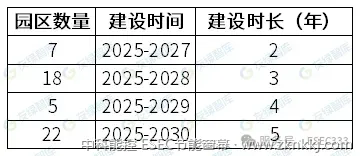
Construction Periods in “Tiers”: Mainly 3-5 Years, Matched to the Difficulty of Regional Transformation
Industrial Positioning with “Clear Emphases”: Focusing on New Energy, High-End Manufacturing and the Transformation of Traditional Industries
In terms of industry type, the first 52 parks can be divided into three major categories, closely aligned with the core needs of China’s industrial decarbonization:
New energy and equipment manufacturing: These parks are the core vehicle of the “green-for-green” model, with the goal of building zero-carbon industrial chains.
High-end manufacturing and the digital economy: These parks focus on low-energy, high-value-added industries and need to achieve “smart zero carbon” through energy and carbon management platforms.
Transformation of traditional industries: These parks are the “hard nuts to crack” in industrial decarbonization and need to achieve deep carbon reduction through technological upgrades.
This fine-grained industrial positioning ensures that zero-carbon park development covers the “main fields” of China’s industry, promoting high-start emerging industries while supporting the green transformation of traditional ones, forming a pattern of a “zero-carbon layout across all industries.”
Driving Zero-Carbon Parks from “Pilots” to “Widespread Adoption”
The release of the first batch of zero-carbon parks is only a starting point. To achieve the goal of building 100 national-level zero-carbon parks during the 15th Five-Year Plan period, challenges in funding, technology and talent must still be overcome. Under the policy deployment, efforts will focus on three areas:
Policy level: Improving Incentive Mechanisms and Strengthening Assessment and Supervision
The state will advance park development through “funding support, factor guarantees and unified standards”: on funding, coordinating existing funding channels and encouraging support from local government special bonds and medium- and long-term credit from policy banks; on production factors, giving priority to meeting the land and sea use needs of park new energy projects; and on standards, unifying carbon accounting and carbon certification systems to avoid “each doing its own thing.” At the same time, a full-process supervision mechanism of “construction-assessment-acceptance” will be established, with acceptance checks for parks that meet the indicators to ensure construction quality.
Technology Level: Breaking Down “Technology Silos” and Promoting Integrated Innovation
In response to issues such as the intermittency of wind and solar power, the high energy consumption of carbon capture and inconsistent hydrogen standards, support will be given to cooperation between parks and universities and research institutions to build a “zero-carbon technology integration ecosystem” — for example, using AI energy and carbon management platforms such as Envision Ark to achieve multi-technology coordination, and relying on virtual power plants (load aggregators) to participate in the electricity market and improve resource allocation efficiency. At the same time, cross-regional technology cooperation will be promoted, such as eastern parks exporting digital management technology to western parks while western parks share green power resources with eastern parks.
Social Level: Cultivating a Low-Carbon Consensus and Attracting Diverse Participation
Building zero-carbon parks requires efforts not only from government and enterprises, but also from the public. In the future, public low-carbon awareness will be cultivated through outreach and promotion (such as summarizing typical cases and publishing white papers), while third-party institutions (such as integrated energy service providers and carbon consulting firms) will be encouraged to participate in park development, forming a diverse collaborative pattern of “government guidance, enterprise leadership and social participation.”
The release of the first batch of national-level zero-carbon parks is an important step in advancing China’s dual carbon goals. The 52 parks will serve as “zero-carbon cells,” playing a demonstration and leading role in energy transition, industrial decarbonization, regional coordination and international competition. As construction progresses, these parks will not only become new benchmarks for green development, but will also offer “Chinese experience” for global carbon neutrality, moving China’s economy and society forward with solid steps toward a comprehensive green transformation.