
Abstract
Driven both by the dual carbon strategic goals and increasingly stringent mandatory building energy-efficiency codes, China’s glass curtain wall industry is undergoing a profound paradigm shift. The industry’s core growth driver has moved decisively away from “scale expansion” toward a new stage led by “low-carbon transformation” and “value reinvention.”
The core insights are as follows:
1. The market has entered a period of structural opportunity: nationwide, the stock of curtain wall past its service life is enormous, and retrofit demand together with the stringent energy-efficiency requirements for new projects forms a “two-wheel drive” market worth more than 100 billion CNY a year. By 2030, the overall market is expected to exceed 410 billion CNY.
2. Technology pathways are diversifying: the market is no longer limited to wholesale replacement. Superimposed and interior retrofit technologies represented by the ESEC window curtain and the insulating view-through shading window curtain, which are high-performance, low-disruption and fast to deploy, are rising rapidly in the existing-building retrofit market thanks to their outstanding cost-effectiveness and minimal impact on building operations, opening up an entirely new value track.
3. The dimensions of competition are upgrading across the board: the focus has shifted from traditional engineering, manufacturing and installation capability to comprehensive capability spanning low-carbon technology integration, full-life-cycle data services, carbon asset management and innovative financial solutions. Platform companies with integrated service capabilities and technology leaders in niche segments will enjoy a marked advantage.
4. Policy and capital are converging: mandatory carbon emission standards and incentive-based carbon market mechanisms such as CCER work together to turn curtain wall energy-saving retrofits from a “cost outlay” into a “value investment” that generates long-term economic returns, significantly changing the investment decision model for projects.
This report aims to provide industry participants, investors and policymakers with a panoramic market analysis, an interpretation of technology pathways and a strategic action framework, helping them seize this historic industrial upgrading opportunity.
Contents
1. Chapter One: The Macro Industry Picture – From Scale Growth to Value Creation
1.1 Market Size and Growth Engines: A Duet of Stock and New-Build
1.2 Policy-Driven Paradigm Shift: From Encouragement to Mandatory Constraint
1.3 Regional Market Characteristics and International Opportunities
2. Chapter Two: The Technology Revolution and Pathway Choices – An Arsenal for Solving Retrofit Challenges
2.1 A Panoramic Scan of Mainstream Energy-Saving Technology Routes
2.2 Disruptive Innovation: A Closer Look at the ESEC Window Curtain
2.3 Matching Application Scenarios: Finding the Optimal Solution for Every Building
3. Chapter Three: Deep Customer Insights – Evolving Decision Logic and Value Demands
3.1 Profiles of Core Customer Groups and the Evolution of Their Priorities
3.2 A Model of the Key Factors Influencing Procurement Decisions
3.3 Emerging Demands: ESG Disclosure, Carbon Assets, Comfort and Health
4. Chapter Four: Market Challenges and Potential Risks
5. Chapter Five: Future Trends and Strategic Recommendations
5.1 Three Trends That Are Certain to Shape the Future
5.2 Investment and Action Recommendations for Different Market Participants
6. Chapter Six: Data Sources and Policy Basis (New Core Chapter)
6.1 Sources of Market Size and Industry Data
6.2 Basis in Core Policies and Regulations
6.3 Methodology Notes
Chapter One: The Macro Industry Picture – From Scale Growth to Value Creation
1.1 Market Size and Growth Engines: A Duet of Stock and New-Build
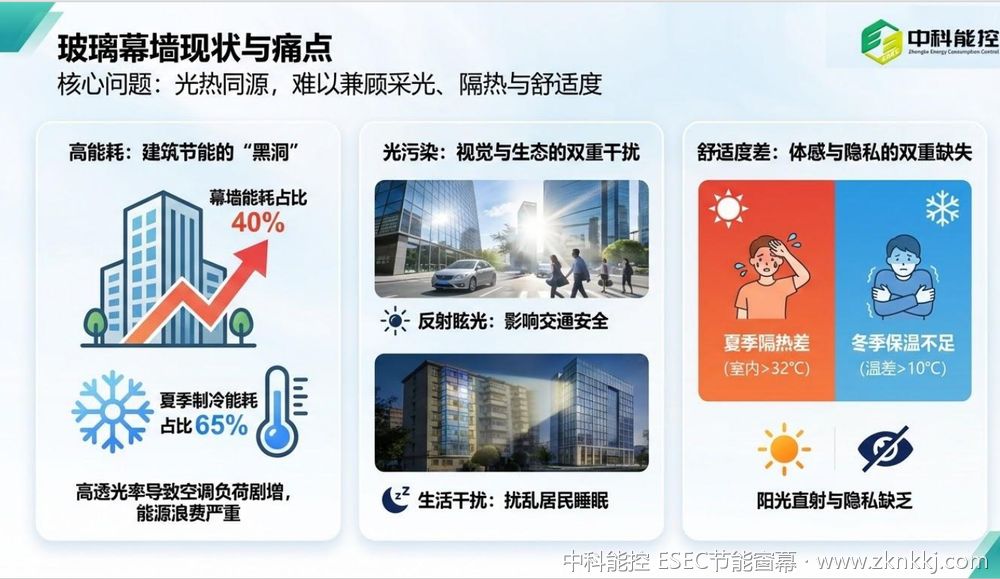
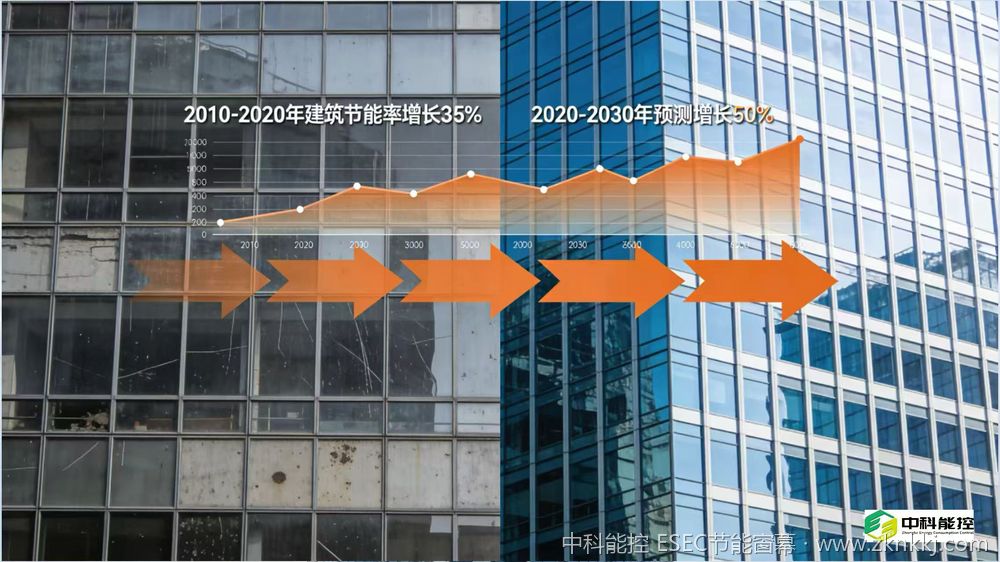
China’s glass curtain wall market has developed a clear “twin-engine” structure. On the new-build side, super-high-rise landmark projects in new first-tier and core second-tier cities continue to generate high-end demand, with unit costs remaining high. The existing-building retrofit market, which has even greater potential, has now reached an explosive inflection point. Nationwide, the stock of curtain wall that has been in service for more than 15 years is enormous, which means not only heavy pressure to screen for safety hazards but also a systematic energy-saving retrofit and performance upgrade market worth hundreds of billions. From 2026 to 2030, this segment is expected to maintain high growth and become the main driver of industry growth.
1.2 Policy-Driven Paradigm Shift: From Encouragement to Mandatory Constraint
Policy is the most fundamental driver of the market, and it has undergone a fundamental shift. Mandatory national standards such as the General Code for Energy Efficiency and Renewable Energy Utilization in Buildings set clear quantitative red lines for the U-value, shading coefficient and air tightness of curtain walls in new buildings. More importantly, the policy framework for energy-saving retrofits of existing buildings is being improved, and some cities have issued incentive-based or mandatory retrofit timetables. At the same time, the development of the national carbon market and the restart of the CCER (Chinese Certified Emission Reduction) mechanism provide a policy channel for building energy-saving retrofit projects to develop carbon assets and earn additional revenue, fundamentally changing the economic evaluation model for projects.
1.3 Regional Market Characteristics and International Opportunities
The market shows clear regional differentiation. Economically developed regions such as East China and South China are the main battleground for existing-building retrofits, where customers demand advanced technology and comprehensive service capability. The central and western regions are still dominated by new-build projects, but their energy-efficiency standards have caught up with those of first-tier regions. In addition, Chinese curtain wall companies have built strong competitiveness in super-high-rise and landmark projects in countries along the Belt and Road, and green energy-saving curtain wall systems are becoming a new growth point for exports.
Chapter Two: The Technology Revolution and Pathway Choices – An Arsenal for Solving Retrofit Challenges
2.1 A Panoramic Scan of Mainstream Energy-Saving Technology Routes
A wide range of technology routes is available on the market today, and the choice can be made according to retrofit depth and performance targets:
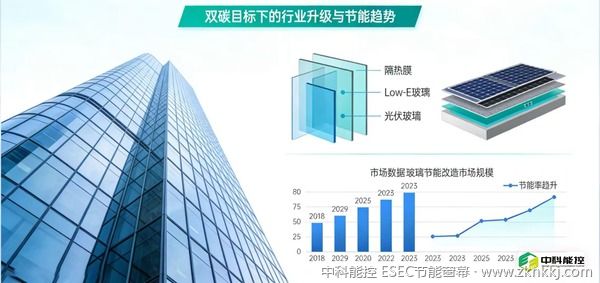
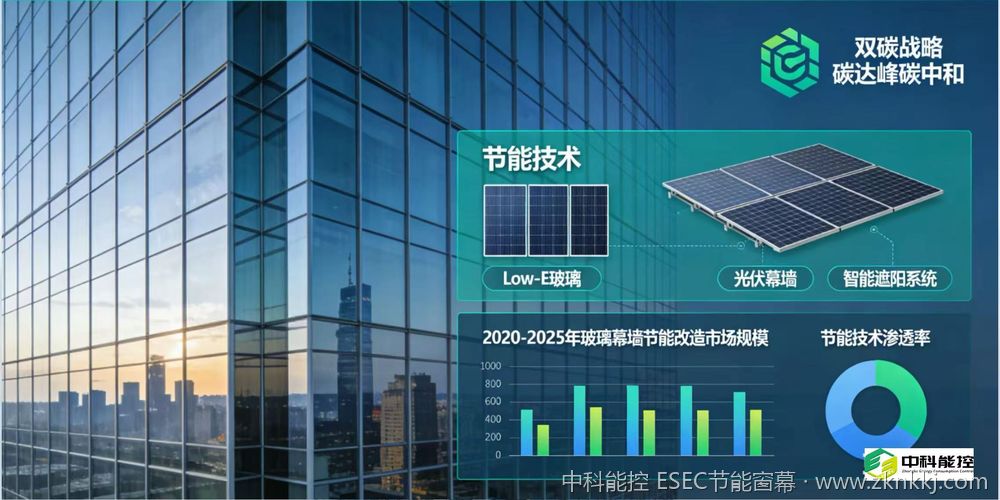
· Conventional upgrade route: mainly replacing ordinary glass with high-performance glazing such as Low-E insulated glazing or vacuum glazing, or adding an intelligent shading system outside the existing curtain wall. These technologies are mature and are the common choice for meeting basic energy-efficiency requirements.
· Deep integration route: mainly building-integrated photovoltaics (BIPV) curtain walls, which merge power generation with the building envelope. This is one of the ultimate solutions for achieving “energy-producing buildings” and is particularly suited to new-build or large-scale renovation projects.
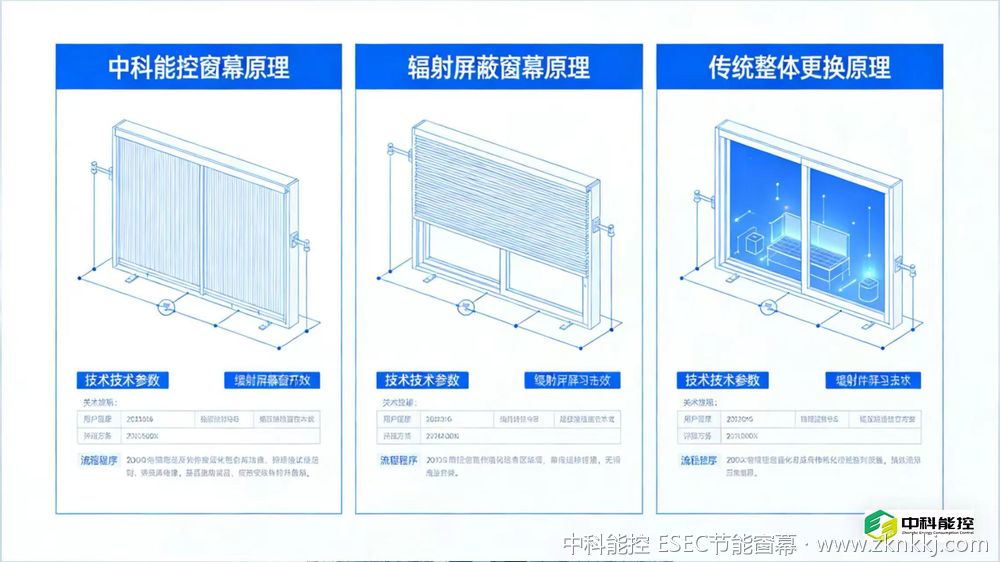
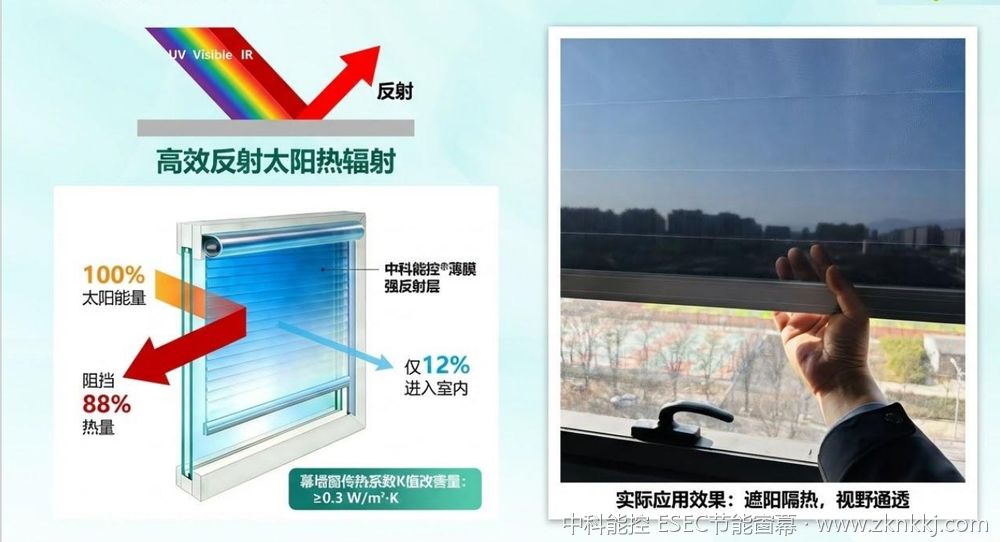
· Disruptive innovation route: represented by the ESEC window curtain and the insulating view-through shading window curtain. These do not call for demolishing the existing curtain wall; instead, they achieve a leap in performance with minimal disruption through interior-side installation or composite integration, making them especially suitable for projects that must keep operating during the retrofit or whose facades are protected.
2.2 Disruptive Innovation: A Closer Look at the ESEC Window Curtain
|
Technical dimension |
ESEC window curtain |
Solar film |
Conventional full replacement |
|
Core principle |
An integrated high-performance roller blind system is installed on the indoor side of the existing window, forming a relatively sealed cavity with the original window and improving the performance of the whole window. |
A film layer of special nanomaterials is coated on or applied to the glass surface or inside the insulated cavity to selectively block near-infrared heat radiation in the solar spectrum while maintaining visible light transmission. |
The old curtain wall is completely demolished and a brand-new high-performance unitized or framed curtain wall system is installed. |
|
Core advantages |
1. Outstanding performance: the U-value is improved by more than 42% on average and the solar heat gain coefficient (SHGC) by more than 50%. 2. Intelligent and controllable: can integrate temperature and light sensing. 3. Near-zero disruption: indoor installation that does not affect the building’s appearance or normal operations. |
1. Efficient insulation: significantly lowers the solar heat gain coefficient (SHGC) and blocks heat entry. 2. Daylight preserved: maintains high visible light transmittance while insulating. 3. Low retrofit cost: can be implemented as a film application retrofit with strong cost-effectiveness. |
1. All-round performance: can incorporate the latest materials and technologies for optimal overall performance. 2. Life reset: completely resolves the ageing of the original structure. 3. Refreshed appearance: provides an opportunity to reinvent the building’s facade image. |
|
Best-fit scenarios |
Buildings with poor curtain wall performance, hot summers and cold winters, and inadequate glass insulation, such as high-end office buildings, hotels, hospitals and sports venues. |
Buildings with severe west-facing sun exposure, heavy air-conditioning loads and a need for natural daylight, such as glass curtain wall office buildings, large shopping malls, airports and high-speed rail stations. |
Projects where the facade is severely aged or the structure poses safety hazards, or where the owner wants to improve both energy efficiency and image at the same time. |
|
Payback period |
3-5 years (high energy savings, strong cost-effectiveness) |
2-5 years (relatively low retrofit cost, but short-lived performance; suitable as a short-term fix for pain points; many product categories exist, so careful vetting is required) |
8-15 years (huge initial investment, including substantial structural engineering costs) |
2.3 Matching Application Scenarios: Finding the Optimal Solution for Every Building
· Super-high-rise and landmark buildings: tend to adopt top-tier integrated solutions such as unitized double-skin curtain walls and BIPV curtain walls, seeking technical benchmark status and brand value.
· Retrofits of existing Grade A office buildings: the main battleground for the ESEC window curtain, where the core demand is to achieve a sharp drop in energy consumption and rental premiums while minimizing disruption to tenants.
· Public buildings (airports and railway stations): the ESEC window curtain and large-area BIPV have broad prospects, solving the energy consumption and comfort challenges of large spaces.
· Historic buildings and buildings with special functions: the ESEC window curtain is almost the only choice, meeting modern building performance requirements while strictly protecting historic character.
Chapter Three: Deep Customer Insights – Evolving Decision Logic and Value Demands
3.1 Profiles of Core Customer Groups and the Evolution of Their Priorities
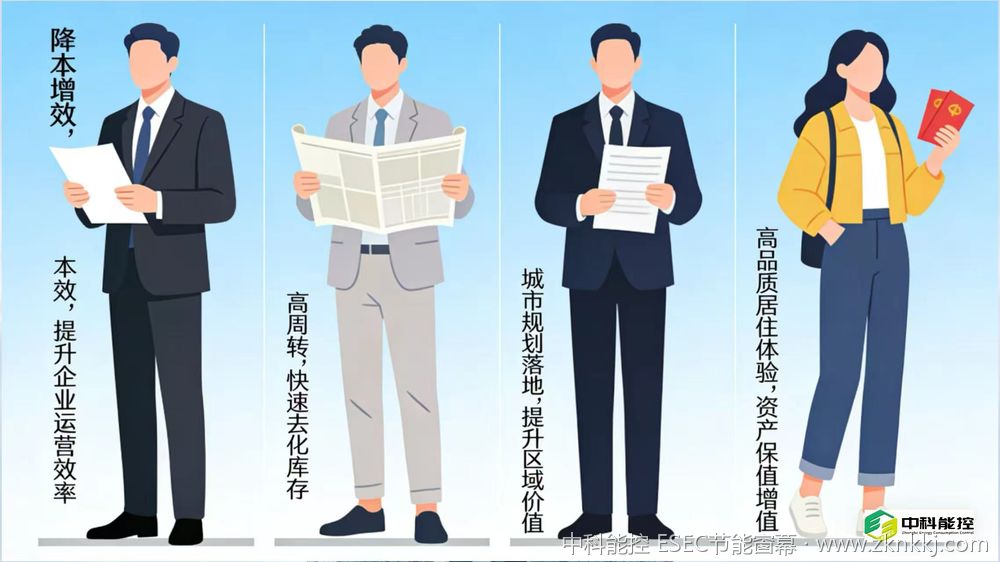
· Corporate executives and ESG officers: their decision-making weight is growing. They focus on how retrofit projects contribute to corporate carbon neutrality goals, require traceable and auditable data, and value technology suppliers’ carbon asset management service capabilities.
· Commercial real estate developers and asset holders (REITs and funds): shifting from a focus on initial construction cost (CAPEX) to full life-cycle cost (LCC) and asset value (NOI, capitalization rate). The rental premium, higher asset valuation and lower vacancy rate brought by energy-saving retrofits are their core considerations.
· Government and public institution owners: their primary goal is to meet mandatory energy-efficiency standards and low-carbon operation requirements for public institutions, with procurement emphasizing compliance, safety and demonstration effect.
· High-end owners and occupants: their requirements for indoor thermal, acoustic and visual comfort (anti-glare) keep rising, and they are willing to pay a premium for a healthy, comfortable indoor environment.
3.2 A Model of the Key Factors Influencing Procurement Decisions
Customer decisions are the result of weighing multiple factors, ranked by importance as follows:
1. Bottom line of compliance and safety: does it meet mandatory codes? Does it eliminate safety hazards?
2. Full life-cycle economics: not just the quoted price, but also the payback period, operating savings and asset appreciation potential.
3. Impact of implementation: how long is the construction period? Is relocation required? How much does it disrupt normal operations and the building’s image?
4. Technological advancement and reliability: are there successful cases? Is the technology mature and stable?
5. Comprehensive service capability: can the supplier provide integrated solutions covering design, financing, operations and maintenance, and carbon assets?
3.3 Emerging Demands: ESG Disclosure, Carbon Assets, Comfort and Health
Beyond basic energy efficiency, leading customers are raising new demands: they need suppliers to provide carbon emission calculation reports that comply with international standards (for example, LCA-based), to assist in developing carbon assets (CCER), and to provide quantified evidence of improvements in indoor environmental quality (IEQ) to support their ESG disclosure and healthy building certification.
Chapter Four: Market Challenges and Potential Risks
· Technology performance and durability risks: the long-term outdoor weather resistance and whole-life reliability of some cutting-edge technologies (such as certain BIPV modules and new coatings) still need time to be verified.
· Overall cost pressure: high-quality energy-saving materials (such as vacuum glazing and special profiles) remain expensive, while the hidden costs of retrofit projects (such as scaffolding and lost rental income) cannot be ignored.
· Standards and talent bottlenecks: national and industry standards for innovative construction methods such as “superimposed retrofits” lag behind, while there is a serious shortage of interdisciplinary talent combining architecture, materials, MEP and digital expertise.
· Market awareness and business model dilemmas: many owners underestimate the urgency of existing-building retrofits and the value of new technologies, while the traditional “lowest bid wins” procurement model is inherently at odds with energy-saving retrofit projects that require greater technical input and long-term service.
Chapter Five: Future Trends and Strategic Recommendations
5.1 Three Trends That Are Certain to Shape the Future
1. Productization and digitalization of technology: the curtain wall will evolve from an engineering component into a monitorable, controllable and interactive “smart building skin unit.” Digital twin technology will be widely applied in design simulation, construction management and smart operations and maintenance.
2. Servitization and financialization of the industry: a “curtain wall as a service” (WaaS) model may emerge. Energy-saving retrofit projects will become increasingly closely tied to green finance (green credit, ABS and mortgages on energy-saving revenue rights).
3. Market segmentation and platformization: the market will split into specialist companies focused on different niches such as super-high-rise new-build, historic building retrofits and regional batch retrofits. At the same time, industrial internet platforms connecting technology, products, services and capital may emerge.
5.2 Strategic Recommendations for Different Market Participants
· For curtain wall engineering companies: they must set up a dedicated “low-carbon retrofit and O&M division” and shift from contractor to solution provider. They should form deep partnerships around one or two core innovative technologies (such as the ESEC window curtain) and build up the capability to design financing schemes.
· For materials and technology companies: drive the productization and standardization of technology and offer a combination of product package, performance insurance and data services. Form joint ventures with large engineering firms or property developers to penetrate the market quickly.
· For asset holders and managers: immediately carry out curtain wall health and energy performance check-ups on their properties and build digital records, and draw up step-by-step retrofit roadmaps. In new procurement contracts, explicitly require tendering based on full life-cycle cost (LCC) and performance guarantees.
· For investors: pay attention to technology companies with core technology patents and successful cases in the low-disruption retrofit niche, and to emerging platform-style service companies able to integrate design, construction, operations and maintenance, and financial resources.
Chapter Six: Data Sources and Policy Basis
To ensure the professionalism and credibility of this white paper, the core data, arguments and trend judgments cited in the report are all based on publicly verifiable authoritative information, industry analysis and policy documents. The main sources are categorized as follows:
6.1 Sources of Market Size and Industry Data
· Macro market size data (such as 286 billion CNY and 410 billion CNY): compiled from the annual reports of the Curtain Wall Engineering Branch of the China Building Decoration Association, fixed asset investment data from the National Bureau of Statistics, and the China Curtain Wall Industry Market Outlook Analysis Report series published by well-known industry research institutions such as Zhiyan Consulting and Zhongyan Puhua.
· Existing curtain wall area data (such as more than 320 million m²): estimated from special inspection statistics on glass curtain walls of existing buildings compiled by the China Academy of Building Research and local housing and urban-rural development departments, with reference to expert interviews in feature articles published by authoritative industry media such as Architecture Technique and Curtain Wall Design.
· Technology application ratios and cost data (such as a 41% adoption rate for Low-E glass and a unit cost of 2,800-4,500 CNY per m²): derived from cross-analysis of market reports by major domestic and international glass manufacturers (such as CSG, Xinyi and Saint-Gobain) and from cost information disclosed in the annual reports and major projects of large listed curtain wall companies (such as Jangho Group and Yuanda China).
· Energy-saving rate and payback period data: based on published measurement and simulation research papers from the Building Energy Research Center of Tsinghua University and the Institute of Building Environment and Energy of the China Academy of Building Research, as well as third-party-tested case reports of typical projects provided by some technology suppliers.
6.2 Basis in Core Policies and Regulations
The core arguments in this report, such as “policy-driven” and “mandatory codes,” are based directly on the following national and ministerial policy documents (as of the first quarter of 2026):
· General Code for Energy Efficiency and Renewable Energy Utilization in Buildings (GB 55015-2021): this is a mandatory engineering construction code that sets out energy-efficiency design indicators for new, expanded and renovated buildings, and it is the most fundamental legal basis for the “mandatory energy-efficiency code” referenced in this report.
· The 14th Five-Year Plan for Building Energy Efficiency and Green Building Development (Jianbiao [2022] No. 24): jointly issued by the Ministry of Housing and Urban-Rural Development and the National Development and Reform Commission, it sets specific targets for the area of existing buildings retrofitted for energy efficiency and for the reduction of building energy intensity by 2025, providing clear policy expectations for the existing-building retrofit market.
· Implementation Plan for Carbon Peaking in the Urban and Rural Construction Sector (Jianbiao [2022] No. 53): it proposes building green, low-carbon cities and creating green, low-carbon county towns and villages, requires strict control over the construction of high-energy-consumption public buildings, and promotes the development of key cities for improving public building energy efficiency, directly driving energy-saving retrofits of public building curtain walls.
· Policies related to the national carbon emissions trading market: the Measures for the Administration of Greenhouse Gas Voluntary Emission Reduction Trading (Trial) and related methodologies issued by the Ministry of Ecology and Environment provide a policy framework and possibilities for building energy-saving retrofit projects to participate in the carbon market and develop carbon assets (such as future CCERs), underpinning the report’s discussion of realizing ESG value and carbon asset management.
· Local urban renewal regulations and facade management measures: such as the Beijing Municipal Urban Renewal Regulations and the Shanghai Municipal Regulations on the Administration of Building Decoration and Renovation, which set specific requirements for the safety, energy efficiency and aesthetics of facade retrofits of existing buildings and serve as the direct legal basis for regional market activity.
6.3 Methodology Notes
This report combines qualitative and quantitative analysis:
· Trend judgment and logical deduction: qualitative judgments on market direction and the competitive landscape are formed based on in-depth interpretation of the above policy documents, tracking of the strategic moves of leading industry players, and summaries of interviews with end customers.
· Data integration and modeling: building on macro and segment data published by authoritative institutions, analytical models (such as stock-renewal models and compound growth models of market size) are used to estimate and forecast future market capacity and structural proportions. All forecasts are marked as expected, reflecting a trend-based outlook.
February 3, 2025