

One Balcony of Glass, Four Problems
1. The balcony becomes a steamer.Chengdu’s basin summers are muggy and humid, and heat disperses slowly. An enclosed balcony is a sealed heat chamber; measured in the afternoon it runs 4–6 degrees C above the living room. Bare feet burn on the floor, and the tiles by the wall feel hot to the touch.
2. A hot balcony drags the living room down with it.Open the balcony door and a blast of heat surges into the living room, undoing the cooling you just paid for. Many households simply shut the balcony door for good — which wastes the balcony entirely, as if they had spent money sealing off a storage closet.
3. Everything on the balcony is being roasted.The washing machine casing and balcony cabinets yellow and age in the sun; the leaves of the potted plants are scorched at the edges; detergent and cleaning products left in the heat all have their shelf life shortened.
4. Glare and privacy, blocked at both ends.The balcony is a full wall of glass, and in the afternoon the reflections are blinding — unpleasant for drinking tea or reading there. With the buildings close together, you dare not leave it open by day, yet closing the blackout curtain darkens the whole home.
Why Neither Film nor Heavy Curtains
The owners first considered two common approaches:
- Heat-insulation window film: an enclosed balcony involves far more glass than a single window, so the total price is not small; Chengdu is humid, and under moisture and temperature swings film blisters and peels more readily; applying it means scraping adhesive and dealing with fumes, and replacement later can damage the glass.
- Blackout curtains or blinds: they block light, but they take the daylight with it. Chengdu is cloudy much of the year and winter sunshine is scarce, so lights are needed even by day; blinds collect dust, and the balcony is the dustiest place in the home, making cleaning harder. Most importantly —a curtain blocks the light but not the heat: the heat has already been absorbed by the glass and the curtain and is still released indoors.
What was finally installedthe ESEC Energy-Saving Window Curtain — a roll-up curtain system fitted on theinterior side of the balcony glass, in effect adding a layer of ‘roll-up Low-E glass’ to the enclosed balcony.
How It Insulates Without Blocking Light
Ordinary shading blocks; this curtain reflects.
- Reflection, not absorption: a specially engineered high-reflectance fabric sends solar radiant heat straight back out through the window, storing and absorbing none of it. Spectral reflectance covers 280–2500 nm, with a 99.9% UV blocking rate and 95%+ near-infrared reflectance, reflecting about 88% of solar radiant heat. The heat never enters the balcony, so it cannot travel on into the living room.
- High clarity, unblocked view: high transmission keeps plenty of visible light. The greenery in the courtyard and the distant skyline outside the balcony stay clearly visible; only the harsh glare turns into soft diffused light — so drinking tea, reading or using a tablet on the balcony no longer means squinting.
- Useful in Both Summer and Winter: in summer it keeps the heat out; in Chengdu’s cold, damp winter with no central heating, the curtain reflects the balcony’s and the room’s warmth back inside, so the balcony is no longer the coldest spot in the home and laundry dries faster.
- Sun Protection for Your Belongings: with more than 99% of UV blocked, the washing machine, balcony cabinets, flooring and plants are no longer baked and aged by direct sun.
- One-Way Vision: by day you see clearly out while those outside cannot see in, so you can leave the balcony open without worrying about the building opposite looking in.
- It Does Not Get in the Way: it stores at the top, taking no drying space, and the lift-and-lower drying rack works as usual; it does not touch the sliding door, so the balcony door opens and closes freely; when you want direct sun, simply roll the curtain up — completely flexible.
- Safe and Durable: B1 flame-retardant, formaldehyde-free with low VOC — reassuring for households with elderly people or young children; the service life is 10–15 years, with no yellowing or blistering, and routine wiping is all the care it needs.
- Easy to Install: installed on the interior side, touching neither the glass nor the window frames, and damaging neither the sealed window nor your finishes — renters can install it too, and take it with them when they move.
The Difference You Can See
The same home, the same enclosed balcony, the same summer afternoon.The difference is not that it gets darker, but that it gets softer.
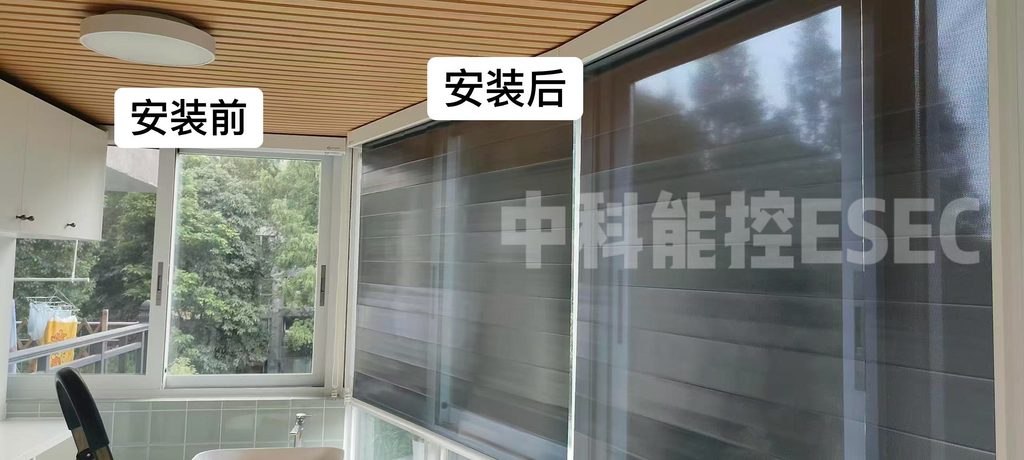
On the right, the curtain is down across the full wall of glass, with a soft translucent quality —the shapes of the trees and the outlines of buildings outside remain clearly discernible, even the layering of the vines is visible, and the indoor brightness is untouched; on the left, where the curtain is not down, the glass is clear and bright, with the green trees outside and the neighbours’ laundry on the balcony below in full view.
The photo also shows what kind of space this is: a wood-grain ceiling, white wall cabinets, white tiled walls, a tap —a typical Chengdu utility balcony, where laundry, drying and storage all happen. It takes direct sun for several hours a day, which is exactly why it needs insulation most.
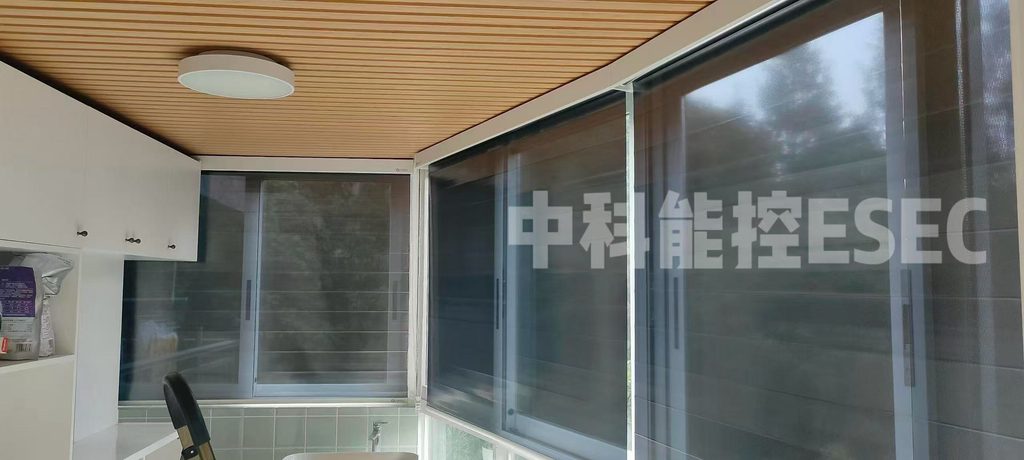
Close-up with the curtain lowered
The horizontal lines are the curtain fabric’swoven reflective structure, not a blackout coating. The tree shadows become soft silhouettes through the curtain and the sunlight no longer glares, while the sink, countertop and wall cabinets inside are unaffected.
This is what insulation without blocking light actually looks like:the light comes in, and the heat is turned back.
Three Reasons Chengdu Households with Enclosed Balconies Should Consider It
- A large glass area means a strong heat-chamber effect: the balcony has the largest glass area in the home and is the gateway through which heat enters. Insulating it here delivers far better value than fighting the heat at the air conditioner.
- Muggy basin summers plus cold, unheated winters: it blocks heat in summer and retains warmth in winter, earning its keep at both ends of the year rather than idling half the time.
- Balconies are being repurposed: today’s balcony doubles as a laundry, tea room, study, workout corner or family play area — a place people actually spend time in, and its comfort deserves its own investment.
ESEC (Zhongke Energy Consumption Control) focuses on heat insulation and energy saving for architectural glass. Its products are listed in the China Electronic Energy-Saving Technology Association’s National Recommended Catalogue of Demonstrated Energy-Saving and Carbon-Reduction Products and Technologies, and have been applied in over a hundred curtain-wall and window retrofit projects, including work for China Development Bank. From on-site survey and product and colour selection to installation, everything is handled in one stop; a typical residential balcony takes only a few hours to complete, with no dust, no building work and no disruption to drying laundry or daily life.