

Before any close-to-occupant material goes into an office space, property managers and admin teams should not ask ‘what is the energy-saving rate?’ first, but three more fundamental questions: Is the material itself safe? Does it pass fire-safety requirements? Does installation touch the building structure? Only once these three are cleared does energy saving mean anything.
Check One: Formaldehyde
For a material hung indoors for the long term, formaldehyde content must be within limits. Our window curtain fabric has been third-party tested, and its formaldehyde content meets the requirements of Table 2 of JG/T 254-2015, Roller blinds for building solar shading (report No. BETC-T6AC-2025-00515). The floor can be used normally the same day it is installed, with no need to ventilate — essential for office floors that cannot shut down.
Check Two: Fire Safety
For materials added to the interior side of high-rise curtain walls, reaction-to-fire performance is a hard requirement. Our material achieves B1(B-s1, d0) per GB 8624-2012 (report No. BETC-T4BC-2025-00042) — under that standard s1 means low smoke production and d0 means no burning droplets. Property managers can check both items directly against the standard during fire-compliance review.
Check Three: Structure and Installation
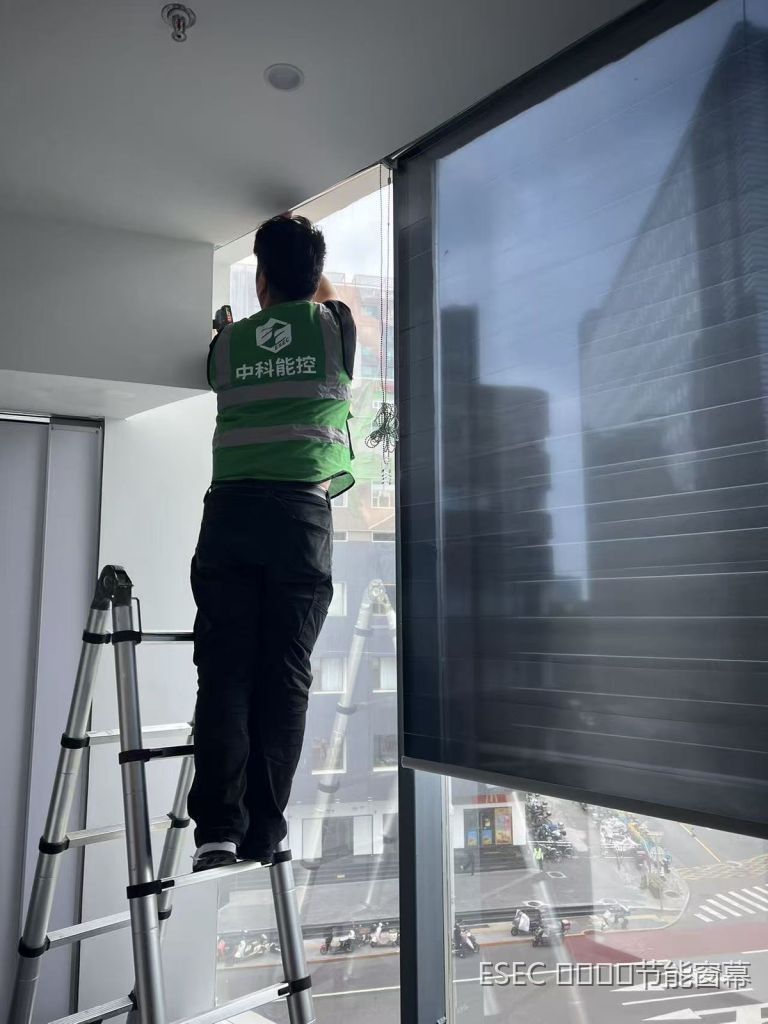
The traditional approach to insulating a curtain wall means touching the glass and the facade — and with that come approval, construction and business-closure costs. The interior-side route avoids all of it: no removal of the original windows, no damage to the curtain-wall structure, no change to the facade; a typical floor is finished in a day, with no retrofit waste. It can be installed in a leased office too, and adjusted or removed at lease exit.

Why these three metrics belong in your procurement process
- For any close-to-occupant material, check the formaldehyde test report number before the sales pitch
- For materials added to high-rise buildings, the flame-retardant grade and its standard (GB 8624-2012) belong in the contract
- Installation method drives hidden cost: touching the structure = approvals + closure + reinforcement; interior-side = one day + far less approval pressure
All three reports come from a testing centre under the national building research institute, and the report numbers can be downloaded and verified on the ‘Third-Party Test Reports’ page of our website. When selecting a product, simply asking two questions — ‘What is the report number?’ and ‘Where is it installed?’ — will screen out most vague proposals.