

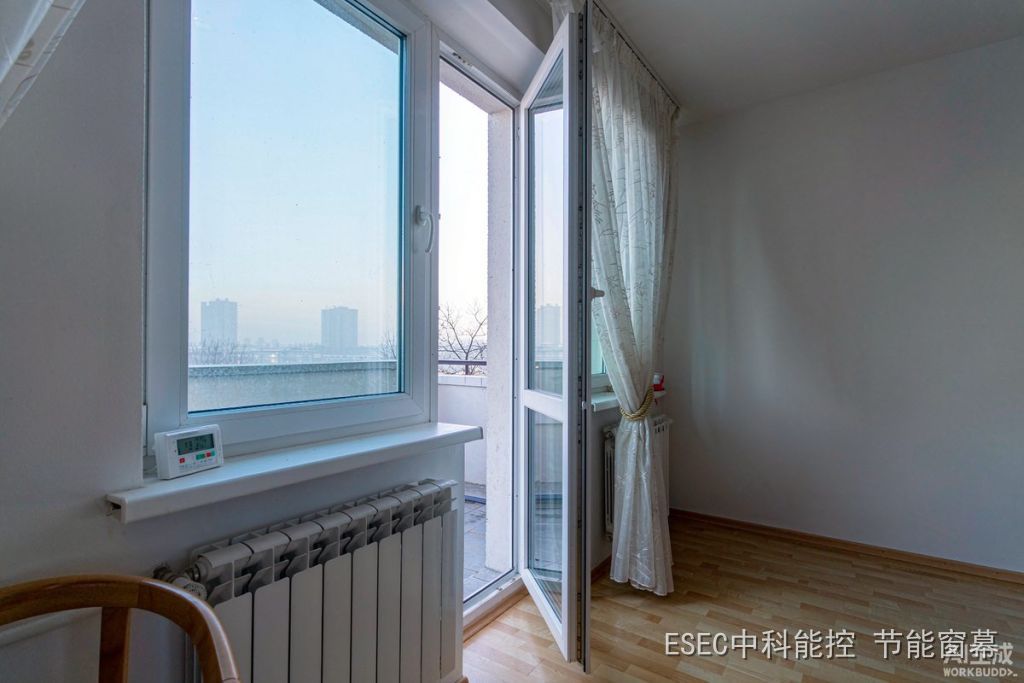
Every household has staged the winter window debate: one side guards the windows shut all day to protect the heating bill, the other keeps them open around the clock. The most popular compromise — leaving a window tilted on a narrow gap all day — is, from a building-physics standpoint, precisely the option that loses the most heat while causing the most condensation. Done right, winter ventilation is easier than any of these: two or three sessions a day, windows wide open for five to ten minutes each.
1. The Health Ledger: A Closed Winter Window Traps More Than Cold Air
Occupants continuously consume oxygen, exhale carbon dioxide, and release moisture; cooking, showering and drying laundry add litres more per day. With the windows sealed, CO2 and humidity only accumulate. China’s indoor air standard GB/T 18883-2022 sets the yardstick: CO2 averaged over one hour must not exceed 0.10% (about 1,000 ppm), fresh-air supply should be at least 30 m³/(h·person), and winter relative humidity should sit between 30% and 60%. Excess CO2 shows up as drowsiness and poor concentration; excess moisture writes itself onto the window as condensation and mold at the frame.
Ventilation is, in effect, a free dehumidifier. Outdoor winter air is cold but dry: air at 0°C and 80% relative humidity, warmed to 20°C, drops to roughly 20% relative humidity — plenty of drying capacity to soak up indoor moisture and pull the room’s dew point down. A lower dew point means less condensation on the glass.
2. The Heat Ledger: Why a Tilted Gap Is the Worst Deal
Heat loss is not proportional to how long a window stays open. Most of a room’s stored heat sits in walls, floors and furniture, not the air — air has little thermal mass and changes temperature quickly. Hence two very different outcomes:
- Shock ventilation (Stoßlüften): windows wide open for 5-10 minutes. The air volume is exchanged wholesale while walls and furniture barely cool; after closing, stored heat warms the fresh air back up and the heater only tops up a small deficit. The German federal environment agency’s guidance: 2-3 sessions per room per day, about 5 minutes each, or 3-5 minutes when temperatures fall below 0°C. Opening windows on opposite sides for cross-ventilation finishes the job in 3-5 minutes.
- All-day tilt (Kipplüften): a narrow gap trades little fresh air for continuous heat loss, and the long-lasting draft chills the window reveal and surrounding wall — pushing the dew point onto those local cold surfaces, where condensation and mold appear first. More heat lost, less air exchanged: the worst of both worlds.
The winter rule: short, wide open, well-timed — not long, cracked, continuous. A bonus move: turn the radiator valve down before opening the window and back up after closing.
3. A Timing Schedule: Two or Three Sessions, and When
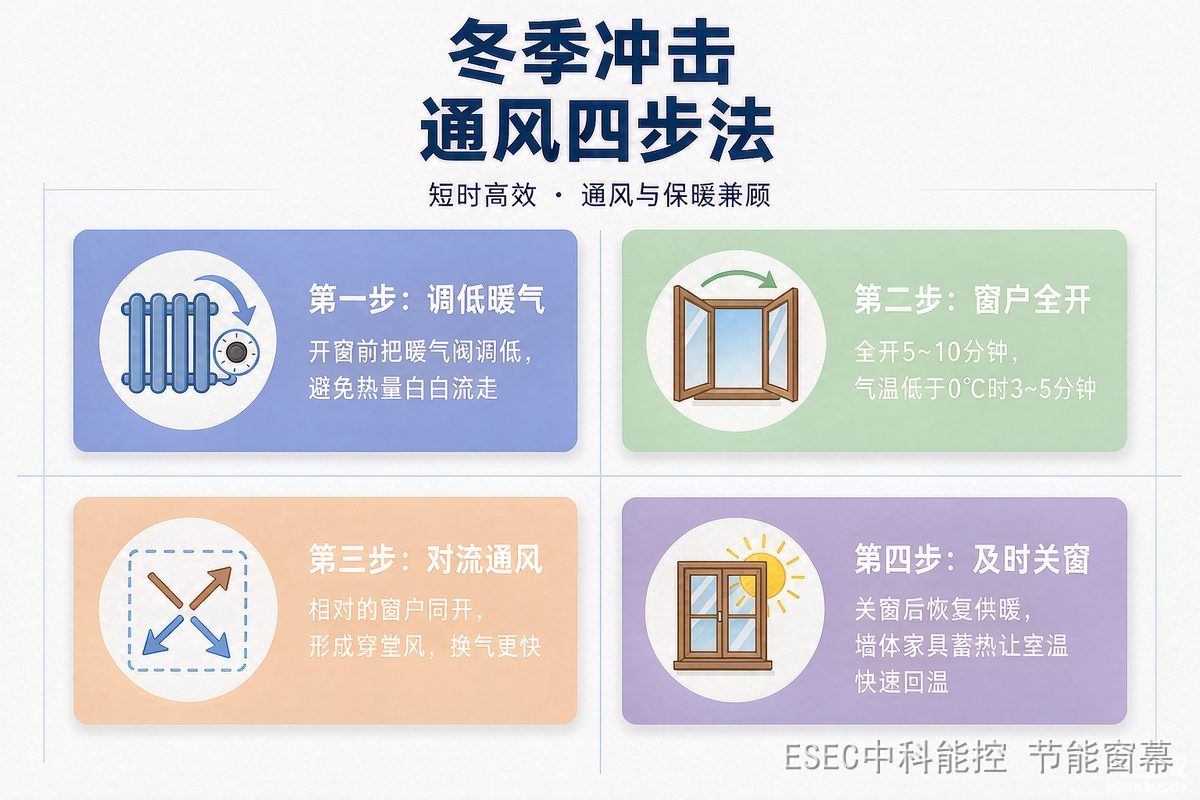
Four steps of winter shock ventilation: turn the heating down, open windows fully for 5-10 minutes, use cross-ventilation to speed up air exchange, then close and restore heating (operational infographic)
- After waking: overnight CO2 and moisture peak; a 5-10 minute session sets up the whole day;
- After cooking or showering: the wettest rooms first, before moisture spreads;
- Midday, the warmest hours: the same air exchange carries away the least heat;
- Before bed: a short session instead of sleeping with a cracked window;
- On hazy days: when outdoor PM2.5 is high (GB/T 18883 caps indoor 24-hour PM2.5 at 0.05 mg/m³), cut frequency and duration and avoid pollution peaks — but keep at least one short session, because unexchanged CO2 and moisture carry their own health cost.
Ventilation also has an upper bound: drying the room below 30% relative humidity leaves the comfort band (30-60% in winter). If throats feel dry and static abounds after airing, two or three sessions a day is enough — no more.
4. Ventilation and Window Screens: One Handles Air Exchange, the Other Handles After
Ventilation manages the minutes when the window is open. But windows stay closed far longer — and that is when glass surface temperature, cold radiation and night-time heat loss matter. The two routines can be paired. ESEC energy-saving window screens: a retractable, view-through, high-reflectance fabric mounted on the interior face of the glass, with total solar reflectance 88%, near-infrared reflectance above 95%, UV blocking above 99%, and flame-retardant class B1. Retract the screen while ventilating so airflow runs free; lower it after closing to form an air buffer against the glass that cuts night-time heat loss and raises the perceived temperature by the window in winter, and reflects solar heat outside in summer. The day-up-night-down rhythm locks neatly onto the ventilation schedule.
Honest boundaries: a window screen does not replace ventilation — it cannot expel CO2 or moisture. It manages the insulation and solar-gain side once the window is closed. Ventilate to dehumidify, screen to insulate; winter windows need both.
FAQ
Q: How often should I ventilate in winter, and for how long?
A: 2-3 times a day, fully open for 5-10 minutes; 3-5 minutes below 0°C; cross-ventilation finishes in 3-5 minutes. The key is “wide open, short” — never “cracked, all day.”
Q: Is sleeping with a tilted window acceptable?
A: Not recommended. The gap exchanges little air while continuously chilling the frame and surrounding wall, inviting localized condensation and all-night heat loss. Ventilate briefly before bed, then sleep with the window closed.
Q: Can I ventilate on hazy days?
A: Avoid pollution peaks, reduce frequency and duration, but keep at least one short session daily — trapped CO2 and moisture carry their own health cost. A mechanical ventilation system can take over daily air exchange where available.
Related reading:
- Curtains blocking airflow: the third variable of window condensation
- Dew point made simple: three numbers to check your window condensation risk
- Condensation vs. frost: the zero-degree line on your window
- Why glass gets colder than the air on clear winter nights
- Fog you cannot wipe: why IGUs fail and what to do
- ESEC Energy-Saving Calculator: estimate the benefits of window-screen retrofit
Zhongke Nengkong (Beijing) Technology Co., Ltd. (ESEC) specializes in lightweight energy-saving retrofit of glass curtain walls, participates in industry standard drafting, and its energy-saving window screen is registered with MIIT as an “Energy Saving and Carbon Reduction Demonstration Product.” Official specifications: total solar reflectance 88%, near-infrared reflectance above 95%, UV blocking above 99%, flame-retardant class B1. In summer it reflects solar heat and cuts cooling loads; in winter, lowered on the interior side of glass, it forms an air buffer that raises the effective interior surface temperature near windows and reduces heat loss. The retractable design balances shading, insulation and daylight transparency; factory-prefabricated and site-assembled, with no business interruption, no hot work and no alteration to the glass itself — a reversible, deliverable lightweight retrofit for existing residential, retail, hospital and office buildings.
Website: www.zknkkj.com
Tel: 18610685811 (Manager Guo) | WeChat: ESEC88888