

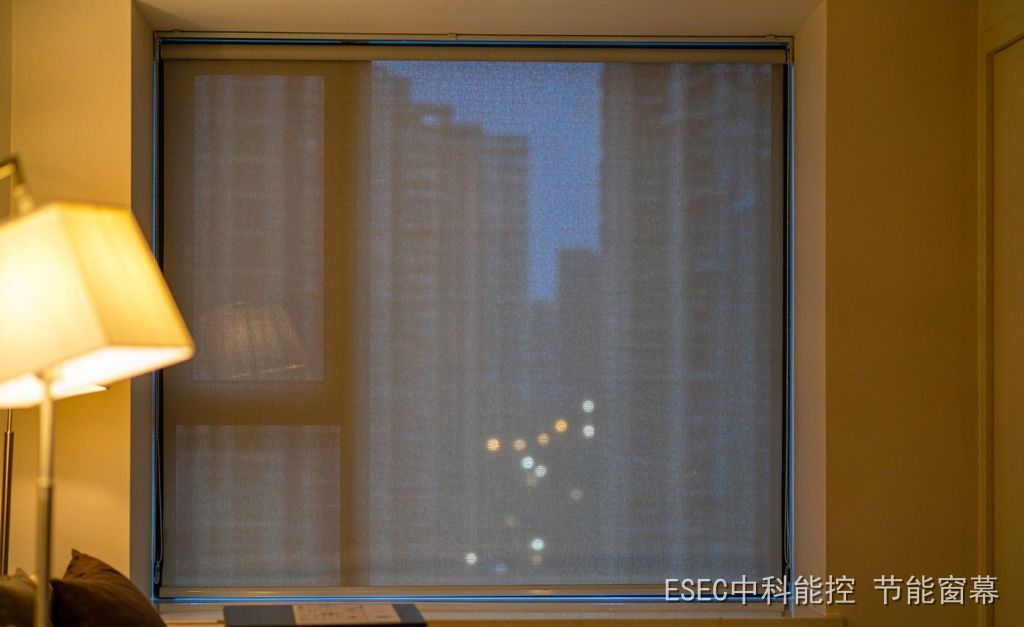
Once the heating season starts, curtains stop being a colour question and become a pull-them-or-not question. Some households insist one layer is enough; others hang two and still feel cold. The good news: this account is less vague than it feels. What a curtain does at night is written down in a standard, as one number — and both the single layer and the second one can be priced.
1. The night account is not the daytime account
1.1 Daytime is about how much comes in; night is about how much goes out
During the day a curtain is busy reflecting and absorbing solar gain — a whole spectroscopic account, covered in shading is not insulation and in more detail in the three accounts of a shading fabric. At night the sun is gone, both books close, and the heat absorbed earlier no longer leaks back indoors — the daytime weakness of interior shading (absorbing heat into the room) disappears on its own. The curtain is left with a single identity: one additional layer of thermal resistance on the room side of the glass.
1.2 Two things decide how a curtain performs at night
First, whether it can hold a layer of still air between itself and the glass. Second, how well the four edges of that air layer are closed. The insulation value of the fabric itself is tiny — a few millimetres of textile is a resistance of a few hundredths. What works at night is not the cloth; it is the air the cloth holds in place.
2. The number in the standard: three classes of additional resistance
2.1 A one-line formula
ISO 10077-1, the international standard for the thermal calculation of windows, has a section on windows fitted with closed shutters or blinds: the shading is treated as an additional resistance, and the reduced U-value is written as Uws = 1/(1/Uw + ΔR). Delta R is the additional thermal resistance the shading brings.
2.2 The three classes, and one conversion
For internal shading — fabric curtains and roller blinds alike — the standard grades by air permeability: if the effective total gap around the shading exceeds 80 mm, ΔR is 0.08; between 20 and 80 mm, 0.11; below 20 mm, 0.14, all in m²·K/W.
Converted into practice: a window with a U-value of 2.8 fitted with a loose 0.08-class curtain drops to 2.29; the 0.11 class gives 2.14; the 0.14 class gives 2.01 — night-time heat loss reduced by 18% to 28%. The worse the window, the harder the curtain works: in the standard’s own example, an old single-glazed window at U = 4.9 falls to 3.52 with just 0.08, a cut of nearly thirty percent.
The ceiling is just as clear: 0.14 is all an internal shading can contribute. Expecting a curtain to push a 2.8 window far below 2.0 is not realistic; the insulation of the glass is still the glass’s own job (triple glazing versus vacuum glass walks through what each level costs).
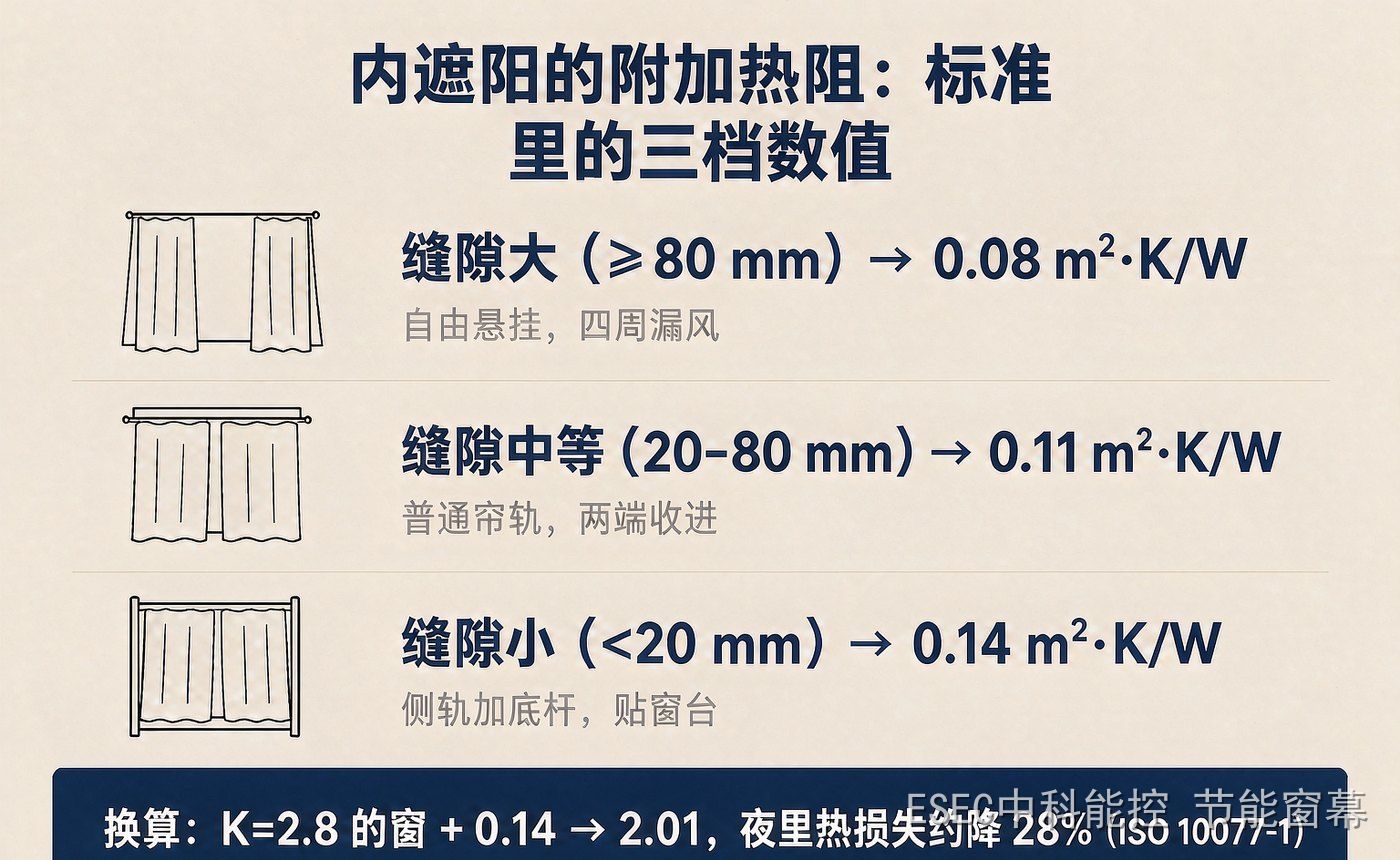
Gaps decide the class; the class decides what a night is worth. This table is also the order in which to choose a curtain.
3. Why most curtains only earn the 0.08 class
3.1 The gaps short-circuit the air layer
Air has a thermal conductivity of only 0.026 W/(m·K) — an excellent insulator, let down by being light and easily moved. In the gap between curtain and glass, if either the top or the bottom edge is open, air cooled by the cold glass sinks, warm air pours in through the gap, and one convection loop undoes the air layer the curtain was holding. GB 50176-2016, the Chinese thermal design code, tabulates heat resistance for enclosed air cavities — and the word “enclosed” in the table title is the whole threshold. Not enclosed, not applicable.
3.2 Three moves that cost nothing
Guide the fabric into side rails instead of letting it hang freely in the middle of the window; press the bottom edge onto the sill or fit a bottom bar; close the gap at the top as far as the track allows. None of this adds a cent of material, yet it decides whether you sit in the 0.08 or the 0.14 class — a difference of 0.06, worth more than changing the fabric.
4. What the second curtain actually adds
4.1 The first layer’s biggest gain is radiation
Pull the curtain and the window edge stops feeling biting — the physics is simple: walls and furniture were radiating at a cold pane, and the curtain intercepts it. Two room-temperature surfaces with an emissivity around 0.9 facing each other exchange heat at roughly 4.7 W/(m²·K); with the curtain drawn, the room sees fabric at near room temperature instead of glass that may sit at barely ten-odd degrees. The cold-radiation account in why the same building feels different by floor is stopped right at the fabric.
4.2 The second layer is usually small change
A second curtain adds one more layer of cloth (a few hundredths of resistance, negligible) and one more air layer. The problem: the air between two curtains leaks just as readily, and the two fabric surfaces radiate at each other with the same 4.7 coefficient — the big radiative path that the first layer cut off has no equivalent left for the second to cut. A rough estimate puts the second layer at 0.03 to 0.08, and only if a three-to-five-centimetre, uncrowded air layer actually exists between them. Two layers pressed together are simply one thicker cloth: more money, barely more resistance.
When is the second layer worth it: single-glazed old windows, a first layer whose gaps cannot be closed, or a household with people particularly sensitive to cold radiation. The order never changes — seal the first layer’s edges before talking about a second.
5. A concrete window: what one night is worth
Take a specific case: a three-metre by two-metre window, 6 m², U-value 2.8, 20°C inside and minus 5°C outside, curtains closed for ten hours.
With no curtain the window loses 420 watts through the night, about 4.2 kWh of heat. A 0.08-class curtain cuts this to 343 watts, saving roughly 0.8 kWh; a well-sealed 0.14-class curtain brings it to 302 watts, about 1.2 kWh; a second layer squeezes out another 0.1 to 0.3.
Converted at electricity prices, this is a few dimes a night — nobody should be selling “half your heating bill”. The real return of the night account is not on the energy bill but in the body: a radiating surface at a dozen degrees is replaced by fabric at room temperature. The thermostat never moves; the person simply stops feeling cold.
6. The flip side: a colder pane, and condensation worth a look
One side effect most people never think through: once the curtain closes, less indoor heat reaches the glass, and the inner surface runs colder than it would otherwise. The four-step glass temperature self-check can be run twice — curtain open and curtain closed — to see the difference. If indoor humidity already rides the dew point (three numbers to compute it), sealing the curtain at night means more water on the sill by morning — the mechanism described in why the pane sweats more once the curtain is drawn.
A simple rule: seal the curtain at night for the insulation, open it in the morning and air the room out. Running a humidifier at full and a curtain pulled to the floor at the same time is fighting yourself.
7. The order of choosing: edges first, then layers, then weight, colour last
Set the priorities in line. First the installation, because the gaps decide the class. Then the number of layers and the air space between them — three to five centimetres, not pressed flat. Then the weight and thickness of the fabric, a refinement. Colour comes last: the emissivity of nearly all textiles sits between 0.8 and 0.95 and barely cares about colour. Colour belongs to the daytime account of reflection and absorption; at night it has no vote.
8. Four questions that come up
8.1 How far from the glass should a curtain hang?
Two or three centimetres already forms a reasonably still air layer. Tighter squeezes the air layer away; much farther (ten centimetres and beyond) and the air starts circulating on its own. In practice, “in side rails and down to the sill” matters far more than the exact distance from the glass.
8.2 When is a second layer worth it?
Any one of three conditions: a single-glazed old window, a first layer whose gaps cannot be sealed, or family members sensitive to cold radiation. On a newer window, seal the edges first and the second layer usually becomes unnecessary.
8.3 Does a light or a dark curtain insulate better at night?
Essentially no difference. What works at night is emissivity, not colour; colour governs daytime reflection and absorption. Choose the colour by the daytime account.
8.4 How can I tell which class my curtain is in?
Draw it and look at the gaps: wide light-leaking sides and open top and bottom mean the 0.08 class; an ordinary track with the ends tucked in, 0.11; side rails with the bottom edge meeting the sill are what reach 0.14.
9. In closing
The night account is not complicated: a curtain is worth between 0.08 and 0.14 of additional resistance, and the gaps — not the fabric — decide where you land. Seal the edges and one window saves about a kilowatt-hour a night; having sealed them, adding a layer usually buys less than spending the same money on rails and a bottom bar.
The curtain trade likes the words “thicker”, “double-layer” and “soundproof”, all of which sound like insulation. Now there is one number to ask for: under ISO 10077-1, which class does this curtain fall into? A vendor who cannot answer has never done the account.
Zhongke Nengkong (Beijing) Technology Co., Ltd. makes heat-insulating see-through shading screens fitted on the room side of glazing. By day: solar heat reflection around 88%, near-infrared rejection 96.5%, UV rejection above 99%, visible light transmittance 28% (GB/T 2680 test report), shading coefficient SC 0.14 (JGJ/T 151-2008), colour rendition above 92%, B1 fire performance for the fabric (GB 8624-2012). By night: side rails plus a bottom bar put the installation in the stricter class of the additional-resistance grading. No glass removal, no facade change, fully retractable — suited to interior-side energy retrofits of residential and public buildings. To have the night-time account of a specific window checked, send us the parameters.