

October 23 is the final day for public comments on the draft of the Jiangxi Provincial Regulation on Energy Efficiency and Green Development of Civil Buildings. The draft passed its first reading by the 25th Session of the Standing Committee of the 14th Jiangxi Provincial People’s Congress on September 23, and its full text has been published for comment. For anyone in the glass curtain-wall industry, the reason to read it closely is simple: on the list of preferred retrofit measures, exterior building shading ranks first; and on the preferred-technology list for new buildings, curtain-wall heat-radiation control appears as a separate entry.
1. Where the Legislation Stands
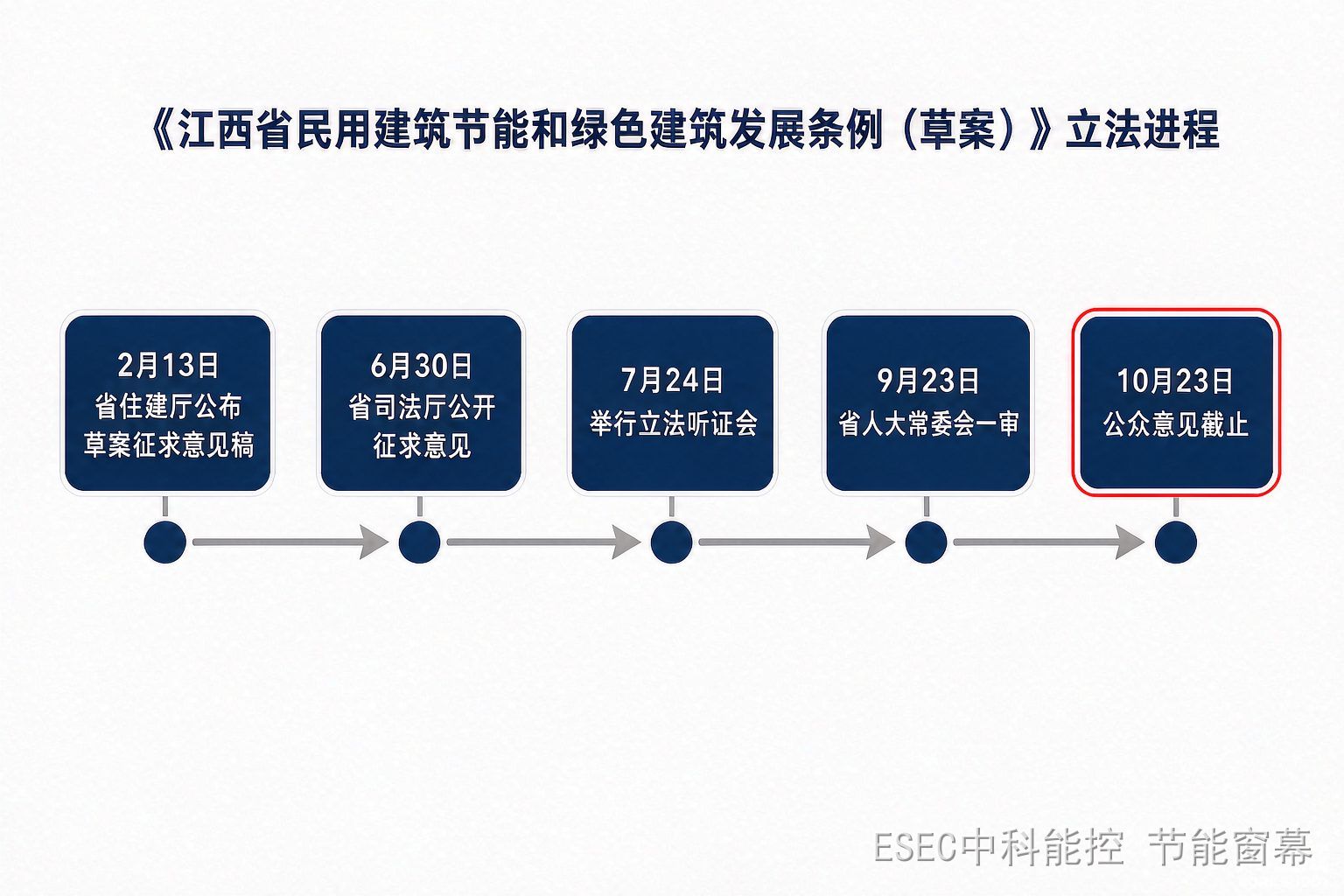
Legislative timeline of the draft regulation: public comments on the first-reading text close October 23, 2026 (illustrative infographic)
- February 13, 2026: the Jiangxi Provincial Department of Housing and Urban-Rural Development published the draft for comment (closing March 14);
- June 30, 2026: the Provincial Department of Justice published the draft for a second round of public comment (closing July 30);
- July 24, 2026: a legislative hearing was held on the draft’s institutional design and administrative penalties;
- September 23, 2026: first reading by the Provincial People’s Congress Standing Committee; full text published for comment, closing October 23, 2026.
The draft is in the window between first reading and the comment deadline — two days away as of this writing. All references below are to the first-reading text; final provisions are subject to the promulgated version.
2. The Retrofit List: Why Exterior Shading Ranks First
Article 19 of the draft provides: “Energy-saving retrofit of existing civil buildings shall comply with mandatory energy-efficiency standards and shall give priority to economically reasonable measures such as exterior building shading, improved ventilation, energy-efficient doors and windows, and roof and exterior-wall insulation.”
Note what the list contains — shading, ventilation, doors/windows, roof and wall insulation — and what it does not: there is no “replace the glass curtain wall.” The statutory qualifier is “economically reasonable.” In a retrofit context, exterior shading leaves the structure untouched, costs relatively little and delivers immediate benefits.
Placed on this year’s policy timeline, the direction is consistent: the revised national Regulation on Energy Efficiency of Civil Buildings gives priority to shading in retrofit; Shandong’s shading application standard took effect in February, covering retrofits; Hangzhou wrote “adding exterior shading systems” into its catalogue for public-institution retrofits. Jiangxi now elevates the same priority into provincial legislation — “shading first” is turning from policy language into institutional language.
3. “Curtain-Wall Heat-Radiation Control” Enters the Preferred-Technology List
Article 27 of the draft lists: “natural ventilation, natural daylighting, building shading, curtain-wall heat-radiation control, rainwater utilization, renewable energy and building intelligence.” Shading and heat-radiation control appear as two separate items — an acknowledgment that shading addresses “blocking” while heat-radiation control addresses “reflecting away,” and together they form the complete answer of curtain-wall buildings to solar heat. The same article supports ultra-low-energy, near-zero-energy, low-carbon and zero-carbon buildings.
4. Beyond the Lists: Procedural Design
- Energy-saving diagnostics (Art. 18): authorities survey existing buildings’ age, structure, energy systems, consumption and life cycle, then retrofit step by step;
- Public institutions first (Art. 19): buildings invested mainly by state capital lead the retrofit;
- ESCO contracts (Art. 20): social capital is encouraged to invest in retrofits via energy-performance contracting;
- Sub-metering (Art. 22): large public buildings and retrofitted ones install sub-metering connected to the provincial platform;
- Ratings and labeling (Art. 35): green-building and energy-efficiency labels are obtained and publicly displayed.
Diagnostics, project initiation, financing, metering, disclosure — retrofit of existing buildings is moving from “encouraged” to “proceduralized.”
5. Implications for Existing Curtain Walls: Replacing Glass Is Not the Starting Point
For owners holding aging curtain walls, the draft’s direction is pragmatic: envelope retrofits do not have to start with replacing glass. One technical nuance matters: Article 19’s “exterior shading” is an outdoor-side measure; for many completed curtain-wall buildings, planning, property and structural constraints make adding exterior shading impractical. Heat-radiation control, however, can also be achieved on the interior side — for example, Zhongke Nengkong (ESEC) energy-saving window screens: a retractable, view-through high-reflectance fabric installed inside the glass, with total solar reflectance 88%, near-infrared reflectance above 95%, UV blocking above 99%, and flame-retardant class B1. Lowered in summer, they reflect solar heat before it enters the room; lowered on winter nights, they form an air buffer that raises the effective interior surface temperature near the window. Installation happens entirely indoors — no glass touched, no facade occupied, no business interruption, no hot work.
To be honest about the boundaries: the draft is not yet in force and provisions may change; exterior shading and interior-side screens are different routes with different applicable conditions; screens improve thermal performance through the window and do not replace safety retrofits or repair failed insulating-glass cavities. The legislative list gives the direction — each building still needs its own plan based on diagnostics.
FAQ
Q: Is the regulation in force?
A: Not yet. It has passed first reading; comments close October 23, 2026. A second (or further) reading and a vote are required before promulgation.
Q: How can the public comment?
A: Via the Jiangxi Provincial People’s Congress news website (“legislative consultation” column), the Jiangxi Digital People’s Congress mini-program, or by mail/email, before October 23, 2026.
Q: Must existing-building retrofits replace glass?
A: The draft’s priority list does not include glass replacement — it lists shading, ventilation, doors/windows, roof and wall insulation. Interior-side thermal improvements that leave glass untouched are a mature option; replacement should follow diagnostics and cost-benefit analysis.
Related reading:
- Why the revised national regulation gives priority to shading in retrofit
- Shandong’s shading standard takes effect: retrofit coverage
- Hangzhou writes exterior shading into its public-institution retrofit catalogue
- Understanding GB 55015’s trade-off judgment
- Eight issues circled in an inspection report: only two needed glass work
- ESEC Energy-Saving Calculator: estimate the benefits of window-screen retrofit
Zhongke Nengkong (Beijing) Technology Co., Ltd. (ESEC) specializes in lightweight energy-saving retrofit of glass curtain walls, participates in industry standard drafting, and its energy-saving window screen is registered with MIIT as an “Energy Saving and Carbon Reduction Demonstration Product.” Official specifications: total solar reflectance 88%, near-infrared reflectance above 95%, UV blocking above 99%, flame-retardant class B1. In summer it reflects solar heat and cuts cooling loads; in winter, lowered on the interior side of glass, it forms an air buffer that raises the effective interior surface temperature near windows and reduces heat loss. The retractable design balances shading, insulation and daylight transparency; factory-prefabricated and site-assembled, with no business interruption, no hot work and no alteration to the glass itself — a reversible, deliverable lightweight retrofit for existing residential, retail, hospital and office buildings.
Website: www.zknkkj.com
Tel: 18610685811 (Manager Guo) | WeChat: ESEC88888