
From November 1, 2026, Shandong Province enforces its Standard for Energy Performance Evaluation and Labeling of Civil Buildings (DB37/T 5359-2026), issued on July 30, 2026 by the Shandong Provincial Department of Housing and Urban-Rural Development together with the Provincial Administration for Market Regulation. It applies to the energy performance evaluation and labeling of new, expanded, renovated and existing civil buildings across the province.
Counter to intuition, a building’s label grade — Level 1 to 5 — is not only about the overall account of insulation and equipment. The standard also contains clauses that push the grade down in one stroke, and two of them relate directly to windows.
How the grade is calculated
Evaluation is based on a single building. Residential buildings undergo completion evaluation; public buildings additionally undergo operational evaluation after one year of normal use at over 60% occupancy. The completion evaluation covers six energy end uses — heating, ventilation, air conditioning, domestic hot water, lighting and elevators — and uses a “comparative building”: an identical model built to a 65% (residential) or 50% (public) energy-saving benchmark. The difference in energy intensity converts into a score from Level 1 to 5; zero-energy buildings score 100. Notably, only Level 1 ratings may deduct renewable power generation as a credit — Levels 2 to 5 may not, preventing photovoltaics from compensating for a poor envelope.
Two window penalty clauses
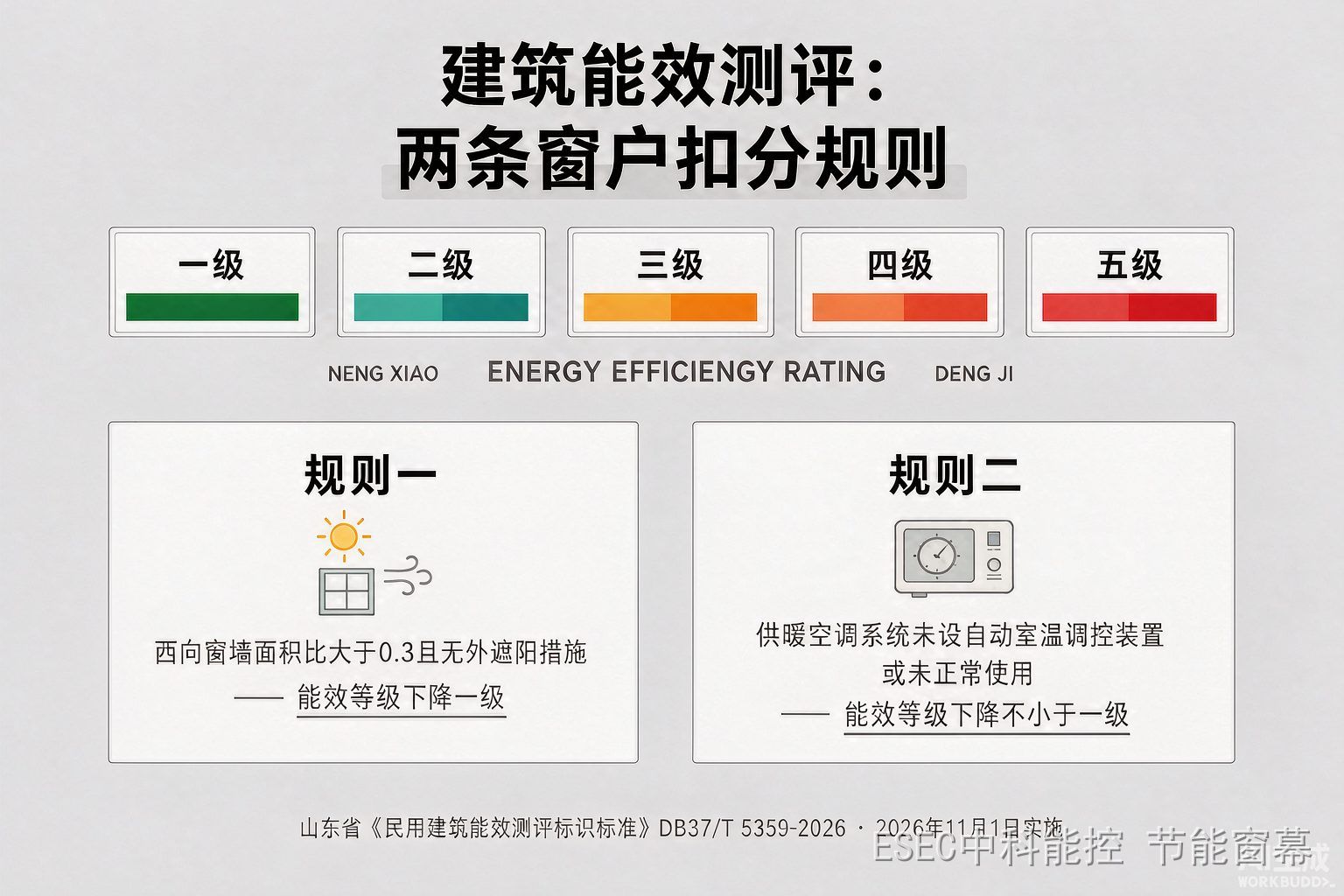
Clause 3.0.1 states: “Where the west-facing window-to-wall area ratio exceeds 0.3 and no external shading is provided, the assessed energy performance grade shall be lowered by one level”; and “heating and air-conditioning systems shall have automatic room-temperature control devices in normal use, otherwise the grade shall be lowered by no less than one level.”
The first clause binds three variables together: orientation (west) × WWR (over 0.3) × external shading (absent). West-facing low-angle afternoon sun is where solar gains hit hardest; the larger the glazing and the less external shading, the deeper the penalty. Windows are no longer just a ratio on the drawings — they are a debit item on the energy ledger.
Another rule: for residential estates, sampled buildings of the same type (no less than 20%, minimum one) determine the grade for the whole group by the lowest sampled level.
Operational evaluation: real bills count
For public buildings, operational evaluation uses actual metered energy data across heating, cooling, lighting, sockets, water, power and cooking (excluding EV charging and landscape lighting), verified against energy bills and readings, then benchmarked against Shandong’s public-building energy consumption limits (hospitals, offices, hotels): within the advanced value is Level 1; beyond 1.2 times the constraint value is Level 5. Labels must carry five elements — grade, building information, energy-use information, issue/expiry dates and a traceability code — and for existing buildings, the report should propose key retrofit positions.
Why interior-side retrofitting comes into play
For an existing building, the west WWR cannot change — so how do you fill the “external shading” box? Traditional external shading (overhangs, louvers) is easy for new builds but often blocked for existing ones by structural capacity, facade-approval issues and high-altitude work costs. This is where interior-side solutions fit: ZKNK’s insulating translucent shading screen adds a liftable functional fabric layer inside the glass — no curtain wall changes, no facade permits, daytime translucency with heat rejection, nighttime added insulation.
An honest boundary: interior-side solutions are not automatically equivalent to external shading in certification terms; recognition in evaluation follows the standard’s clauses and local review practice. But the direction is clear — windows are on the energy ledger, and they are the one line item you can still fix yourself. From the national energy efficiency rating system, to Beijing’s five-grade labeling, to Shandong’s west-window penalty clause, the envelope account is only getting finer.
ZKNK (Beijing) Technology Co., Ltd. specializes in insulating translucent shading screens for buildings, offering interior-side energy retrofit solutions for existing glass curtain walls and floor-to-ceiling windows — no glass replacement, no facade alteration, cutting summer heat gain while improving winter insulation.