

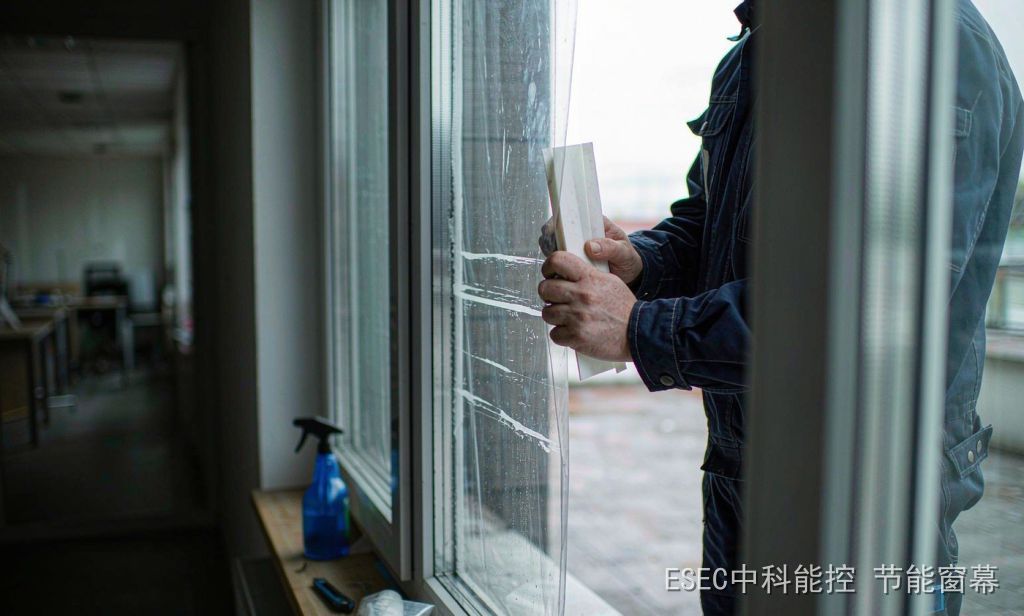
Applying film to sun-baked glazing is the proposal owners hear most often: a salesperson measures the glass, a quotation arrives within half an hour, and the job is quoted in hours. Open the current industry standard JGJ/T 351-2015, Technical Specification for Application of Building Glass Film, however, and heat-control film is not a stick-on plastic sheet – the code sets four steps for it, and one of them is a thermal stress calculation for the glass itself.
A shading screen, hung on the same room side of the same glass, has no such step in the code. That is not because one technology outranks the other; it is because the two routes change different things. This article lays out the clauses and the physics, and draws the boundary.
1. The conclusion first: film and screen do not change the same thing
1.1 One clause, 4.3.4, separates the two routes
Clause 4.3.4 reads: heat-control film or heat-control coating applied to flat glass shall undergo thermal stress design in accordance with JGJ 113, Technical Specification for Glass Application, and measures shall be taken to prevent thermal cracking. In one sentence: once film is bonded to glass, the thermal state of the glass changes, and the designer must work through the glass-safety process. A screen never touches the glass – the glass remains the glass it was – and no clause anywhere requires thermal stress design for a screen. The boundary sits here: whoever changes the glass body signs for the glass; whoever stands in front of it manages their own layer.

2. The clauses: the four steps JGJ/T 351 sets for heat-control film
2.1 Clause 4.3.1: the design file must contain anti-crack measures
Clause 4.3.1 lists what the design file shall include: the purpose and basis of the design, the energy-saving calculation report for the heat insulation, and the anti-crack measures. The wording is shall include, not suggested. A compliant film design file should end with a page explaining how thermal cracking of that particular glass is to be prevented; without that page, the file itself is incomplete.
2.2 Clause 4.3.3: optics measured to GB/T 2680, thermal values computed to JGJ/T 151
Clause 4.3.2 requires energy-saving design, checked against current national standards, whenever heat-control film or coating is used on the external envelope. Clause 4.3.3 then fixes the parameter basis: thermal transmittance, shading coefficient and visible light transmittance are computed per JGJ/T 151, Calculation Regulation for Thermal Performance of Windows, Doors and Glass Curtains Walls; optical properties are measured per GB/T 2680, using spectral data from 300 to 2500 nm at intervals of 5, 10 or 50 nm. A marketing line such as 80 percent heat rejection on a product page sits outside all of these – the code recognises the three numbers derived from spectral data.
2.3 Clause 4.3.4: thermal stress design, referencing JGJ 113
Clause 4.3.4 routes thermal stress design to JGJ 113. An easily missed detail sits in clause 5.2.3: when edge trimming is done for interior installation, the gap between the film edge and the surrounding sealing material shall not exceed 1 mm. Film is not trimmed at will – the code even specifies the edge gap.
3. Where thermal stress comes from: a difference disease, not a heat disease
3.1 The centre warms, the edge is held by the frame, and the boundary carries tension
Sunlight falls on the middle of the pane and that zone heats and expands; the edge, buried in the frame and shaded by setting blocks, stays cooler and is held back. Tension appears along the boundary – and tension is exactly what glass is weakest at. Cracks start at an edge and run in an arc; that is the classic path of thermal fracture. The keyword of the mechanism is local temperature difference, not absolute temperature.
3.2 A sunny winter morning is the most dangerous condition
Here is the counter-intuitive part: overnight the glass around the frame is chilled through; when the morning sun arrives, the centre heats quickly while the edge is still cold – a larger difference than on a midsummer afternoon. The seasonal swing of the solar altitude angle also lets low winter sun strike deep into the room. A share of thermal cracking incidents therefore happens on winter mornings. Film-covered glass baking in winter sun sits precisely in the most sensitive condition of the mechanism.
3.3 Why tempered glass is exempt – the boundary inside the commentary
The commentary states it plainly: thermal stress calculation applies only to framed annealed flat glass; heat-strengthened and toughened glass are exempt from thermal cracking design, because their allowable stress is high and thermal fracture almost never occurs. Read the other way: if the glass is ordinary annealed glass – as in older buildings and large shopfront panes – the pre-installation calculation is not a formality. The relation between film and spontaneous breakage is a consumer-side topic covered in an earlier article; it is not repeated here.
4. The product standard has just been revised: GB/T 29061-2025 took effect in July 2026
4.1 The 2012 edition is repealed, the 2025 edition takes over, and functional film splits three ways
On 2 December 2025, national standard announcement No. 33 of 2025 issued GB/T 29061-2025, Functional Films for Building Glass, effective 1 July 2026, replacing GB/T 29061-2012 in full, with the old edition repealed the same day. The standard covers polyester films with heat-insulating, safety and decorative functions applied to building glass. Which class a film belongs to, and which edition it claims, changes how the data sheet should be read.
4.2 What the revision means for owners: read the data sheet against the new edition
The practical effect: reports and product sheets issued after July 2026 should follow the 2025 edition; data sheets still carrying the 2012 basis deserve extra care. The edition number is a one-glance check, and the most commonly skipped one.
5. Two energy paths: absorption leaves heat in the glass, reflection turns it back in front of the room
5.1 The two principles of film, in the words of the commentary: reflection or absorption
The commentary to clause 4.3.4 is blunt: these films block infrared radiation by reflecting or absorbing solar infrared heat. Absorbed heat does not disappear – it stays in the glass, and the commentary continues, the glass temperature after film application will be higher than before. Reflective films send heat back and warm the glass less, but the adhesive layer still bonds film and glass into one heated body. Near infrared carries the larger share of solar heat, and film and screen compete over how that share is handled.
5.2 The screen: Low-E metallised fabric plus an air gap, the glass body does not heat up
A screen takes the purely reflective path: Low-E metallised fabric hangs on the room side with a ventilated air gap to the glass, and radiant heat is turned back at the fabric surface; the glass body does not heat up. Stacking over Low-E glazing follows the same logic – the screen touches no glass and changes no thermal state, which is why the code has no thermal stress clause for it. For the ESEC2.5 fabric, total solar reflection is 88 percent and the shading coefficient 0.14, per third-party test report WT2025E09B00609.
5.3 A comparison table
| Dimension | Heat-control film | Heat-insulating screen |
|---|---|---|
| What it changes | Glass and adhesive become one heated body | An added layer on the room side, touching no glass |
| Glass body temperature | Higher than before (words of the commentary) | No extra heating |
| Thermal stress design duty | Yes, clause 4.3.4 | None |
| Reversibility | Low: removal risks adhesive residue and renewed heating | High: full-width retraction, removable |
| Winter night account | Film stays put; small thermal resistance | Night-time lowering adds resistance (next section) |
6. The U-value side: one layer of film does not fix insulation
6.1 K-value belongs to frame and glazing build-up; a film adds little
The whole-window K-value is set by frame material, glazing build-up, cavity gas and sealing. One PET base film plus adhesive contributes very little thermal resistance. Expecting film to cut the winter heating bill confuses two accounts – heat gain control and insulation.
6.2 The winter night account belongs to a retractable fabric layer
The winter account is reckoned differently: additional thermal resistance of internal shading is graded in three tiers per ISO 10077-1 Annex G, and a fabric layer delivers its benefit only when lowered at night, retracting by day to let the sun in – a freedom a permanent film does not have. Hold a thermometer against the glass in heating season and the surface temperature before and after lowering the screen can be verified by anyone.
7. Two questions to carry into any selection
7.1 Who runs the thermal stress check for this glass, and who signs it?
When comparing film quotations, ask beyond price. Three questions: is there an energy-saving calculation report? Under which standards were the optical and thermal values measured? Who performs the thermal stress design, and in which document do the anti-crack measures live? The three questions map directly onto clauses 4.3.1 to 4.3.4. Of the three classic dilemmas in shading retrofits, unclear responsibility is the one that ends badly.
7.2 Will this layer still be there in winter – and will it still let the sun in?
A summer heat solution owes an answer for winter. Film is permanent and blocks visible light on winter days all the same; a screen retracts by day and lowers at night, switching between day and night and between seasons. An earlier article compared four west-facing retrofit options; this one adds the code line behind them.
8. Four questions that come up every time
8.1 Does this mean film cannot be used?
No. The code provides a complete path: a design file with the energy calculation report and anti-crack measures, optics measured to GB/T 2680 and thermal values computed to JGJ/T 151, then thermal stress design per JGJ 113. The gap is that almost nobody in the retail channel walks this path. The shortfall lies in process, not product.
8.2 Does film on the room side of insulating glazing change the risk?
Film applied to the room-side surface of insulating glazing does not put the absorbed heat into the outer pane, so thermal stress risk is lower than for single glazing. But as the inner pane warms, the gas in the cavity warms with it, and the working conditions of the sealant and spacer change. The thermal stress clause addresses framed flat glass; for an insulating unit the check belongs to the whole-unit calculation of JGJ/T 151, not a single-pane shortcut.
8.3 Will a lowered winter screen smother the glass into trouble?
The direction is the opposite. A screen stops radiant heat before it reaches the glass, so the glass body does not heat up; at night the air gap between screen and glass slows heat loss from the inner surface, which runs warmer than bare glazing, not colder. The code sets no thermal stress clause for screens precisely because they change no thermal state of the glass.
8.4 Where does a curtain-wall owner start before filming?
Start with the original facade designer or a qualified curtain-wall testing body: establish the glass type – annealed, heat-strengthened or toughened – the edge seating detail and any existing cracks, then decide whether a thermal stress calculation is required. Replacement cost and the chain of responsibility on curtain walls both dwarf domestic windows; the survey fee is not the place to save.
9. In closing: whoever changes the glass signs for it; whoever stands in front of it manages their own layer
The code drew the boundary long ago: film changes the glass body, so it signs for glass safety – the energy calculation report, the optical and thermal measurements, the thermal stress design and the anti-crack measures, none optional. A screen stands on the air gap, the glass remains the glass, and what it must manage is its own layer – how much heat it turns back, how much light it passes, how much resistance it adds on winter nights.
The next time a film quotation lands on the desk, leave the price aside, finish the four questions from section two, and then decide how the money is spent.
Zhongke Nengkong (Beijing) Technology Co., Ltd. makes heat-insulating see-through shading screens fitted on the room side of glazing. By day: solar heat reflection around 88%, near-infrared rejection 96.5%, UV rejection above 99%, visible light transmittance 28% (GB/T 2680 test report), shading coefficient SC 0.14 (JGJ/T 151-2008), colour rendition above 92%, B1 fire performance for the fabric (GB 8624-2012). The Low-E metallised fabric never touches the glass – a ventilated air gap sits between fabric and pane – with a 15-year design service life, a compression head rail, clamping side rails and a weighted bottom bar, no drilling, nothing entering a curtain wall component, full-width retraction and removability. It walks no film thermal-stress process, and it does not need to – it does not touch the glass. Suited to west-facing offices, street-front shops and interior-side curtain wall retrofits. If a film quotation or a glazing build-up sheet is on your desk, send it over and we will go through it with you.