

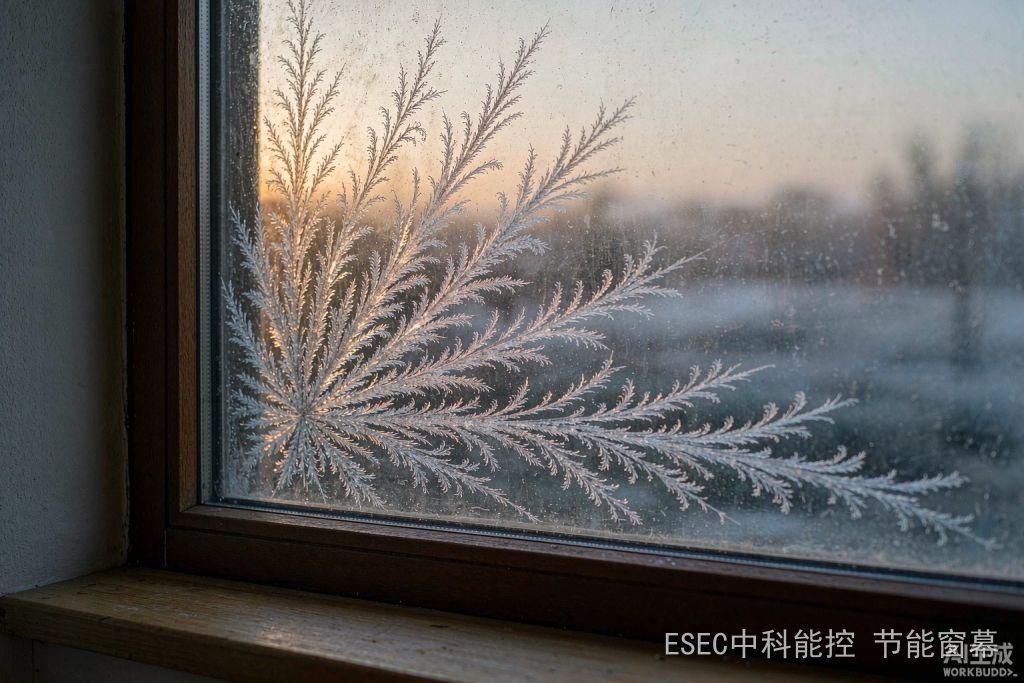
23 October marks Frost’s Descent (Shuangjiang), the last solar term of autumn. For windows, this point in the calendar sits on an invisible dividing line: before it, glass problems are mainly about “sweating” – a film of fine droplets on early mornings; after it, more and more households in northern China will see their windows “bloom” – feather-like ice crystals growing from the corners. Both are water vapour from the air landing on glass, so why does one become water and the other ice? This article settles both questions at once.
1. Two different paths first: condensation takes the water road, deposition takes the ice road
Condensation is a liquid-phase event: water vapour in the air meets a surface colder than the “dew point” and turns into liquid water on that surface. It needs two conditions at once – enough moisture in the air, and a surface cold enough.
Frosting is deposition: once the surface temperature falls below 0 degrees C, the vapour skips the liquid stage entirely and transforms directly into ice crystals on the surface – the pattern known as window frost. Frost, in other words, is not “dew that froze”; in most cases it was never water at all.
There is a subtle physical detail here: at the same temperature, the saturation vapour pressure over ice is lower than over supercooled water. For the same air humidity, the corresponding “frost point” is actually slightly higher than the dew point. That is why deep-winter glass often blooms without shedding a single drop – the air never gets the chance to wet the surface first; vapour meeting a surface below the frost point turns to ice directly.
2. Four quadrants: first ask which side the water is on, then whether it is above or below zero

Four-quadrant method: first ask which side of the glass the water is on, then whether the surface temperature is above or below 0 degrees C (illustrative infographic).
To identify the water on a window and decide whether to act, two questions are enough – four combinations in total:
- Interior side, above 0 degrees C – condensation: indoor moist air meets a glass inner surface below the dew point. This is the only quadrant jointly determined by “indoor humidity times window insulation”, and the one the owner can control;
- Exterior side, above 0 degrees C – morning dew: outdoor warm humid air meets a glass outer surface chilled by the room’s radiative loss or the night’s cooling. It dries as soon as the sun comes out – a normal physical phenomenon;
- Interior side, below 0 degrees C – window frost: the glass inner surface is below zero and vapour deposits directly. Most common on single glazing and poorly insulated old windows; if the interior face of a double-glazed unit starts frosting, that surface has fallen to remarkably low temperatures and the unit’s insulation deserves a fresh assessment;
- Exterior side, below 0 degrees C – exterior frost: on clear winter nights the glass outer surface radiates heat to the sky and can fall below the outdoor air temperature, frosting on the outside. This has nothing to do with indoor humidity – wipe it off and it returns the next night.
One line on responsibility: the two right-hand quadrants (exterior side) are weather phenomena – nobody is at fault; the two left-hand quadrants (interior side) are the building reporting a problem – humidity too high, window insulation too weak, or both.
3. Why window frost always starts at the edges
Anyone who has watched window frost will have noticed the pattern: ice crystals almost always appear first at the corners and lower edge, then spread toward the centre. Three factors stack up behind this:
- Thermal bridging at the edges: the centre of the pane faces room air on one side and outdoor air on the other, but the edges are additionally tied to the spacer bar and the frame – linear thermal bridges pull the edge temperatures below those of the centre;
- Cold air sinks: indoor air cooled by the glass slides down its surface, so the bottom edge of the glass contacts the coldest air layer in the room – which is why frost often climbs upward from a lower corner;
- Growth radiating from a nucleus: once an ice crystal nucleates at one point, it consumes the moisture around it and grows outward along the temperature field, branching into fern-like shapes – which is why frost fans out from a single corner.
This suggests a practical self-check: point an infrared thermometer at the centre and at a corner of the glass inner surface. If the corner reads clearly lower, the window’s edge thermal bridge is significant – and the spot where frost forms is precisely where meltwater seepage and mould will start later.
4. The melted water causes more trouble than the frost
Popular impressions of window frost stop at “pretty” or “cold-looking”, but building maintenance really has to deal with what happens after it melts: as indoor temperatures rise in the daytime, the frost melts from the inner side and the water runs down onto the sill – swelling wooden finishes and sills, seeping into the sealant between glass and frame, and leaving repeatedly damp, mouldy patches. The generic criterion in building physics (e.g. EN ISO 13788) treats a surface relative humidity persistently above 80 percent as a micro-environment where mould can grow – and the sill zone of a frosting window is exactly that place in winter.
So “blooming glass” is, in essence, the envelope filing a report: this glass inner surface regularly sits below 0 degrees C in winter – which, in the language of thermal standards, corresponds to a considerable level of heat loss through the window. The prettier the frost, the more heat that window leaks.
5. Moving the line down: only two directions of improvement
The condition for both condensation and frost compresses into one sentence: the glass inner surface temperature is below the dew point or frost point of that surface. Improvement therefore has only two natural directions:
- Control humidity – push the dew point down: ventilation, mechanical dehumidification, avoiding large-scale indoor drying of laundry, so the air holds less condensable moisture;
- Raise the temperature – lift the glass inner surface temperature: replace the glazing with better-insulating units (Low-E double or triple glazing), or add a buffer layer on the interior side of the glass.
Zhongke Nengkong (ESEC) energy-saving thermal curtains, for example, add a retractable curtain layer on the interior side of the glass: face fabric with 88 percent total solar reflectance, above 95 percent near-infrared reflectance, above 99 percent UV blocking, and a B1 flame-retardant rating. Lowered on winter nights, the curtain creates an air buffer between itself and the glass, reducing both convective heat transfer from indoor air to the glass and radiative loss from the glass to the room. The glass side is “held” by this buffer, its inner surface temperature rises overall and the frost line moves down; the curtain’s own inner surface stays well above the glass temperature, so the side you see and touch no longer fogs or frosts. Lowered in summer, the same layer reflects solar heat and trims cooling loads – one system serving both seasons.
The boundary should be stated honestly: a thermal curtain is not a dehumidifier – if indoor moisture sources are strong (heavy laundry drying, fresh renovation), ventilation and dehumidification are still required; fog or frost between the two panes of a double-glazed unit means seal failure, which calls for inspection and panel replacement, and a curtain cannot reach inside the cavity; what the curtain improves is the inner-surface temperature field and the heat loss through the glass – it does not replace wall insulation or routine maintenance of hardware.
6. A three-step diagnosis: what to do when water appears on a window
- Step one, look at the position: is the water or frost on the interior or exterior side? Exterior-side water is weather – no action needed, and wiping is futile;
- Step two, take the temperature: point an infrared thermometer at the centre and corner of the glass inner surface and compare with the day’s indoor humidity (the dew-point quick-check method from the previous article), and you will know how much margin remains before trouble;
- Step three, watch the timing: water that vanishes soon after sunrise is exterior dew or frost; what persists all day and recurs is an interior-side problem – and the order of remedies is always humidity control first, window upgrade second; doing both together works fastest.
FAQ
Q: The window frost wipes off but returns the next day – is the glass broken?
A: No. The glass itself is fine; its inner surface simply falls below the frost point at night. It is the joint result of indoor humidity and window insulation – either bring the humidity down or raise the inner surface temperature; wiping the glass addresses neither.
Q: Frost or fog has appeared between the panes of a double-glazed unit – what should be done?
A: Moisture has entered a failed seal, which counts as insulated glass unit failure; the remedy is inspection and panel replacement. An interior-side thermal curtain improves the temperature field on the room side and cannot fix anything inside the cavity. The two diagnoses must be kept apart.
Q: Is frosting the same thing as a draughty window?
A: No. A draught is convective heat transfer through gaps – the disease is in the “line” of the joint; frost is a phase change occurring when a large surface falls below the frost point – the disease is in the “plane”. Both make the window area feel cold, but one is treated with sealing and the other by raising surface temperature or lowering humidity.
Further reading:
- Why is the window glass colder than the night air on clear winter evenings? Nocturnal longwave radiation, explained
- Where does the water on the windowsill come from after a winter of humidifier use? A three-number dew-point self-check
- Pull the curtain and the glass sweats more: airflow, the third variable of condensation
- The fog you can never wipe: why insulated glass units fail and what to do about it
Zhongke Energy Consumption Control (Beijing) Technology Co., Ltd. (ESEC) specialises in lightweight energy-saving retrofit of glass curtain walls, participates in industry standard drafting, and its energy-saving thermal curtain is registered with the MIIT Energy Conservation Department as an “Energy Saving and Carbon Reduction Demonstration Product”. Product specifications per the official website: total solar reflectance 88 percent, near-infrared reflectance above 95 percent, UV blocking above 99 percent, B1 flame-retardant rating. In summer the curtain reflects solar heat and lowers cooling loads; in winter, lowered on the interior side of the glass it forms an air-buffer interface that raises the effective inner-surface temperature at the window and reduces heat loss. The retractable design balances shading, insulation and daylight; factory prefabrication and on-site assembly mean no business interruption, no hot work and no alteration to the glass itself – a reversible, deliverable lightweight retrofit for residential, retail, hospital and office buildings with existing curtain walls.
Website: www.zknkkj.com (installation footage and product videos on the homepage)
Tel: 18610685811 (Mr. Guo) | WeChat: ESEC88888