

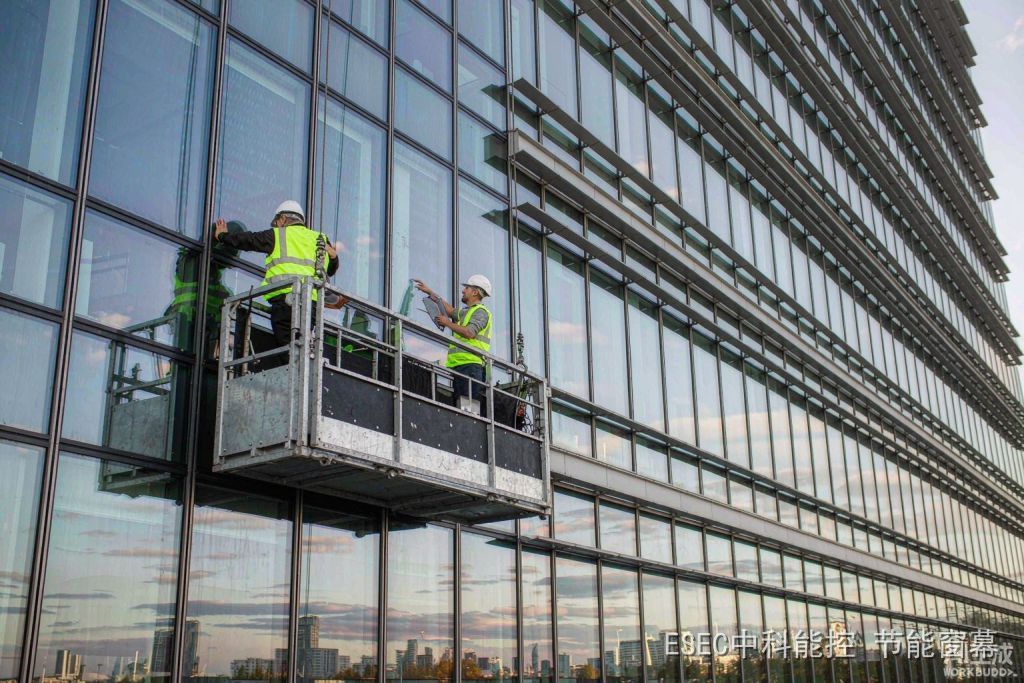
A commercial building just past its tenth year in service received a thin document last week: its periodic curtain-wall inspection report. The property team expected a formality — everything looked fine from the lobby. Then the last page showed eight circled issues. That list was eventually split into three different retrofit schemes, and only two of them involved touching glass. This article walks through how the building handled it, for every owner holding a similar report.
1. Why “Ten Years” Matters: Periodic Inspection Is Not Optional
Under China’s Measures for the Safety Maintenance of Existing Building Curtain Walls (Jianzhi [2006] No. 291), curtain-wall safety maintenance is the owner’s responsibility. A full inspection is required one year after completion acceptance and every five years thereafter; beyond the design service life, annually. Inspections must be carried out by qualified organizations, which submit a report and are accountable for its conclusions.
Delivered around 2015, this building was due under the five-year cycle. A periodic inspection is never a formality: it puts professional eyes where owners cannot reach — panel edges high above the ground, deep inside sealant joints, inside drainage holes.
2. What an Inspection Covers
Per the Technical Code for Glass Curtain Wall Engineering (JGJ 102), a full inspection covers: overall deformation, displacement or loosening; loose or damaged glass panels; sealant delamination, cracking or blistering, and aged or detached gaskets; operable vents — smooth operation, functional hardware, tight fasteners; and unobstructed drainage.
In addition, for structurally bonded curtain walls, a sampling test of structural silicone sealant adhesion is due after ten years of service, then every three years. This building sat exactly on that line, so its report included a sealant sampling page — the most consequential page many owners skip.
3. Eight Issues, Three Natures
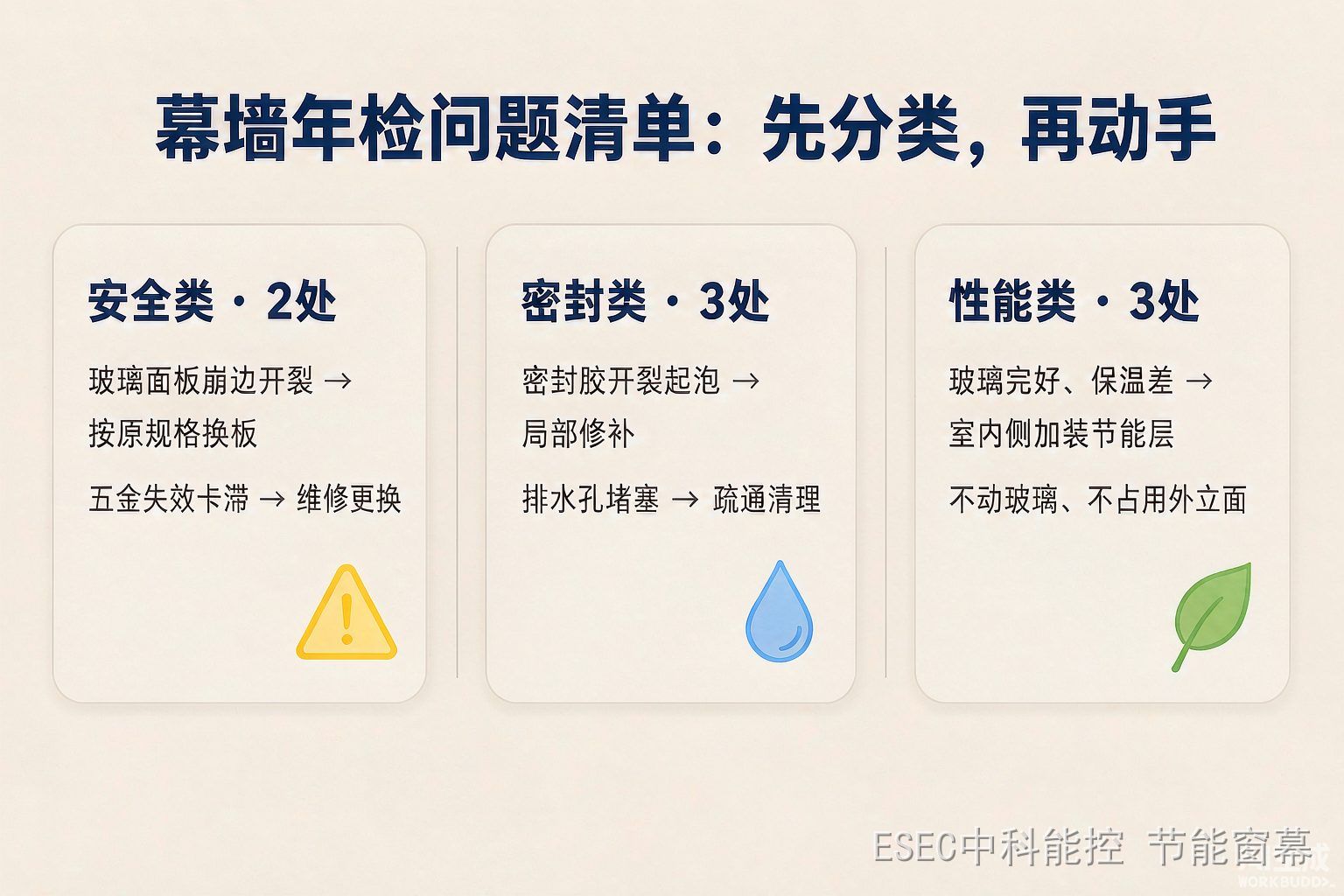
Classify first, then act: safety items, sealant items, and performance items follow different paths (illustrative infographic)
- Safety · 2 items: an edge-chipped glass panel on the west facade (impact damage); a vent with jammed hardware and a failed position limiter on the north facade;
- Sealant · 3 items: two spots of cracked/blistered sealant; one aged, detached gasket section; one row of clogged drainage holes on the east facade;
- Performance · 3 items: not measured by instruments but reported by occupants — cold workstations by the glass in winter, harsh afternoon glare, condensation at window corners. The report’s verdict was objective: panels intact, sealing normal; the gap is thermal performance versus current expectations.
4. Safety Items: When Glass Must Be Touched, Do It Right
A chipped panel leaves no room for “wait and see.” The fix was a like-for-like panel replacement — dimensions, thickness, color and coating ordered to the original specification. Given spontaneous-breakage risk and the code’s preference for heat-soak treatment of curtain-wall tempered glass, the new panel was heat-soak tested. As covered before, spontaneous breakage picks no time or place; the remedy goes through panel replacement.
The vent issue involved no glass but still counted as safety: a window that cannot hold its position at height is a falling hazard. The hardware set was replaced in full and fasteners re-torqued — patching worn hardware rarely survives the next five-year cycle.
5. Sealant Items: Work the Sealant, Not the Glass
Cracked sealant was cut out and re-applied locally; the aged gasket was replaced section by section; drainage holes were cleared and verified with a water test. Such work is cheap in materials but dependent on aerial work platforms — the cost sits in the gondola and labor. The lesson: share one gondola window across safety and sealant items, and finish all facade work in one go.
6. Performance Items: Intact Glass Means You Don’t Have to Touch It
For the three “complaint” items, the glass itself had no defects. The envelope was not broken — its as-built thermal level simply predates today’s comfort and energy expectations. Replacing glass would work, but re-cladding a facade for three window-side offices is disproportionate in both cost and logistics.
Instead, retractable energy-saving window screens were added on the interior side at those three workstations. Using Zhongke Nengkong (ESEC) energy-saving window screens as an example: total solar reflectance 88%, near-infrared reflectance above 95%, UV blocking above 99%, flame-retardant class B1. In summer they reflect solar heat and tame west-facing glare; lowered on winter nights, they form an air buffer between screen and glass, raising the effective interior surface temperature near the window and easing cold radiation and corner condensation — the same logic as a school retrofit completed during a winter break. The installation happened entirely indoors: no glass touched, no facade occupied, no hot work, running in parallel with the gondola crew without a single extra closed day.
To be honest about the boundary: window screens improve the interior-side surface temperature field and heat loss through the window — they do not replace safety retrofits. Safety and sealant items must still be handled as such; screens cannot repair a failed insulating-glass cavity or bring dead hardware back to life. Handle each circled item according to its nature.
7. Work Organization: One Report, Two Work Streams
- Exterior (gondola): panel replacement, re-sealing, gasket replacement, drainage clearing — two weekend windows, daily cleanup;
- Interior (no aerial platform): vent hardware and the three screen installations, flowing workstation by workstation, zero conflict with the exterior crew.
The only shared constraint was the schedule: both streams finished before the heating season, so window-side workstations could go through winter in comfort.
8. Three Takeaways for Similar Owners
- Classify the report before budgeting: safety items immediately, sealant items by work window, performance items by budget. Mixing them invites over-renovation;
- Read “glass intact” carefully: it signals interior-side solutions that leave the facade untouched;
- Put the inspection cycle into the annual budget: five-year intervals are a planned obligation with qualification and accountability requirements, not a last-minute scramble.
FAQ
Q: How often should an existing curtain wall be inspected?
A: Per Jianzhi [2006] No. 291: one full inspection one year after completion acceptance, then every five years; annually beyond the design service life. Pre-tensioned rod/cable structures (first check at six months, then every three years) and structurally bonded areas (sampling after ten years, then every three years) have shorter dedicated cycles.
Q: If the report flags glass issues, must the whole facade be replaced?
A: Usually not. Panel issues are handled pane by pane, ordered to original specifications. Whether broader appraisal or strengthening is needed should follow the report’s conclusions and professional assessment — not a quotation.
Q: Does “thermal performance gap” count as a safety issue?
A: No — keep the two apart. Safety items (damaged panels, failed hardware, aged structural sealant) carry falling risks and need prompt action; performance items affect comfort, energy use and bills, and can be scheduled by budget — typically the category solvable without touching glass.
Related reading:
- Why does curtain-wall glass shatter without impact? Spontaneous breakage and why the remedy goes through panel replacement
- “The radiators are hot, but it’s still cold by the window”: an air-leakage investigation
- The fog you can’t wipe away: how insulated glass units fail
- The row of desks by the window was always cold — a school’s four-week winter-break insulation retrofit
- ESEC Energy-Saving Calculator: estimate the benefits of window-screen retrofit
Zhongke Nengkong (Beijing) Technology Co., Ltd. (ESEC) specializes in lightweight energy-saving retrofit of glass curtain walls, participates in industry standard drafting, and its energy-saving window screen is registered with MIIT as an “Energy Saving and Carbon Reduction Demonstration Product.” Official specifications: total solar reflectance 88%, near-infrared reflectance above 95%, UV blocking above 99%, flame-retardant class B1. In summer it reflects solar heat and cuts cooling loads; in winter, lowered on the interior side of glass, it forms an air buffer that raises the effective interior surface temperature near windows and reduces heat loss. The retractable design balances shading, insulation and daylight transparency; factory-prefabricated and site-assembled, with no business interruption, no hot work and no alteration to the glass itself — a reversible, deliverable lightweight retrofit for existing residential, retail, hospital and office buildings.
Website: www.zknkkj.com
Tel: 18610685811 (Manager Guo) | WeChat: ESEC88888