

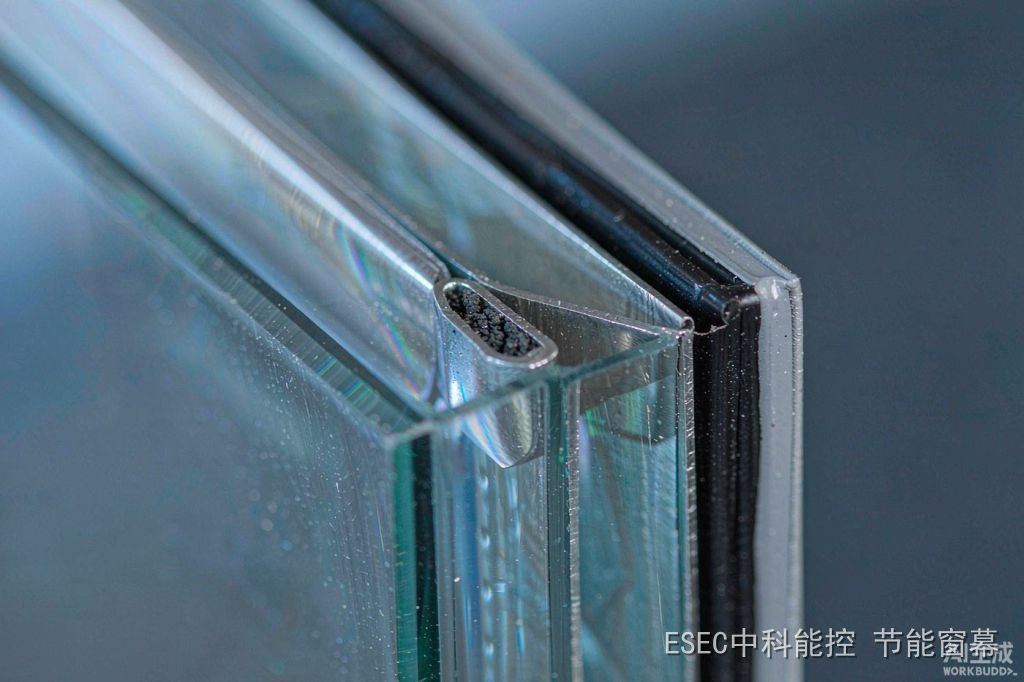
In winter, many windows show a counter-intuitive pattern: the center of the glass feels acceptable, but the perimeter near the frame is noticeably cold, and condensation always starts at the edge before creeping inward. The first suspect is usually a leaky frame — but the real culprit often sits inside the glass system itself: the narrow spacer between the two panes. This article dissects the edge of an insulating glass unit (IGU): what the spacer does, how an aluminum spacer becomes a thermal bridge, what the warm-edge criterion means, and what interior-side options remain for existing curtain walls.
1. The Spacer: One Narrow Frame, Three Jobs
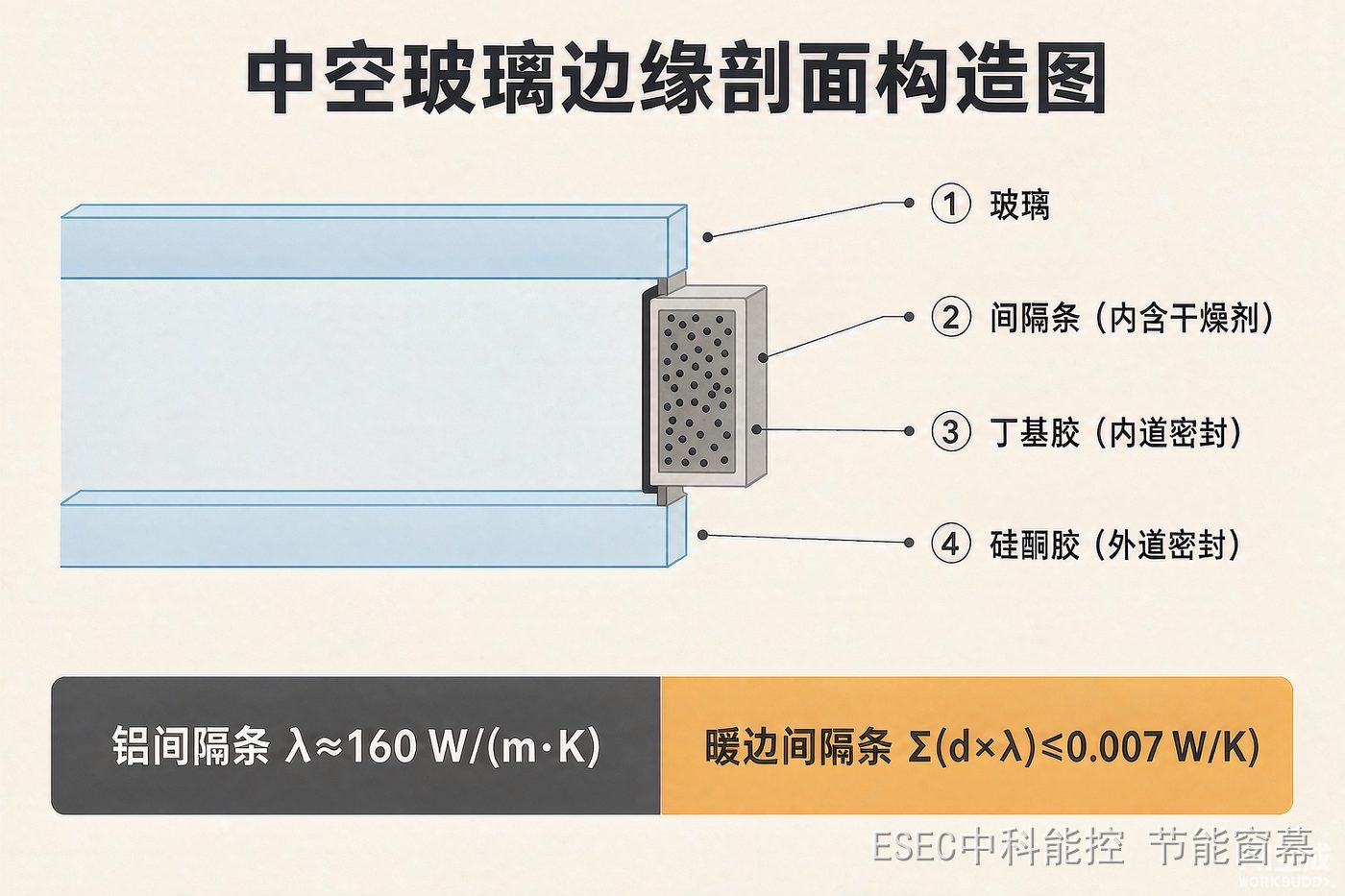
Cross-section construction of an IGU edge: the spacer and dual-seal system, plus a thermal-conductivity comparison between aluminum and warm-edge spacers (illustrative infographic)
An IGU lives or dies at its edge: the two panes are held apart by a spacer that forms a gas cavity roughly a dozen millimeters thick, filled with desiccant to absorb residual moisture, and sealed to the glass with a dual-seal system — a primary seal of hot-melt butyl (the moisture barrier) and a secondary seal of polysulfide or silicone (structural bonding and protection). GB/T 11944, the Chinese standard for IGUs, sets corresponding requirements for appearance, dimensions, sealing, dew point and durability. The construction is mature; the problem lies in the choice of material.
2. Accounting for the Thermal Bridge: 160 vs 0.007
Traditional IGUs use aluminum spacers. Aluminum has a thermal conductivity of about 160 W/(m·K) — a highly conductive metal wrapped in a continuous ring right at the glass edge. In winter, indoor heat drains along the ring, so the inner surface of the glass is markedly colder at the edge than at the center. Once the surface temperature falls below the dew point, condensation starts at the edge, and mold often follows along the frame. Hence the familiar pattern: a comfortable glass center, a freezing and wet edge.
The accounting can be made precise. The overall window U-value is not a simple weighted average of glass and frame — it also includes the linear thermal transmittance Ψ of the edge, which describes heat loss through the spacer system:
Uw = (Ug·Ag + Uf·Af + Ψ·Lf) / Aw
However good the glass center (low Ug), a poor edge Ψ erodes the window’s overall rating — the energy performance achieved at the center is partly canceled by the ring.
3. Warm Edge: How Standards Define “Warm”
“Warm edge” is not a brand but a category of low-conductance spacer systems. The common quantitative criterion comes from ISO 10077: summing thickness × conductivity (Σ(d×λ)) over the spacer system’s materials, a system qualifies as warm edge when the sum is no greater than 0.007 W/K. A conventional aluminum spacer system scores about 0.112 W/K — more than an order of magnitude higher. Two Chinese industry standards, JC/T 2453-2018 (Part 3: warm-edge spacers) and HBZ/T 003-2016, adopt the same 0.007 W/K limit, and several provincial building-energy standards now specify that IGU spacers should preferably be warm-edge types.
Three material routes meet the criterion:
- Stainless-steel spacers: conductivity around 15-17 W/(m·K), roughly one-tenth of aluminum, thinner walls and better strength — common in high-end European window systems;
- Composite spacers: plastic (e.g. polypropylene) combined with thin stainless-steel foil — plastic insulates, metal carries strength and sealing; the mainstream form today;
- Thermoplastic flexible spacers (TPS, 4SG etc.): extruded from modified butyl-based material, integrating spacing, desiccant and sealing in one continuous profile, with the lowest conductance and better stress absorption — typical in passive-house projects.
The two direct benefits: the inner surface temperature at the glass edge rises (by several degrees Celsius under common industry estimates, depending on configuration and climate), visibly reducing winter edge condensation; and with the glass configuration unchanged, the whole-window U-value drops — the exact margin depends on frame, visible glass area and the change in Ψ, and should be confirmed by measurement or simulation.
4. Buying and Checking: the Name Is Not Enough
Warm edge costs more than aluminum, so black-painted aluminum spacers are sometimes marketed as warm edge. Three practical checks:
- Look at the cross-section: composite spacers show a plastic-plus-metal-foil structure; flexible spacers are entirely gel-like — clearly different from solid metal;
- Ask for test reports: verify Σ(d×λ) against JC/T 2453-2018 or HBZ/T 003-2016;
- Confirm dual sealing: building IGUs should use a dual-seal system (hot-melt butyl primary + polysulfide/silicone secondary); single-seal units age much faster.
Fairness requires noting that aluminum spacers remain mainstream in ordinary windows — mature, cheap, strong. Warm edge pays off where insulation, condensation resistance and long-term durability matter most: cold and severe-cold regions, ultra-low-energy buildings, and condensation-sensitive public buildings. And warm edge addresses only the edge; whole-window performance still depends on glass, frames and seals as a system.
5. Existing Curtain Walls: Interior-Side Answers Without Replacing Glass
Warm-edge spacers belong to new glass — they are built in at the factory. For completed curtain-wall buildings, the real question is the reverse: the edge-cold problem is already there, but the glass cannot easily be replaced. Glass replacement means facade work, structural involvement, long schedules and high cost.
Fortunately, the comfort problem can also be addressed from the interior side. For example, ESEC energy-saving window screens: a retractable, view-through high-reflectance fabric installed over the full interior face of the glass, with total solar reflectance 88%, near-infrared reflectance above 95%, UV blocking above 99%, and flame-retardant class B1. Lowered on winter nights, the screen forms an air buffer against the glass — covering the edge region too — raising the perceived temperature near the window so workstations no longer sit against a cold surface. Lowered in summer, it reflects solar heat before it enters the room. Installation is entirely interior: no glass touched, no facade work, no business interruption, no hot work.
To be honest about the boundaries: a window screen does not change the spacer. It adds a thermal buffer on the interior side — a different layer of the problem from warm-edge spacers, and the two can be combined. Screens do not repair failed IGU cavities (that requires glass replacement) and do not replace necessary safety retrofits. Whether and how to touch the glass should follow the inspection findings first.
FAQ
Q: How do warm-edge spacers relate to Low-E glass? Do I need both?
A: They are not substitutes. Low-E coatings manage radiant heat through the glass; warm-edge spacers manage conductive heat at the edge. High-performance projects usually specify both; on a limited budget, choose based on which weakness the thermal diagnosis identifies.
Q: My glass already condenses at the edge — must I replace it?
A: First distinguish two cases. Fog or droplets inside the IGU cavity that cannot be wiped mean seal failure — the unit has reached the end of its life and replacement is the only fix. Droplets on the room-side surface, concentrated at the edge, usually indicate an edge thermal bridge pulling the surface below the dew point — such cases can often be improved first with interior-side measures that reduce cold radiation and raise the surface temperature.
Q: How do I verify a “warm edge” is genuine rather than painted aluminum?
A: Check the cross-section (composite and flexible spacers look clearly different from solid metal), request test reports against the Σ(d×λ) ≤ 0.007 W/K criterion, and confirm the dual-seal construction.
Related reading:
- Fog you cannot wipe: why IGUs fail and what to do
- Dew point made simple: three numbers to check your window condensation risk
- Curtains blocking airflow: the third variable of window condensation
- How the “silver layer” of Low-E glass actually works
- Single, insulating, Low-E: understanding your curtain wall’s glass constitution
- ESEC Energy-Saving Calculator: estimate the benefits of window-screen retrofit
Zhongke Nengkong (Beijing) Technology Co., Ltd. (ESEC) specializes in lightweight energy-saving retrofit of glass curtain walls, participates in industry standard drafting, and its energy-saving window screen is registered with MIIT as an “Energy Saving and Carbon Reduction Demonstration Product.” Official specifications: total solar reflectance 88%, near-infrared reflectance above 95%, UV blocking above 99%, flame-retardant class B1. In summer it reflects solar heat and cuts cooling loads; in winter, lowered on the interior side of glass, it forms an air buffer that raises the effective interior surface temperature near windows and reduces heat loss. The retractable design balances shading, insulation and daylight transparency; factory-prefabricated and site-assembled, with no business interruption, no hot work and no alteration to the glass itself — a reversible, deliverable lightweight retrofit for existing residential, retail, hospital and office buildings.
Website: www.zknkkj.com
Tel: 18610685811 (Manager Guo) | WeChat: ESEC88888