

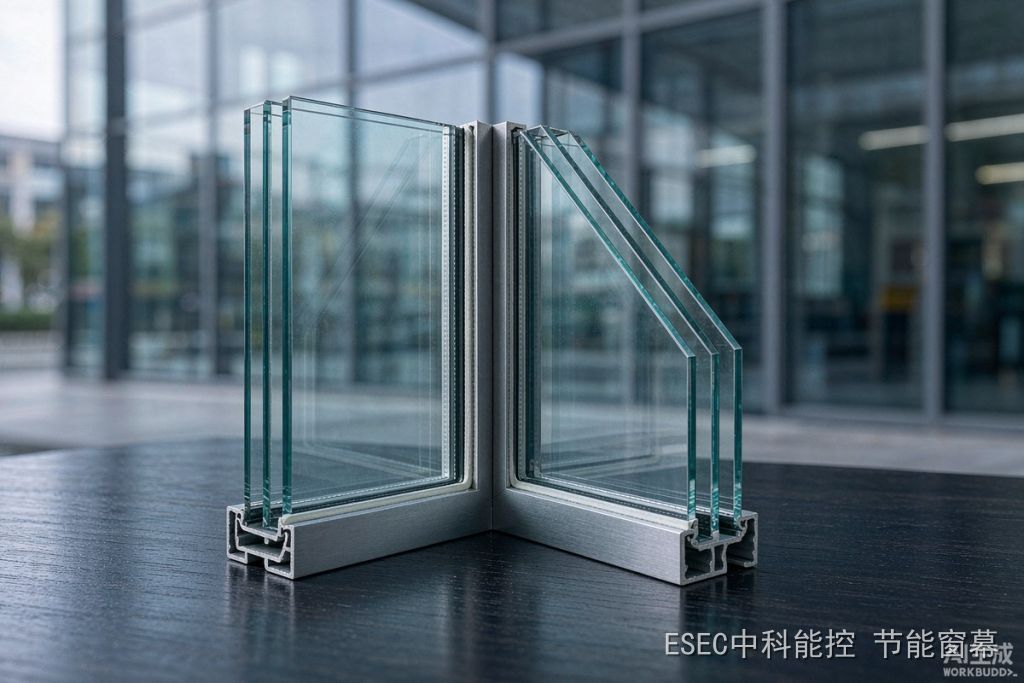
Standing near a window in winter, you can feel the chill on the back of your hand ten centimeters from the glass — that is heat leaking from your side to the outdoors. To block this path, the glass industry has doubled panes, tripled them, and even pulled a vacuum. This article puts the two mainstream routes side by side: triple-insulated glazing (three panes, two cavities) and vacuum glass — understand the physics each uses to lower the U-value, and you can judge which direction your building should go.
1. Two Routes, Two Physics
Heat crosses glass three ways: conduction (needs a medium), convection (needs moving gas) and radiation (infrared). The two routes differ completely:
- Triple glazing: add panes and cavities. Three panes form two sealed cavities filled with dry air or argon; each cavity adds thermal resistance, at the cost of thickness and weight. A common 5+12A+5+12A+5 build-up totals about 34 mm.
- Vacuum glass: remove the medium. Two panes are edge-welded with low-melting solder and evacuated below 0.1 Pa, with a vacuum gap of only 0.1–0.3 mm — with no gas, conduction and convection nearly vanish. Arrays of tiny pillars (0.3–0.5 mm diameter, 20–60 mm spacing) keep the panes from collapsing under atmospheric pressure.
Both routes hand radiation to a Low-E coating — a mechanism covered in our earlier article on how Low-E coatings work.
2. The U-Value Ladder
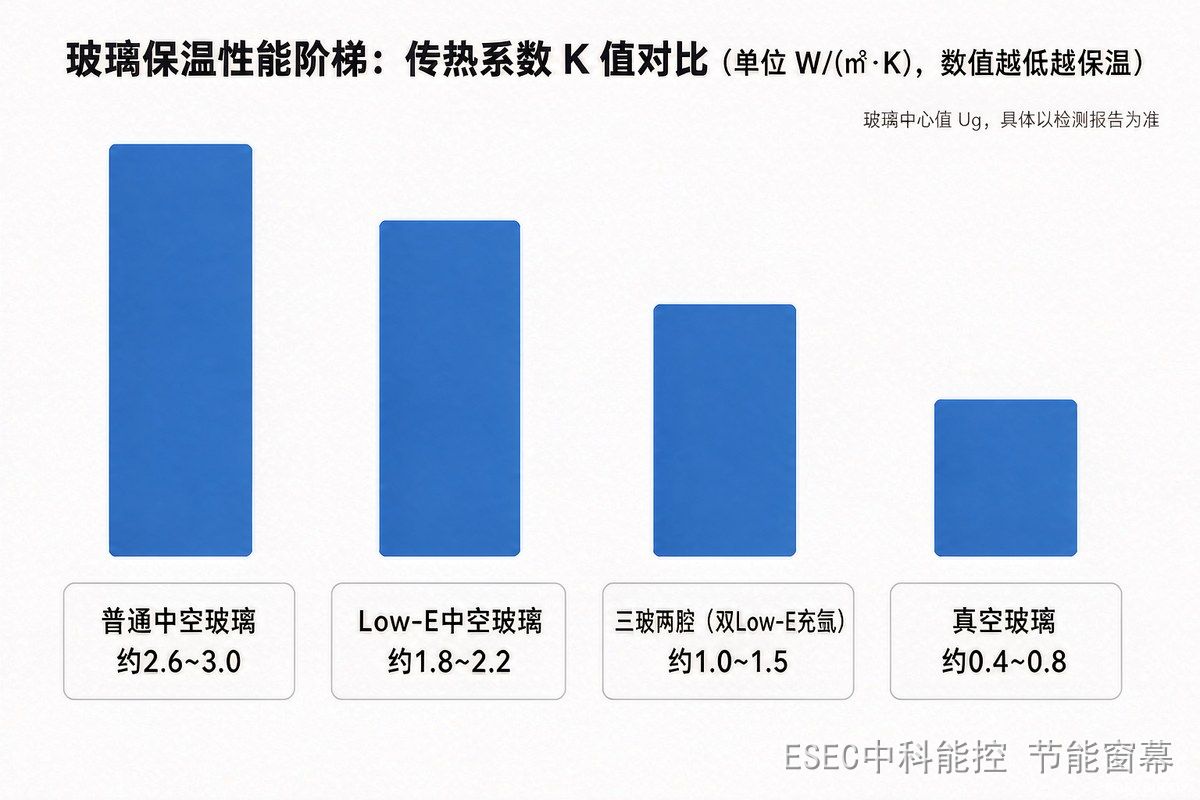
Center-of-glass U-values fall step by step from ordinary double glazing to vacuum glass (illustrative infographic; refer to test reports for exact figures)
- Ordinary double glazing (e.g. 5+12A+5): about 2.6–3.0 W/(㎡·K);
- Low-E double glazing: about 1.8–2.2; argon fill brings it to 1.5–1.8;
- Triple glazing (double Low-E + argon): about 1.0–1.5, with 0.7 near the structural limit;
- Vacuum glass: 0.4–0.8, with mainstream products readily below 0.5.
These are center-of-glass values; whole-window U-values also include frames and edge spacers. But the ladder’s relative order never changes.
3. Vacuum Glass’s Three Unique Cards
- Thin and light: two panes around a 0.1–0.2 mm vacuum gap, about 10–12 mm thick and roughly one-third lighter than triple glazing of comparable insulation. It fits glazing pockets where 34 mm triple units cannot — a key reason it is used in European heritage buildings with pockets under 15 mm.
- Better light transmission: triple units often need double Low-E to reach low U-values, pushing visible transmittance below 0.6; vacuum glass achieves lower U-values with a single Low-E coating and can exceed 0.8 visible transmittance. Insulation and daylight need not trade off.
- Acoustics: sound needs a medium; the vacuum layer blocks it, with weighted sound reduction around 40 dB versus 30–35 dB for ordinary double glazing — noticeable along arterials and viaducts.
On durability: GB/T 11944-2012 suggests at least 15 years of expected service life for insulated glass units; vacuum glass, with metal fusion seals, carries 15-year warranties and expected lives above 25 years from major makers. The trade-offs: higher unit price, difficulty producing very large panels, and costly edge-damage repairs. It is the performance ceiling, not the default.
4. The Real Bottleneck: Pocket, Weight and Construction
It is tempting to conclude “just switch to vacuum glass.” For existing buildings — especially glass curtain walls — the real costs sit off the spec sheet:
- Replacing glass means touching the curtain wall: panel removal, structural silicone, work at height, acceptance — usually by whole unitized modules, with downtime costs;
- Pockets and load: existing frames were designed for their original build-up; 34 mm triple units rarely fit, and even vacuum glass implies swapping whole sashes or panels;
- Cost magnitude: high-performance glass plus curtain-wall construction is often the single most expensive envelope retrofit item.
That is why Beijing’s retrofit technical regulations for existing residential buildings list, alongside glass replacement, another measure: adding a second window layer on the interior side — leaving the original window untouched.
5. The Practical Path for Existing Curtain Walls: a Second Cavity Indoors
Vacuum glass’s logic — add a layer of thermal resistance on the interior side — can be borrowed without touching the glass. ESEC energy-saving window screens install a retractable, view-through, high-reflectance fabric on the interior side of the glass; when lowered, the air buffer between fabric and glass acts like an added cavity, with total solar reflectance 88%, near-infrared reflectance above 95%, UV blocking above 99%, and class B1 flame retardancy. In summer the layer reflects solar heat before it enters; on winter nights it raises the effective interior surface temperature near the window.
Honest boundaries: screens are not a glass upgrade — they do not turn 2.8 into 0.5. Their value is improving window thermal performance without touching glass, facade, operations or hot work, on curtain walls that cannot afford reglazing. Safety issues (spontaneous breakage, seal failure) still require proper engineering; screens add thermal performance, not a safety waiver.
6. A Decision Checklist
- New builds or full window replacement: triple glazing is the mature mainstream for extreme insulation; vacuum glass deserves separate evaluation where pockets are tight or traffic noise matters;
- Existing curtain walls, glass untouched: check airtightness and sealing systems first, then consider interior-side window screens to cut seasonal window loads;
- Measure before deciding: an infrared camera’s map of interior surface temperatures tells you more than a spec sheet.
Insulating glass is a game against conduction, convection and radiation. Triple glazing sets up layer after layer of checkpoints; vacuum glass removes the ground the heat travels on; interior-side screens add a layer without redrawing the original. The routes don’t conflict — they fit different situations, and knowing which situation you are in matters more than memorizing which U-value is smaller.
FAQ
Q: Which feels warmer to the touch in winter, triple glazing or vacuum glass?
A: By center-of-glass U-value, vacuum glass (0.4–0.8) beats triple glazing (1.0–1.5), so its interior surface stays closer to room temperature and resists condensation. Whole-window feel also depends on frames, spacers and sealing — judge by whole-window test reports.
Q: What are the tiny dots inside vacuum glass?
A: Micro-pillars that keep the panes from collapsing under atmospheric pressure, about 0.3–0.5 mm in diameter at 20–60 mm spacing. Visible only against the light; not a visual disturbance at normal viewing distances.
Q: Can an existing curtain wall improve insulation without replacing glass?
A: Yes — interior-side retrofits such as retractable energy-saving window screens form an air buffer against the glass, improving thermal performance both seasons. The gain is smaller than high-performance reglazing, but involves no curtain-wall dismantling or downtime — the lightweight first step for existing buildings.
Related reading:
- How does the “silver layer” in Low-E glass work?
- Warm-edge spacers and the thermal bridge at the glass edge
- The fog you can’t wipe: why insulated glass units fail
- Single, double, Low-E: knowing your curtain wall’s “constitution”
- Window-to-wall ratio explained
- ESEC Energy-Saving Calculator
Zhongke Nengkong (Beijing) Technology Co., Ltd. (ESEC) specializes in lightweight energy-saving retrofit of glass curtain walls, participates in industry standard drafting, and its energy-saving window screen is registered with MIIT as an “Energy Saving and Carbon Reduction Demonstration Product.” Official specifications: total solar reflectance 88%, near-infrared reflectance above 95%, UV blocking above 99%, flame-retardant class B1. In summer it reflects solar heat and cuts cooling loads; in winter, lowered on the interior side of glass, it forms an air buffer that raises the effective interior surface temperature near windows. Factory-prefabricated and site-assembled, with no business interruption, no hot work and no alteration to the glass — a reversible, deliverable lightweight retrofit for existing office, retail and hospital buildings.
Website: www.zknkkj.com
Tel: 18610685811 (Manager Guo) | WeChat: ESEC88888