
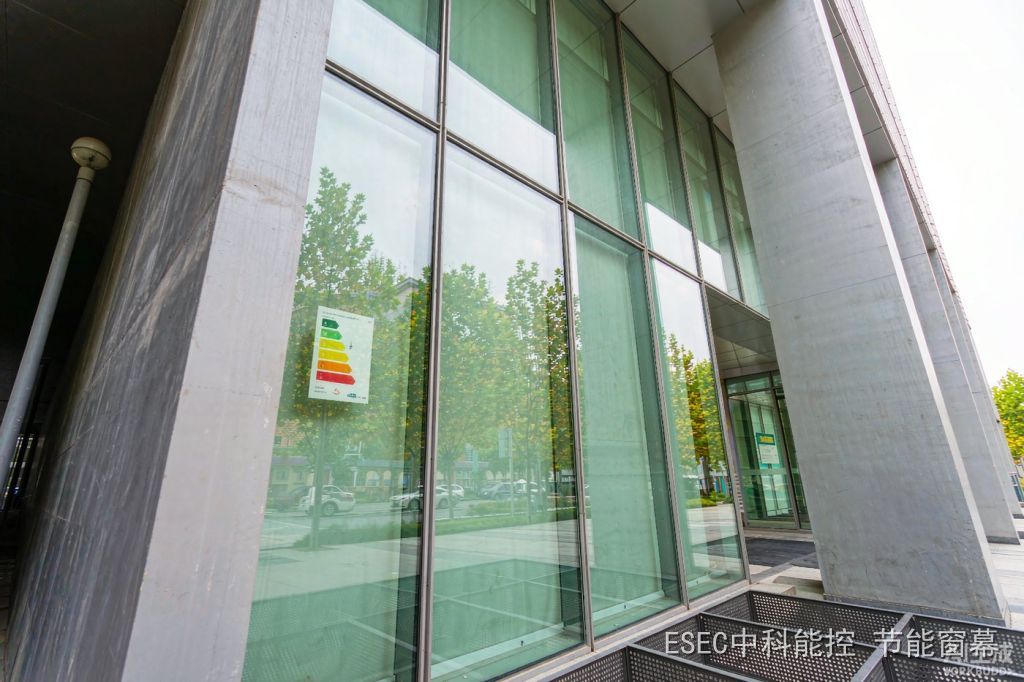
Buying an air conditioner means checking its energy label. Since February 1, 2025, public buildings in Beijing have gone through the same ritual: the Beijing Measures for Energy Efficiency Grading of Public Buildings took effect, requiring eligible public buildings to be graded annually from one to five by annual comprehensive energy-use intensity. Level one is the best; level five is the bottom — and large public buildings rated level five for two consecutive years must implement energy-saving green retrofit based on energy-audit findings. The central government has repeatedly called for “establishing a building energy efficiency rating system”; Beijing has turned that phrase into an enforceable, assessable, publicly visible local institution.
1. From “Electricity Quotas” to “Efficiency Grading”
The 2020 Interim Measures on Electricity Consumption Quotas for Public Buildings were repealed simultaneously. The changes go beyond a new name:
- Broader scope: from electricity alone to comprehensive energy-use intensity, covering heating/cooling, ventilation and air conditioning, office equipment, elevators, lighting, domestic hot water and more;
- Explicit benchmarks: five grades referenced to the guiding value and limiting value of comprehensive energy-use indicators in Beijing’s Civil Building Energy Consumption Standard (DB11/T 1413);
- Clear responsibility: the building owner is responsible for compiling energy data and completing annual grading;
- Defined coverage: single buildings with over 3,000 m² of public-building floor area accounting for more than 50% of the total; buildings involving state secrets are exempt.
2. The Five Grades
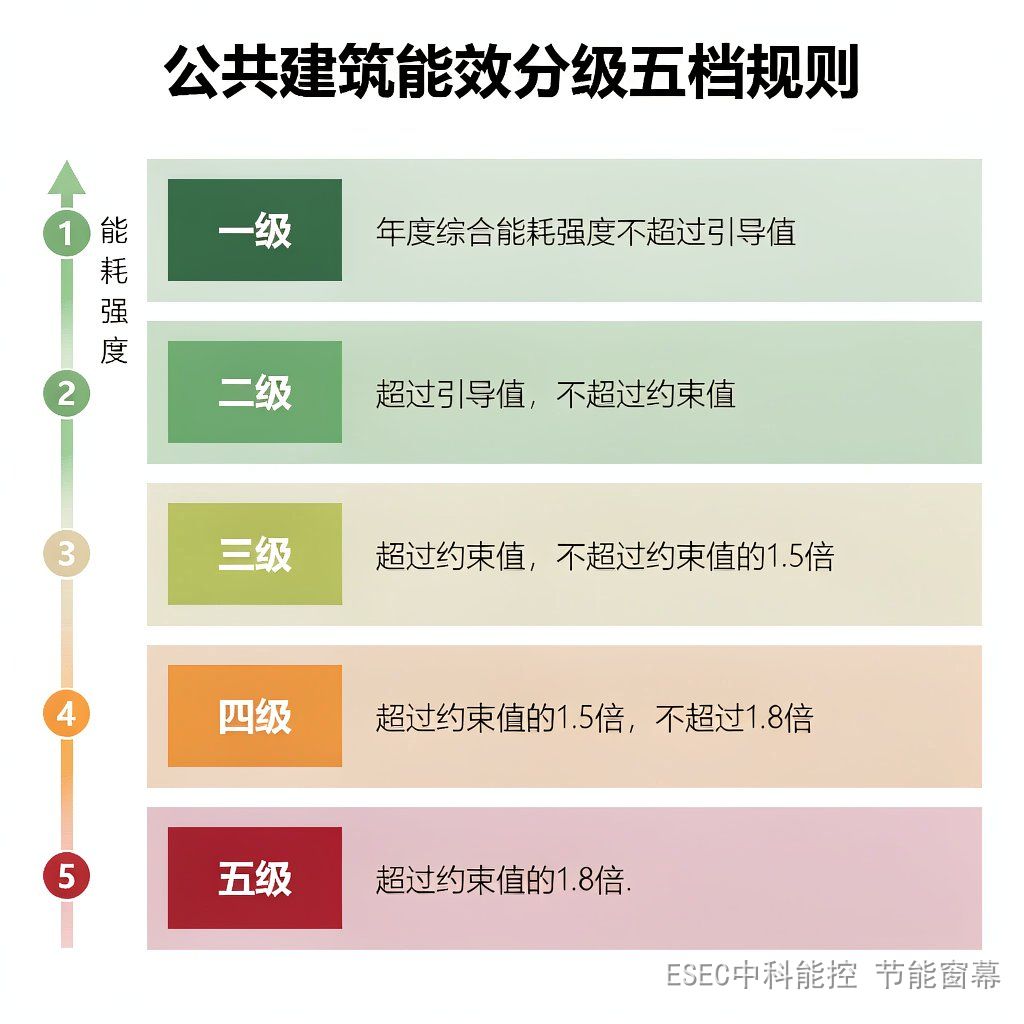
The five-tier grading rules: annual comprehensive energy-use intensity is graded against the guiding and limiting values (illustrative infographic)
- Level 1: intensity not exceeding the guiding value;
- Level 2: above the guiding value, not exceeding the limiting value;
- Level 3: above the limiting value, up to 1.5 times;
- Level 4: above 1.5 times, up to 1.8 times;
- Level 5: above 1.8 times the limiting value.
The guiding value marks “a good building”; the limiting value is the pass line. Levels three to five all sit in the failing zone.
3. What a Low Grade Triggers
- Levels 3-4: owners should improve green operation and maintenance management, designate energy-management staff, identify efficiency factors, and may conduct general energy audits;
- Level 5: test and diagnose major energy-using equipment and conduct a deep energy audit per DB11/T 1007, then improve accordingly;
- Two consecutive years at level 5: energy-saving green retrofit must be implemented; non-compliant large public buildings face enforcement under Article 59 of the Beijing Building Green Development Regulation;
- Spot checks and credit: districts randomly inspect 5% of large public buildings annually; non-participation leads to rectification orders and credit-system listing;
- Incentives: level 1-2 buildings may apply for demonstration selection, with results published; rating labels may be displayed at prominent positions.
4. When the Audit Turns to the Envelope, Windows Take Center Stage
For a glass curtain-wall building graded level five, a deep energy audit inevitably covers the envelope — for curtain-wall buildings, windows and glazing are usually the largest source of heat gain and loss. A large share of cooling and heating load compensates for heat passing through glass. But an audit pointing to “retrofit” does not necessarily mean “replace the glass.” The thermal performance of the window can also be improved on the interior side: for example, Zhongke Nengkong (ESEC) energy-saving window screens — a retractable, view-through, high-reflectance fabric installed inside the glass, with total solar reflectance 88%, near-infrared reflectance above 95%, UV blocking above 99%, and flame-retardant class B1. Lowered in summer, they reflect solar heat before it enters; lowered on winter nights, they form an air buffer that raises the effective interior surface temperature. Installation is entirely indoors — no glass touched, no facade work, no business interruption, no hot work.
To be honest about the boundaries: screens improve thermal performance through the window; they do not replace equipment upgrades or address walls and roofs. The grade reflects whole-building annual intensity — whether one measure can lift a level-five rating depends on the audit’s breakdown. Audit first, then plan.
5. Three Steps for Beijing Building Owners
- Know your grade: owners are the responsible party; non-participation brings rectification orders and credit listing;
- Manage from level 3: levels 3-4 require green-management systems, factor identification and general audits — do the low-cost operational fixes first;
- Don’t wait at level 5: two consecutive years trigger mandatory retrofit; start the deep energy audit in year one and prioritize measures that leave the structure untouched.
The “building energy efficiency rating system” has moved from central policy language to a local institution that runs every year in Beijing. For public buildings, the rating is becoming an unavoidable public identity — and improving it does not always have to start with the most expensive glass.
FAQ
Q: Which buildings must participate?
A: Single buildings in Beijing with over 3,000 m² of public-building area exceeding 50% of total floor area; grouped buildings whose meters cannot be separated are treated as single buildings; state-secret buildings are exempt.
Q: Does level five mean immediate costly retrofit?
A: No. A level-five rating first requires equipment testing and a deep energy audit with improvements based on findings. Only large public buildings at level five for two consecutive years must implement retrofit — but the countdown starts from the first year.
Q: Where do the guiding and limiting values come from?
A: From Beijing’s Civil Building Energy Consumption Standard (DB11/T 1413), by building type and energy-use composition; consult professional institutions or the grading service system.
Related reading:
- Central documents call for a building energy efficiency rating system
- The 15th Five-Year plan for public institutions: envelope retrofits listed first
- Two-part heat tariffs: the window becomes the one item on the bill you can change
- Understanding GB 55015’s trade-off judgment
- Eight issues circled in an inspection report: only two needed glass work
- ESEC Energy-Saving Calculator
Zhongke Nengkong (Beijing) Technology Co., Ltd. (ESEC) specializes in lightweight energy-saving retrofit of glass curtain walls, participates in industry standard drafting, and its energy-saving window screen is registered with MIIT as an “Energy Saving and Carbon Reduction Demonstration Product.” Official specifications: total solar reflectance 88%, near-infrared reflectance above 95%, UV blocking above 99%, flame-retardant class B1. In summer it reflects solar heat and cuts cooling loads; in winter, lowered on the interior side of glass, it forms an air buffer that raises the effective interior surface temperature near windows. Factory-prefabricated and site-assembled, with no business interruption, no hot work and no alteration to the glass — a reversible, deliverable lightweight retrofit for existing office, retail and hospital buildings.
Website: www.zknkkj.com
Tel: 18610685811 (Manager Guo) | WeChat: ESEC88888