

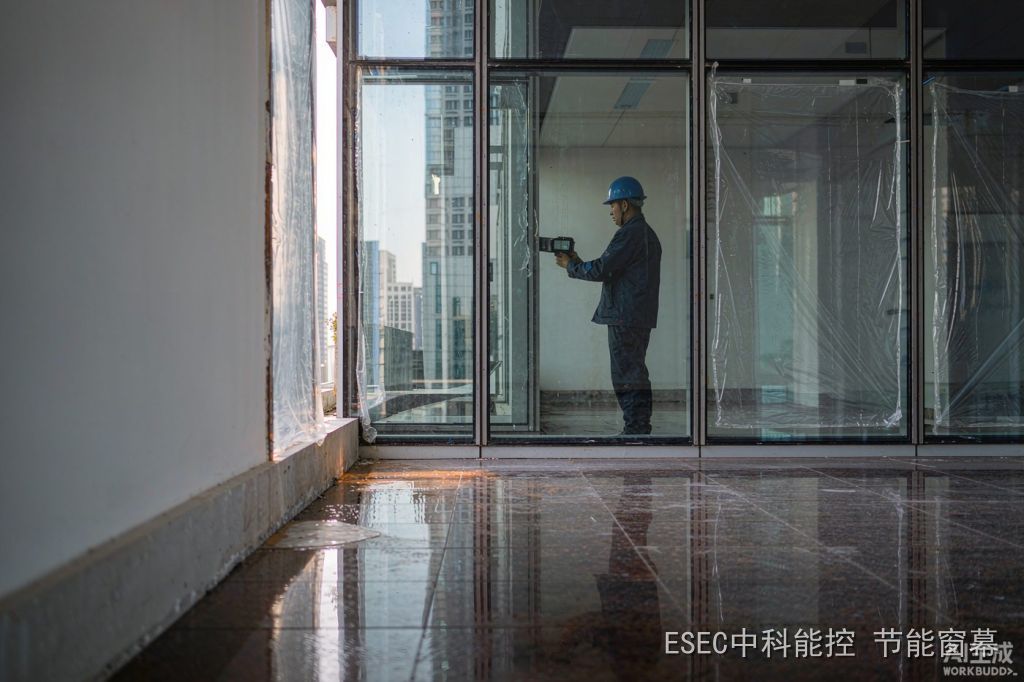
Before a glass curtain wall building is handed over, the “joints” face two exams: one in the laboratory, one on site. In the lab, a mock-up identical to the project must pass air tightness, water tightness and wind-pressure resistance in sequence; on site, the installed facade is sprayed and pressurized once more. Both regimes sit in one family of Chinese standards: GB/T 21086 (Building Curtain Wall) defines the grades, GB/T 15227 (Test Methods) defines how to test, and JGJ/T 324 (Standard for Test Methods of Curtain Wall Engineering) governs site work.
Air tightness: a pressure box that counts leaks
The principle is simple: the specimen is sealed against a pressure box, a fan builds a pressure difference, and air permeability is measured. GB/T 21086 grades curtain wall air tightness into four levels on two tracks: openable parts by joint length qL (m³/(m·h), best level qL≤0.5) and the whole facade by area qA (m³/(m²·h), best level qA≤0.5). Typical design values follow building height and climate zone — e.g. elsewhere in China, buildings of 7 storeys or more generally use level 3 (qL≤1.5 openable, qA≤1.2 overall).
Site testing has a weather threshold: JGJ/T 324 requires outdoor temperature of at least 5°C, wind speed no more than 5.0 m/s and no precipitation, with atmospheric pressure and temperature recorded. In other words, “does this facade leak air” becomes a reproducible number.
Water tightness: spraying water while applying pressure
Water tightness testing simulates wind-driven rain. In the lab (GB/T 15227, steady-pressure method): after three 500 Pa conditioning pulses, water is sprayed uniformly at 3 L/(m²·min) while pressure steps up through 250, 350, 500, 700, 1000, 1500, 2000 Pa (held 15 minutes at the specified value for project testing) while observers inside record each stage: droplets, beads joining into lines, splashing, or continuous runoff — the last two count as “severe leakage”. The cyclic-pressure method replaces steady pressure with pulsing and raises spraying to 4 L/(m²·min), closer to gusts with rain.
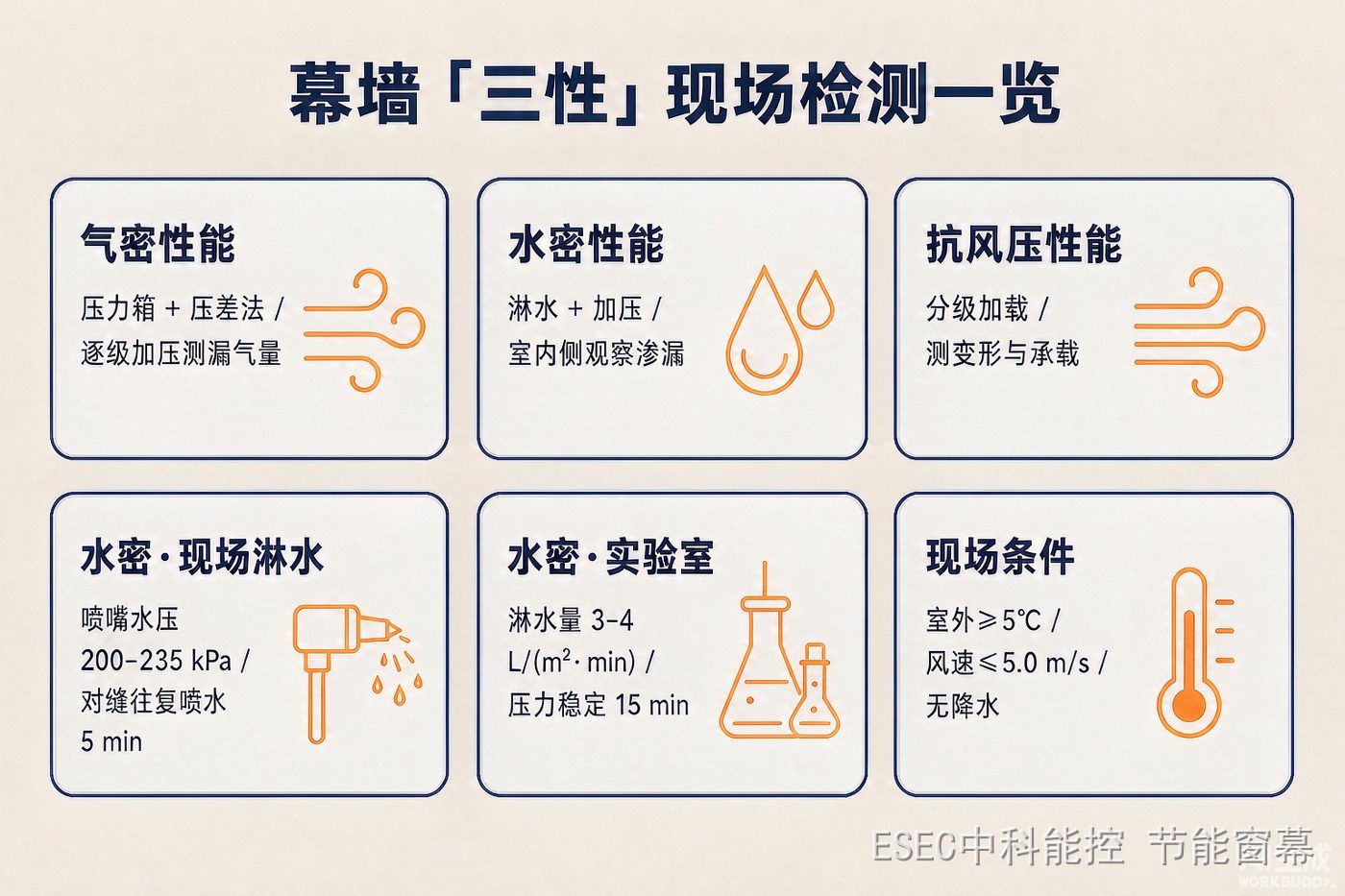
On the installed facade, the field water-spray test applies: a B-25 nozzle at 200–235 kPa, held about 0.7 m from the facade, spraying back and forth over a 1.5 m section of joint for 5 minutes while someone inside watches for leaks; joints are tested bottom-up — horizontal lower joints first, then intersections, then verticals. Leaks are marked, repaired, and re-tested after drying until tight. Sealant generally needs at least 7 days to cure before spraying, which is why the spray test lands at the end of acceptance.
Why joints are hard to keep
Both regimes converge on the same insight: a curtain wall’s performance boundary lives in its joints — glass-to-frame, frame-to-frame, around openable vents, and against the structure. Sealing relies on gaskets, sealant and pressure-equalized cavities, all aging materials: hardened gaskets, cracked sealant and blocked drainage can let a facade that once passed acceptance start leaking again years later.
Testing the joints vs. improving the glass
An honest boundary: sealing problems found by testing must be fixed by re-gasketing or re-sealing — interior-side retrofitting is no substitute for safety or water-tightness remediation. But once the seals are sound, many owners want something else: a warmer window edge in winter, a cooler west facade in summer, on glass that is nowhere near replacement. That is where interior-side solutions fit: ZKNK’s insulating translucent shading screen adds a liftable functional fabric layer inside the glass — no curtain wall changes, no touching the freshly accepted joints, daytime translucency with heat rejection, nighttime added insulation. Installation happens indoors and does not trigger renewed air or water tightness acceptance.
In short: the “three performances” exam tests the joints; energy retrofit works on the heat. They follow different standards and solve different problems — keeping that boundary clear keeps retrofit projects out of trouble.
ZKNK (Beijing) Technology Co., Ltd. specializes in insulating translucent shading screens for buildings, offering interior-side energy retrofit solutions for existing glass curtain walls and floor-to-ceiling windows — no glass replacement, no facade alteration, cutting summer heat gain while improving winter insulation.