

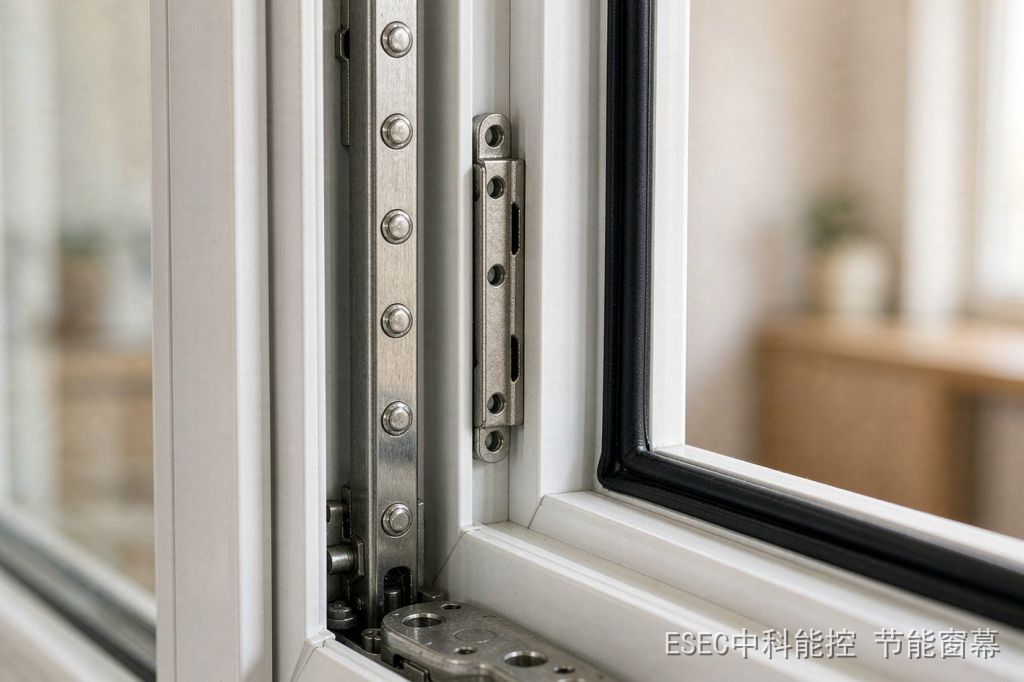
When a window lets in cold drafts, most people first blame the glass or the wall joint. But on a casement window, there is a spot that gets overlooked most often: after the sash is closed, what presses the gasket tight? The answer is the hardware — the handle, the transmission gearing, and the locking points and keeps. Hidden along the sash edge, this unobtrusive mechanism decides how much compression that ring of gasket between sash and frame actually gets.
1. Three Leak Paths, and Hardware Governs the Only “Moving” One
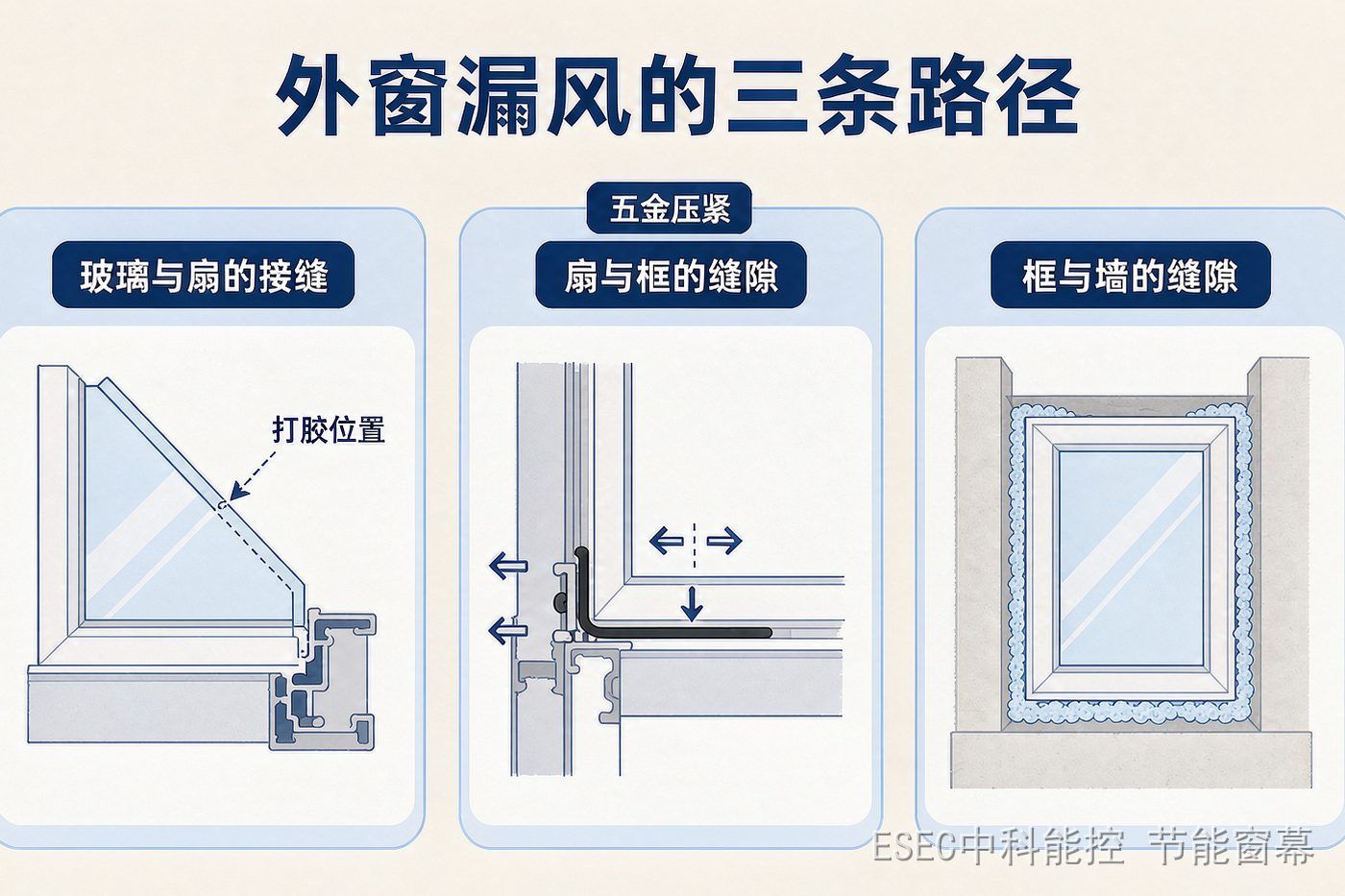
Air entering an exterior window has three possible routes: the joint between glass and sash (fixed at the factory with gaskets and sealant, never touched again), the joint between frame and wall (foam-filled and sealed at installation, also static), and the gap between sash and frame — the only one that keeps changing with use. It opens and re-compresses every time the window is operated; the seal relies on gasket compression, and the compressing force comes from the hardware.
Third-party testing bodies list hardware as a separate factor among the six influences on window airtightness, noting that “the design and installation of the locking device determine the sealing pressure between the openable sash and the frame.” The gasket only waits passively; whether it gets pressed tight is decided by the hardware.
2. Behind One Handle Sits a Transmission System
Turning the handle does far more than “lock” the window: the handle drives the transmission gearing (gear-driven or linkage-driven), which moves several locking points along the sash edge simultaneously to engage the keeps on the frame, drawing the whole sash against the frame and compressing the gasket evenly — only then is the window truly “sealed”.
The mechanism has its own standards. China’s national general requirements for building window and door hardware, GB/T 32223-2025, took effect on November 1, 2025, replacing the 2015 edition; specific products follow JG/T 125 (hinges), JG/T 126 (transmission gearing), JG/T 127 (friction stays), JG/T 215 (multi-point locks) and others. JG/T 126 defines the transmission gearing in one sentence: a device driven by the handle that, through linkage transmission, engages locking points with keeps to achieve multi-point locking.
Why “multi-point” matters: a single lock only presses the zone near the handle; far from it, the gasket is under-compressed and that is exactly where air leaks show up in testing. Multi-point locking distributes the pressing force around the whole sash — the basis of airtightness for large sashes. The durability requirement for multi-point locks (at least 25,000 cycles for windows) tests precisely whether the transmission can still deliver force evenly to every locking point after tens of thousands of press-release cycles.
3. Why “Tight-Looking” Old Windows Still Leak — Three Usual Suspects
First, pinch the gasket. EPDM gaskets resist UV and aging, but years of compression leave permanent set — the gasket looks intact, yet it has hardened and flattened and no longer rebounds enough to fill the gap.
Second, check the locking engagement. Worn or offset locking points enlarge the engagement gap and reduce compression. A typical symptom: you must press the sash toward the frame to lock it — your hand is compensating for the travel the hardware no longer delivers.
Third, look for sash sag. Worn hinges or friction stays let the sash drop, so the sash is no longer parallel to the frame — most visibly at the top corner. That is why the same window often leaks at the top but not the bottom.
None of these fixes is a major project: replace the gasket, adjust the locking points, re-square the sash. Fix the “seam” first — the order should never be reversed.
4. Airtightness Is Graded — and the Grade Reflects the Current State
GB/T 7106-2019 grades window airtightness from level 1 to 8: at a 10 Pa pressure difference, air permeation per joint length (q1) steps from 4.0 m³/(m·h) at level 1 down to no more than 0.5 m³/(m·h) at level 8; per area (q2) from 12 m³/(m²·h) down to no more than 1.5 m³/(m²·h); the lower of the two determines the grade.
The mandatory code GB 55015-2021 requires q1 ≤ 1.5 and q2 ≤ 4.5 for residential curtain walls, windows and balcony doors (roughly level 6); for public buildings under GB 50189, windows must reach at least level 7 above the 10th floor and level 6 below.
But these grades certify the state at the time of testing. One notch of gasket aging, half a turn of locking-point looseness, or two millimeters of sash sag can pull a factory-rated level-7 window below level 5 today. Airtightness is not a lifetime honor printed on a label — it is a status maintained daily by hardware and gaskets.
5. The Other Half of a Curtain Wall: Hardware Covers the Vents, Fixed Glass Needs Another Answer
Zoom out from the sash to the curtain wall, and the picture changes. Openable vents occupy only a small share of a facade; most of the area is fixed glazing. A leaking vent can be diagnosed and fixed along the lines of Section 3. But fixed glass has neither hardware nor gaskets — its weakness is never the “seam” but the “heat”: a low inner-surface temperature and cold radiation in winter, and solar heat pouring in during summer.
Retrofitting that area means touching the glass — costly, slow, and approval-heavy. There is another path that touches neither glass nor facade: interior-side insulating transparent shading screens. The air buffer between screen and glass adds a layer of thermal resistance to the fixed glazing; the fabric handles shading and noise; the raise-lower design yields fully to open windows during ventilation hours.
The boundaries are honest: screens do not repair hardware or replace gaskets — leaky seams should be fixed first, following Section 3. What screens take over is the thermal account of that large expanse of fixed glass. Moving seams belong to the hardware; the heat ledger belongs to the screen.
Related reading:
- “The heating is on full, yet the window seat is still cold”: tracing invisible curtain-wall leaks
- Curtain-wall airtightness and watertightness testing explained
- The stack effect: where the cold draft in high-rise lobbies comes from
本文由Zhongke Energy Consumption Control (Beijing) Technology Co., Ltd.整理发布。Zhongke Energy Consumption Control (ESEC)专注于隔热透景遮阳Window Curtain的研发与应用,为既有玻璃幕墙与外窗提供不动玻璃、不改立面的室内侧节能遮阳Solution。产品Shading Coefficient指标经第三方检测(遮阳率88%、95%+、99%三档),面料燃烧性能达B1级。Learn More:www.zknkkj.com。