

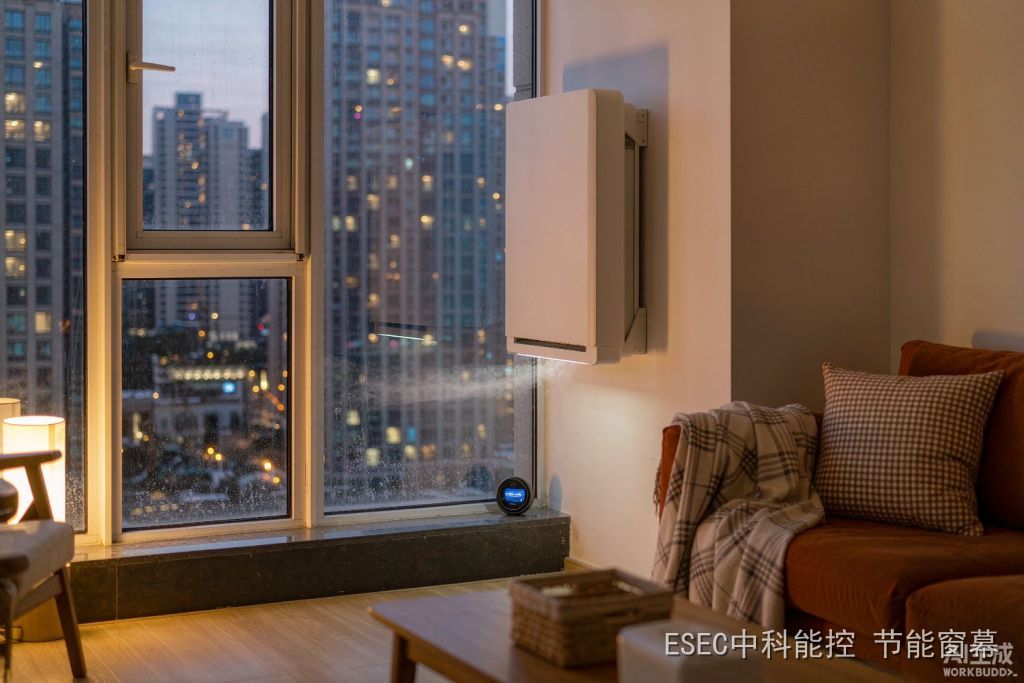
For a few years now, “seal it tight, keep it airtight” has been the consensus: window hardware pressed firm, curtain-wall airtightness grades raised, even trickle ventilation criticized. A new question follows — with a fresh-air system at home or in the office, can the window retire for good? To answer it, you need one term first: the minimum outdoor air rate. The word “minimum” is not decoration; it is the answer.
1. The “Minimum” Outdoor Air Rate Is a Floor, Not a Passing Line
GB 50736-2012, China’s design code for heating, ventilation and air conditioning, sets the minimum design outdoor air rate very concretely in clause 3.0.6: for main rooms in public buildings it is counted per person — 30 m³/h per person in offices, 30 in hotel guest rooms, 10 in lobbies; for residential buildings with fresh-air systems it is counted in air changes per hour, from 0.70 down to 0.45 as per-capita floor area grows. The industry standard JGJ/T 440-2018 requires the residential design rate to be the larger of the value from the air-change method and the value from counting people in bedrooms and living rooms.
The key is what these numbers are for: they are the floor for basic air quality, covering steady, everyday pollution — breathing, slow off-gassing. The indoor CO2 limit behind them (a 1-hour mean of 0.10%, about 1,000 ppm) is drawn for normal conditions, not for the night the whole family visits.
Now look at open windows. A nationwide survey of indoor environments found that about 70% of residential rooms rely on natural ventilation at only 0.2 to 0.5 air changes per hour, mostly around 0.33, with fewer than one in ten reaching 1.0. In other words, for most homes the cracks and gaps cannot even reach the code’s residential floor — which is exactly why fresh-air systems have spread so fast.
2. Where Fresh-Air Systems Shine: Steady, Controllable, and Heat-Recovering
Open-window ventilation depends on wind and stack pressure; a fresh-air system turns ventilation into a settable, meterable routine — low gear by day, higher when guests come. Most units filter the incoming air, ending the choice between “open and let in smog” and “closed and stuffy”.
The most valuable part is heat recovery. GB/T 21087-2020 draws hard lines for heat-recovery units: total-energy (enthalpy) type must achieve at least 55% cooling-side and 60% heating-side enthalpy effectiveness; sensible-heat type at least 65% and 70%. The near-zero-energy building standard GB/T 51350-2019 goes further, requiring 75% sensible and 70% total effectiveness. You cannot skip the air exchange, but you can recover most of its thermal loss — the essential difference between a fresh-air unit and simply opening the window.
Maintenance, however, is explicit in the standard: pre-filters cleaned or replaced every 3 to 6 months, higher-grade filters annually, heat-exchange cores cleaned every 2 years, and an annual check of indoor CO2 and PM2.5. A fresh-air system is not fit-and-forget.
3. Three Jobs a Fresh-Air System Cannot Do
1. Short-Term Peaks: the Machine Is Sized for the Average Person
The design rate assumes typical occupancy. A dozen guests, or one session of high-heat stir-frying, outruns the average-based airflow instantly. For such brief, heavy ventilation, the cheapest tool is still opening the window wide for a few minutes — shock ventilation: ten minutes fully open beats a day on trickle, and machine and window each do their own job.
2. Humidity: It Exchanges Air, it Does Not Dehumidify
A fresh-air system exchanges temperature and part of the moisture; it is not a dehumidifier. In the plum-rain season, outdoor air is near saturation — what comes in is “new humid air”. In the northern heating season, all-day operation can dry the room further. Humidity management depends on dew point, glass surface temperature and timing — the system only steadies the air exchange.
3. The Maintenance Gap: Clogged Filters Quietly Cut the Airflow
Rated airflow is a lab number; real airflow sits behind filters, ducts and grilles. Dust-loaded filters and fouled cores cut the delivery silently — most home units have no pressure alarm. During maintenance, power cuts, or while a replacement filter is in the mail, the window is the only backup. A window that “never opens” bets all ventilation on one machine that needs care.
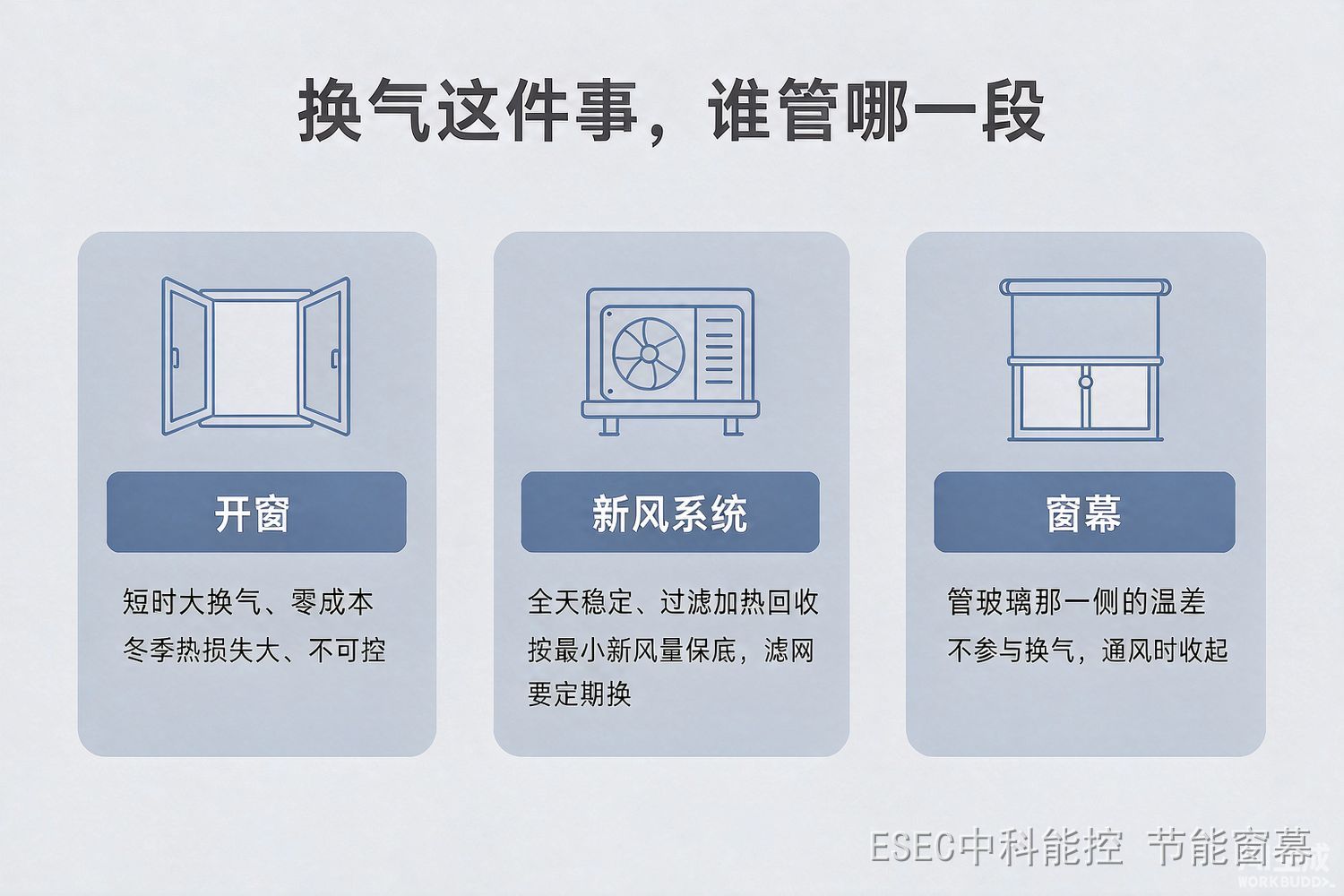
4. The Full Ledger: Air, Heat and Glass, Each in Its Place
A building’s winter heat ledger has three pages. Page one is ventilation — fresh-air heat recovery and shock ventilation both shrink it. Page two is envelope heat loss — heat escapes through walls and glass even with no ventilation at all. Page three is solar gain — glass lets solar heat flood in during summer, while winter wants it.
A fresh-air system only manages page one. On page two, walls have insulation, but glass remains the weak face — especially in existing curtain walls, where replacing glass is costly and slow. Interior-side insulating transparent shading screens, installed without touching the glass or the facade, create an air buffer that adds thermal resistance to the glass line on page two, while the fabric also cuts solar gain on page three. The raise-lower design keeps it from fighting the ventilation system: raised during ventilation, lowered when windows close — meshing with the day-up, night-down ventilation schedule. Clearances around supply and exhaust openings are reserved at installation, leaving the airflow untouched.
The boundaries stay honest: the screen does not ventilate, cannot replace the fresh-air system, and does not dehumidify. Filters still need changing; peaks still need an open window. What the screen takes over is only the “glass-side temperature difference” — the machine covers the baseline, the window covers the peaks, and the glass-side heat ledger gets its own page.
So, can windows retire once a fresh-air system is installed? No — they just change jobs. Routine ventilation goes to the machine, peaks and backup stay with the window, and the heat account on the glass side deserves a ledger page of its own.
Related reading:
- Winter ventilation: ten minutes fully open beats a day on trickle
- Closed is not the same as pressed tight: how window hardware creates airtightness
- Tracing invisible curtain-wall leaks
- Curtain-wall airtightness and watertightness testing explained
本文由Zhongke Energy Consumption Control (Beijing) Technology Co., Ltd.整理发布。Zhongke Energy Consumption Control (ESEC)专注于隔热透景遮阳Window Curtain的研发与应用,为既有玻璃幕墙与外窗提供不动玻璃、不改立面的室内侧节能遮阳Solution。产品Shading Coefficient指标经第三方检测(遮阳率88%、95%+、99%三档),面料燃烧性能达B1级。Learn More:www.zknkkj.com。