

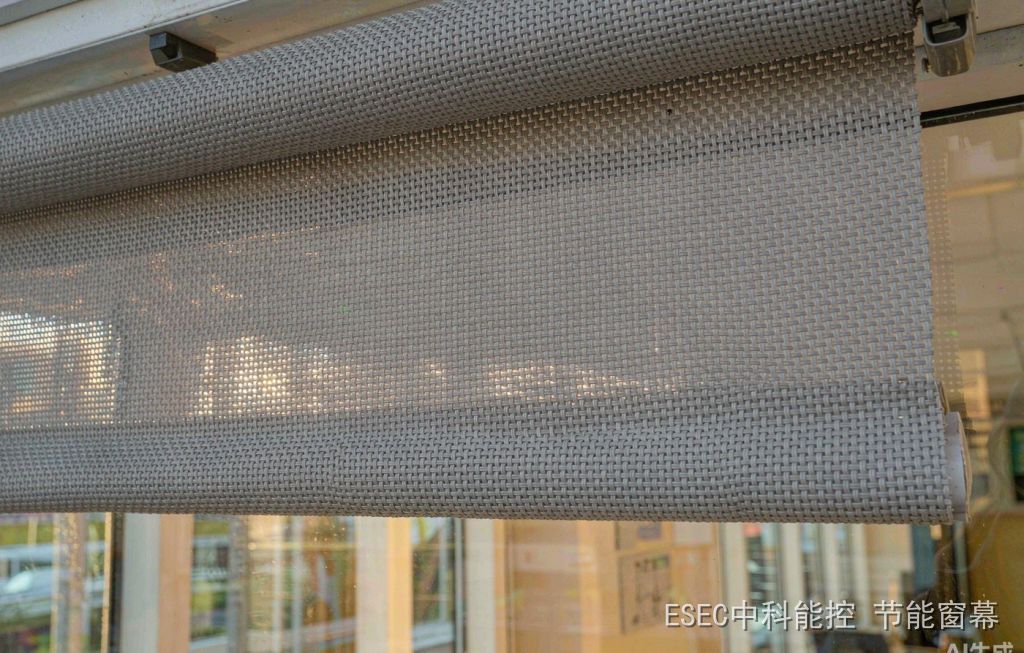
Two windows on the same floor, facing the same direction: one fitted with dark grey shade fabric, the other with light beige. Looking out from inside, the buildings and trees behind the dark fabric have clear outlines, while through the light fabric everything looks veiled in a thin haze. When direct sunlight hits the light fabric, it glows on its own and can even become a glare source indoors. Many people blame this on “product quality” — it is not. It is the fabric booking solar radiation into different ledger accounts.
1. The Three-Way Ledger: Transmittance, Reflection, Absorption
Solar radiation comes in three bands: ultraviolet, visible and near-infrared. Glass insulation is mainly about blocking the near-infrared share — we broke this down in our piece on the three-band solar spectrum (see also how Low-E coatings reflect infrared). When radiation lands on a woven fabric, it has only three destinations: transmit, reflect, or be absorbed. The three always sum to 100% — every difference between fabrics is, in essence, a different split of these three accounts.
More Than One Beam Gets Through: Direct and Diffuse
Shade fabric is woven from warp and weft yarns with gaps between them. Light therefore passes through in two ways: directly through the openings, carrying the outlines of the view outside — this is what makes the view possible; and diffusely, through or between the fibres, scattered into a uniform bright haze. Researchers book these two separately: direct transmittance corresponds to “seeing clearly”, diffuse transmittance to “seeing brightness”. How clear the view looks depends mainly on the direct share.
Reflection and Absorption: The Two Outlets for Heat
Reflected radiation bounces straight back and never enters the fabric. Absorbed radiation heats the fabric itself, which then releases the heat by convection and long-wave radiation — toward whichever side of the glass it hangs on (see Section 4). So the thermal potential of a fabric is judged by its reflectance: the more it reflects, the less is left to absorb and transmit.
2. How the Standard Keeps the Books: The Test Items of JG/T 424
The product standard JG/T 424-2013, General Technical Requirements for Fabrics for Building Shading, breaks the ledger into fixed items. Its type-inspection table lists, for optical and thermal performance: solar direct transmittance, solar direct reflectance, visible light transmittance, UV transmittance, transparency and glare control, tested per JG/T 356; combustion performance and light colour fastness are also on the checklist. Measurements use a spectrophotometer with an integrating sphere covering UV to near-infrared; dark and light specimens are recorded separately, and where necessary the two faces of the fabric are measured separately — the same fabric behaves differently depending on which face meets the sun.
These items are not isolated: visible transmittance sets indoor brightness and view clarity; solar direct transmittance and reflectance set the thermal potential; UV transmittance corresponds to sun protection. And the commonly compared “shading coefficient” is a combined figure calculated for the fabric-plus-glass assembly — see our pieces on SC vs SHGC and the basics of SC and U-value.
So when you receive a fabric test report, first check which items it books: a vague single “shading rate” without band-by-band transmittance and reflectance data is an incomplete ledger.
3. Openness Factor: Governs the “Direct” Account
Openness factor is the share of a fabric’s area taken by the gaps in the weave, and it mainly tunes the direct-transmission account. Common practice uses three bands:
- 1%–3%: strongest blocking of direct light, best insulation and glare control, darkest view — typical for west-facing exposure and clear glass curtain walls;
- around 5%: the compromise, most widely used in projects;
- around 10%: clearest view, weaker heat and glare control — typical for north-facing or tinted-glass facades.
Note that openness factor has comparatively little effect on diffuse transmission — which is why high-openness fabrics look bright, and let more heat in with the light.
4. Colour: Governs “Diffuse, Reflection, Absorption”
Openness sets the gaps; colour sets how the yarns themselves treat radiation:
- Dark fabrics: a higher direct-transmission share, hence a clearer view; more absorption — on the exterior side the absorbed heat dissipates outdoors, which is why dark fabrics are common for external shading. On the interior side, however, that absorbed heat stays indoors.
- Light fabrics: higher diffuse and reflective shares, a hazier view; under direct sun the fabric glows and can become an indoor glare source. The benefit is more reflected heat — on the interior side, more radiation is bounced back before it enters the room.
- Duplex designs: a light, highly reflective face toward the heat source and a dark face toward the room combine both roles in one fabric.
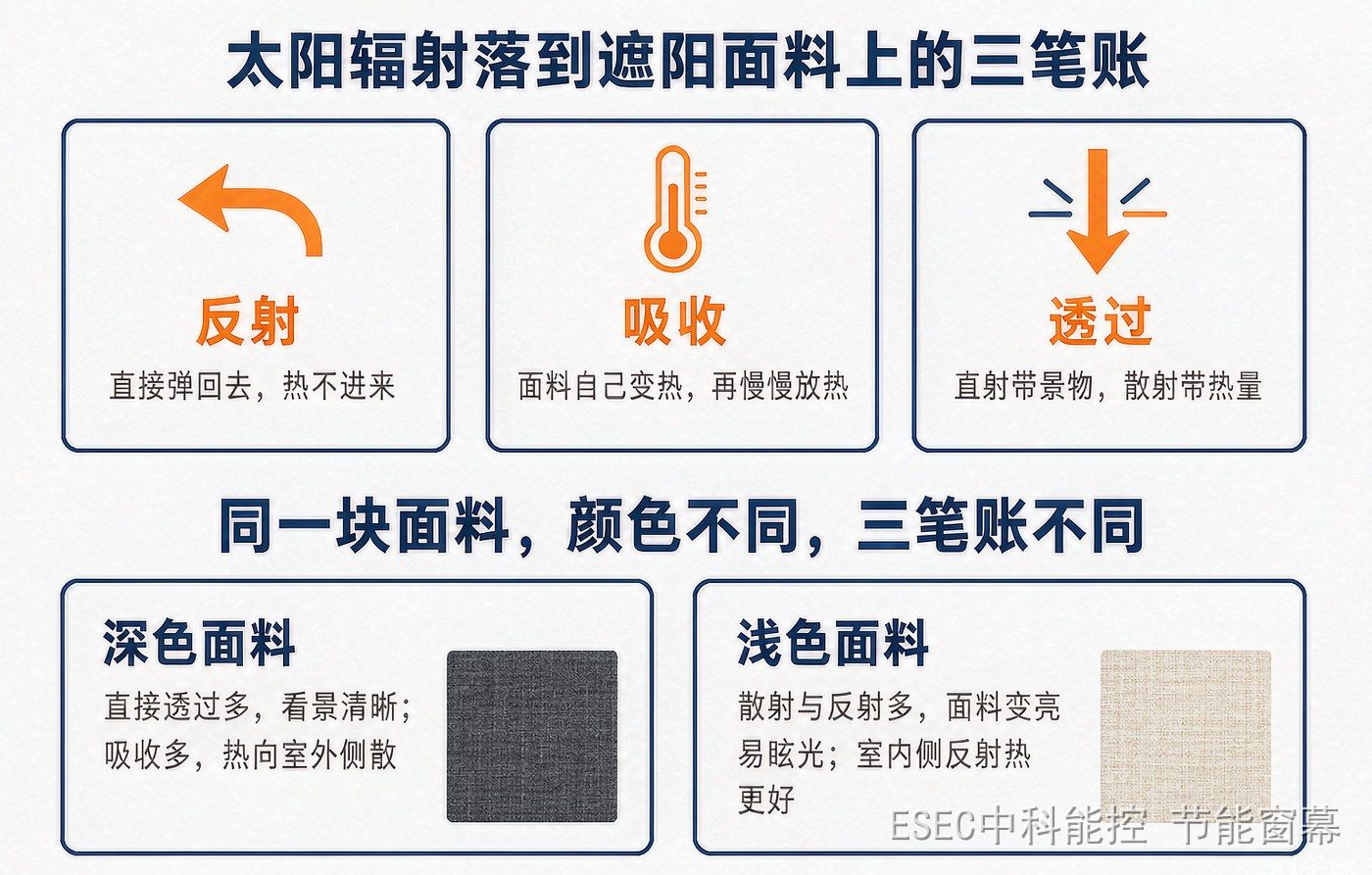
The three destinations of solar radiation on a shade fabric, and how dark and light fabrics split them differently (diagram)
One physical boundary must be made explicit: the share of radiation absorbed by an interior-side shade fabric stays indoors no matter what — that is the ceiling of interior-side shading performance, regardless of fabric thickness. The competitive edge of an interior solution therefore lies not in “absorbing less” but in “reflecting more”: a highly reflective fabric bounces most radiation back before it enters the room, and the smaller absorbed share dissipates slowly through the glass. Once this is clear, it is easy to see why thermal performance varies widely between interior shading fabrics.
5. Clear View by Day, Seen Through at Night: The Directionality of View
A fabric’s view-through has no direction switch; the direction comes from the luminance difference between the two sides. By day the outdoor side is brighter, so the eye picks up the bright outdoor scene — you can see out clearly. At night with indoor lights on, the bright side becomes the room, and people outside see in more easily. View and privacy are two faces of the same account — fabric alone cannot solve it; only a two-state, retractable design can: raised when you want view and daylight, lowered when you want screening.
6. Three Questions Before Choosing a Fabric
- Which side, which orientation? Exterior favours absorption without reflectivity (dark fabrics cause no light pollution); interior favours reflection. Tighten the openness factor on exposed west facades; relax it on the north side.
- View or coolness? Openness factor sets the direct share — define how the window is used before picking a band.
- Is the report complete? Band-by-band transmittance and reflectance, visible transmittance, and a shading coefficient calculated for the glass assembly — if any is missing, ask.
Checked against these items, the published figures for the ESEC insulating transparent shading screen by Zhongke Nengkong read as a complete ledger: the high-reflectance film reflects about 88% of total solar radiation, with 96.5% near-infrared reflectance and over 99% UV blocking; visible transmittance of 28% (GB/T 2680, report No. WT2025E09B00609) keeps the view; the shading coefficient SC is only 0.14 (per JGJ/T 151-2008), colour rendering exceeds 92%, and the fabric meets class B1 fire performance. Reflection takes the largest share, visible transmission is preserved, UV is nearly zeroed — a full booking of the three accounts. The limits are equally clear: the screen does not replace the structural and facade functions of external shading, and it cannot repeal the physical ceiling of interior shading — what it does is push the reflection account as high as possible, leaving the rest to the glass and ventilation.
FAQ
Dark or light shade fabric — which is better?
It depends on which side it hangs: outdoors, dark fabrics win — absorbed heat dissipates outside, no light pollution, and a clearer view; indoors, light or highly reflective fabrics insulate better by bouncing radiation back. A duplex fabric (reflective face to the glass, dark face to the room) offers both.
How to choose between 3% and 10% openness?
By orientation and use: 1%–3% for exposed west facades and clear glass; around 10% for north-facing or tinted glass where view matters most; around 5% as the general compromise. Higher openness means a brighter view but weaker insulation and glare control.
What visible transmittance is appropriate?
There is no single answer — it depends on the space. A workstation needs a glare-free screen and a clear view, so one usually trades some daylight for insulation and keeps visible transmittance low as long as lighting suffices. The key when buying is whether the vendor can provide band-by-band test data and a report number, not a vague “shading rate”.
About Zhongke Nengkong: Zhongke Nengkong (Beijing) Technology Co., Ltd. develops heat-insulating transparent shading screens for building glazing: reflecting solar heat in summer with 88% heat insulation, 95%+ infrared and 99% UV blocking; adding a thermal resistance layer indoors in winter to reduce heat loss. The fabric achieves class B1 fire performance, retracting by day and lowering at night, suitable for interior-side energy retrofitting of residential and public buildings.