

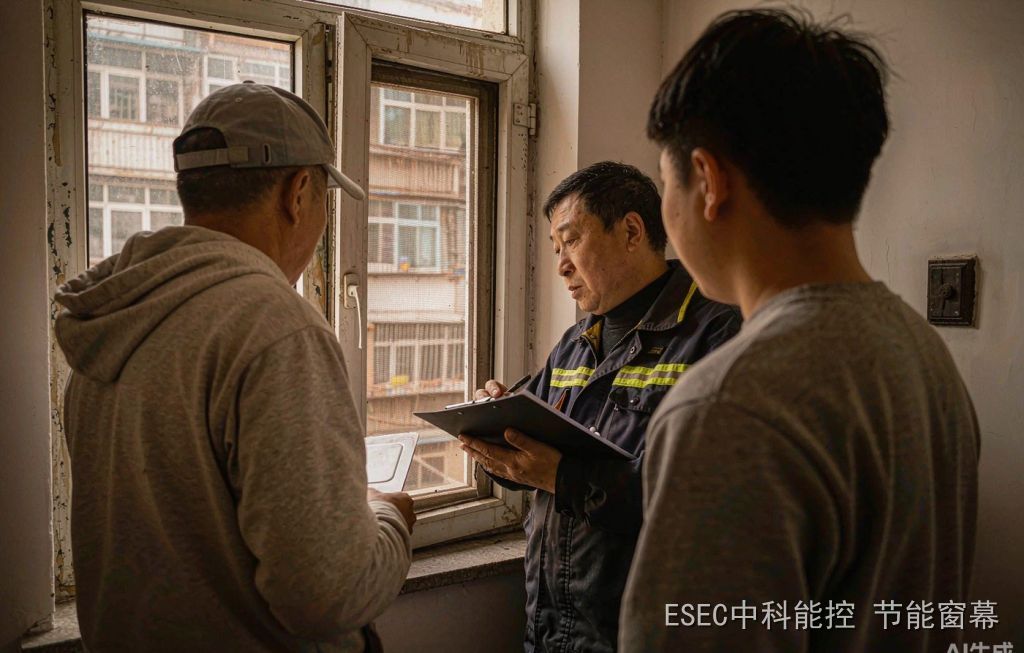
At 10:00 a.m. on October 10, the “2026 Jilin Province Energy-Efficient Window Replacement Consumer Subsidy Program for Old Residential Buildings” officially opened for applications. This is neither a plan nor a standard — it is money that goes directly to residents: 50% of the cost of window replacement, capped at 6,000 RMB per household. What deserves even more attention is how eligibility is determined: a joint on-site inspection by the heating authority produces an official document titled the “External Window Thermal Defect Assessment Form.” For the first time, how well a window insulates becomes a conclusion written on an official template.
1. The Assessment Form: An Official Definition of “External Window Thermal Defect”
The scope in the announcement is specific: existing residential buildings within the district-heating coverage of Tonghua’s main urban area, whose winter heating performance is affected by thermal defects of external windows. Three conditions are all mandatory: within district-heating coverage, where heat bills and heat losses are directly linked; existing residential buildings — targeting the existing stock, not new construction; and the object of assessment is the thermal defect of the external window — not the whole envelope, just the window.
The application materials are equally detailed about windows: three sets of watermarked site photos are required — a panoramic photo of the building and unit number (with the residential compound sign), full shots of all existing old external windows in the home, and close-ups of the defects. Applicants must also submit a 2025 or 2026 heating payment receipt. Putting the heat bill and the window photos in the same checklist makes the logic plain: tracing a room that fails to reach temperature leads to the window.
2. How the Subsidy Works: Half the Cost, 6,000 RMB Cap, First Come First Served
- Rate: 50% of the pre-tax total cost paid for the renovation. The total covers removal, main materials, hoisting, installation, auxiliary materials and non-decorative restoration; transport of finished products is excluded.
- Cap: up to 6,000 RMB per household, once per person/household.
- Funding rules: total-amount control, first come first served, closed when funds run out; the program runs from October 10, 2026 to June 30, 2027.
- Process: apply via the UnionPay QuickPass (Yunshanfu) app; after preliminary and secondary review by municipal heating authorities, a subsidy voucher is issued; sign with a shortlisted contractor, pay via the program-specific POS terminal, and 50% is automatically deducted, capped at 6,000 RMB.
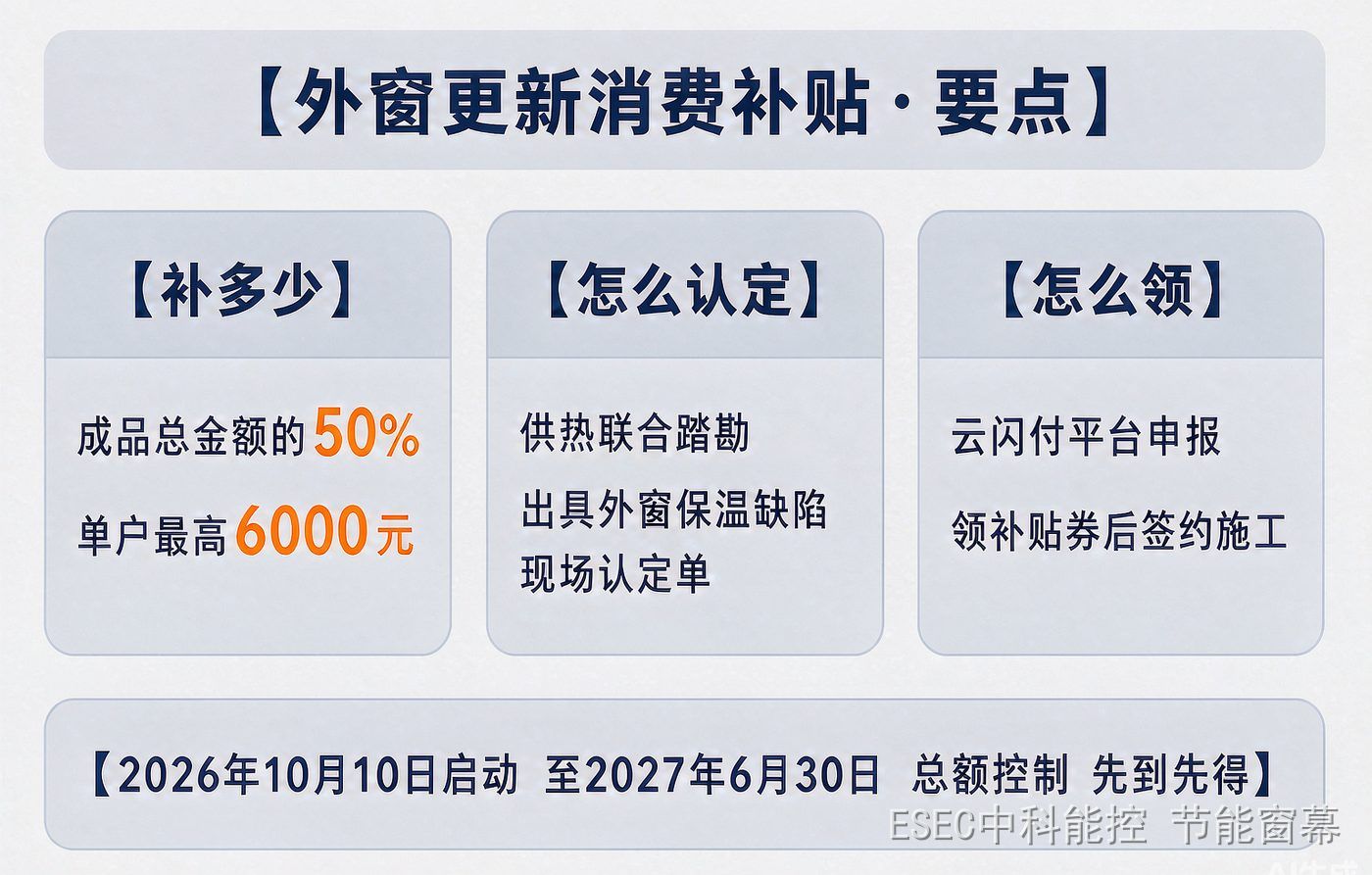
Key points: how much, how assessed, how to claim (source: Tonghua municipal government announcement, October 10, 2026)
Contractor-side rules are also notable: failing to use the standard contract, substituting poor-quality products, fraudulent invoicing, or failing to remove old windows all lead to rectification orders, suspension, or removal from the shortlist. Even “old windows must be taken away” is written into the rules — the subsidy targets the thermal performance of the window itself, not renovation in the name of replacement.
3. Putting the Form Back into the Heating Ledger
This subsidy does not stand alone. In June, the head of Jilin’s housing and urban-rural development department explained the “Action Plan for Sustained Heating Quality and Efficiency Improvement (2026–2028)”: in the 2026–2027 heating season, bedroom and living-room temperatures in district-heated areas of 8 prefecture-level cities including Changchun and Yanji should “basically reach 22°C”; by 2028–2029, all city and county built-up areas should reach that level. The same briefing made two things clear: residents who voluntarily replace energy-efficient windows to fix drafts pay out of their own pocket; but “whether to replace is the user’s decision, and the government will subsidize a certain proportion of energy-efficient window replacement.”
Read together, the policy line is consistent: tracing complaints about low indoor temperature runs from heat sources and networks all the way indoors — users on edges, top floors and ground floors, old compounds, drafty doors and windows are repeatedly named (in the six-ministry “Warm Project” three-year plan, doors and windows are called the “last meter” of heating). And as we wrote before, as heat billing shifts from floor area to metered heat, the window becomes the only item on the bill that residents can change themselves. Jilin now channels subsidies straight into window replacement — turning “windows affect temperature and heat bills” from an argument into funding.
4. For Households Not Replacing Windows
Full window replacement does not fit every household: subsidies are capped and time-limited; complex window types in old buildings, property management coordination and construction schedules are real barriers. Some households simply do not want to touch the window frame yet, and only want to ease the cold band around the window.
For windows with intact glass whose main weakness is thermal performance, installing a retractable interior shading screen is a complementary route that leaves the frame untouched: an air buffer added on the inner side of the glass reflects solar heat in summer and reduces indoor heat loss in winter — raised by day without blocking light, lowered at night as extra thermal resistance. Its limits should be stated honestly: screens do not fix air leakage from aged hardware and seals, which should be repaired first; they do not change the glass itself, and failed insulating-glass units still need panel replacement. What they address is the specific need of “poor glass performance, but a frame still in service.”
5. How to Apply in Four Steps
- Check the scope: confirm the building is within district-heating coverage and is an existing residential building. This article uses the Tonghua announcement as an example; local rules in other cities follow local announcements.
- Request a joint inspection: apply to the heating authority, which organizes the inspection and issues the External Window Thermal Defect Assessment Form with watermarked photos.
- Prepare materials: applicant ID, 2025 or 2026 heating payment receipt, the assessment form, and the authenticity commitment letter.
- Apply online: submit via the “Consumer Subsidy” section of the Yunshanfu app; after review, receive the voucher and sign with a shortlisted contractor.
One reminder: total-amount control and first come first served — applying early in the heating season leaves more room.
FAQ
Which homes are eligible?
Per the announcement: existing residential buildings within district-heating coverage of Tonghua’s main urban area, whose winter heating is affected by external window thermal defects. Implementation details in other cities follow local announcements.
How much is subsidized?
50% of the pre-tax total cost paid for the renovation, capped at 6,000 RMB per household; once per person/household.
How is the “external window thermal defect” assessed?
Through a joint on-site inspection with the heating department, which issues the External Window Thermal Defect Assessment Form plus three sets of watermarked photos: building panorama, full shots of existing old windows, and defect close-ups.
Is there a deadline?
The program runs from October 10, 2026 to June 30, 2027, and ends early if funds are exhausted.
About Zhongke Nengkong: Zhongke Nengkong (Beijing) Technology Co., Ltd. develops heat-insulating transparent shading screens for building glazing: reflecting solar heat in summer with 88% heat insulation, 95%+ infrared and 99% UV blocking; adding a thermal resistance layer indoors in winter to reduce heat loss. The fabric achieves class B1 fire performance, retracting by day and lowering at night, suitable for interior-side energy retrofitting of residential and public buildings.