

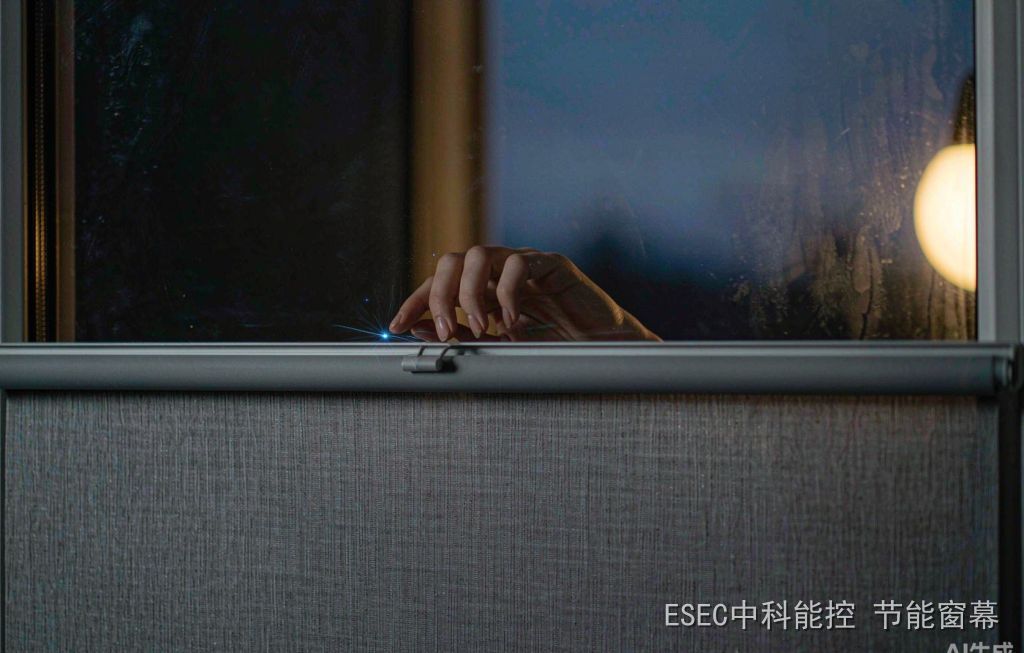
As soon as the heating season starts, offices and homes run into the same thing: reach for the curtain, touch the track, and — snap — a shock. Doorknobs, lift buttons, taking off a coat: all little surprises. Some blame the curtain — “it must be synthetic; a cotton one will fix it.” Two curtains later, the shocks continue. The problem is not the fabric; it is the air. Winter static is not caused by curtains — it is the direct signal of an over-dry heated room: below a certain humidity, charges from friction stay put instead of leaking away, and everything you touch zaps you. This article unpacks the account: how humidity sets the strength of static, how the “constitution” of a fibre matters, and the right order for fixing it.
1. The Heating-Season Humidity Ledger: Static as a Dryness Signal
First, where the dryness comes from. Outdoor winter air simply “holds little water” — the colder the air, the less moisture it can carry: air saturated at 0°C holds about 4 grams of water per cubic metre, while at 20°C it can hold about 17 grams. Take a small stream of outdoor air, heat it to 20°C indoors, and the absolute moisture barely changes while the relative humidity is more than halved. A typical heating-season calculation: outdoor at −5°C and 60% RH, heated to 20°C indoors, lands at well under 20% RH in theory. Meanwhile GB/T 18883-2022, the Chinese indoor air quality standard, sets the comfortable winter range at 30%~60% RH — so an unhumidified heated room in northern China mostly runs below the bottom of that band.
When humidity drops, static arrives. The principle is simple: a slightly damp surface carries a microscopically thin, weakly conductive water film that bleeds friction charges away continuously; when the air dries out, the film vanishes, surfaces become insulators, and charge keeps accumulating until you touch metal and release it all at once. Public-education material from the China Meteorological Administration gives measured figures: walking across a carpet can generate 1,500~35,000 volts, vinyl flooring 250~12,000 volts, and simply rising from a chair more than 1,800 volts — while the threshold for a clearly felt shock is around 7,000 volts. The comparison table (per MIL-HDBK-263B, long used by the ESD industry) makes it vivid:
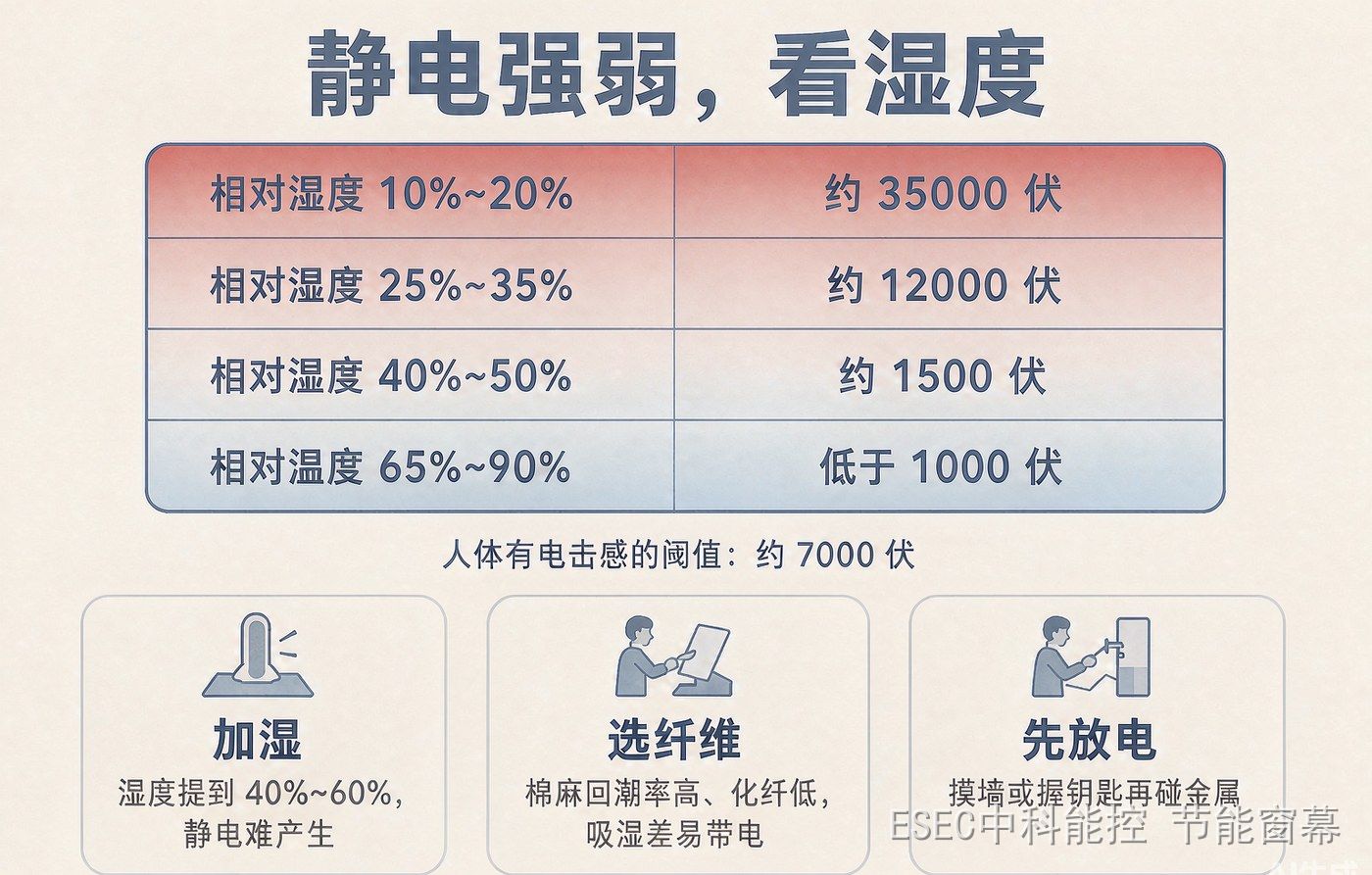
Relative humidity versus voltage carried by the human body, and the three-step order for taming static (diagram)
Same person, same shoes, same carpet: as humidity falls from 65% to 10%, body voltage can rise from under 1,000 volts to 35,000 volts. That is why static arrives “on schedule” every heating season and vanishes in the rainy season — it has nothing to do with the brand of curtain or floor, only with humidity.
2. Fibres Have a Constitution: Moisture Regain Decides Who Charges First
Humidity sets the big direction; the fibre sets the microclimate. The textile industry uses “moisture regain” to describe how much moisture a fibre absorbs: the weight of absorbed water as a percentage of dry weight under standard conditions. The spread is huge: cotton regains about 8.5%, wool 15%~17%, while polyester only about 0.4% — a twenty-fold gap. High-regain fibres keep a conductive water film on the surface, so charges leak as fast as they are generated; near-zero-regain synthetics let charges settle in on the spot. Resistance makes it even clearer: the volume resistivity of cotton is around 10⁹ Ω·cm, while polyester can exceed 10¹⁴ — five orders of magnitude apart.
So in the same dry room, synthetic curtains, carpets and fleece sweaters really do “shock more” than cotton and linen — that is fibre physics, not superstition. But mind the order: humidity is the first variable, fibre the second. A cotton curtain in a 20% RH room only helps a little; return humidity to 50% and most friction charges leak away before they build, and even synthetics stop zapping. For quantitative evaluation there is a ready-made ruler: the GB/T 12703-2021 series, Textiles — Evaluation of electrostatic properties, measuring the half-life of static voltage by the corona charging method, charged voltage by manual friction, and charge surface density — when buying curtains or carpets, ask for test data under these methods rather than a vendor’s promise of “static-free”.
3. Why Anti-Static Advice Always Names Curtains
Among the China Meteorological Administration’s winter anti-static tips, one line names fabrics explicitly: “avoid synthetic carpets, curtains and plastic decorations where possible.” Why do curtains make the list? Three compounding reasons: they are large — one floor-length curtain has far more surface than a sweater; they sit by the window — precisely the driest, most temperature-stressed zone of the room; and their daily use is pure friction — opening, closing and brushing against clothes, the textbook triboelectric scenario. Stack the three and curtains become one of the indoor fabrics most prone to accumulating charge.
But swapping to cotton solves only part of the second variable. The first-order fix remains humidity.
4. The Right Order: Humidify → Choose Fibres → Discharge First
Ranked by effectiveness, static control has three layers:
- Layer one, humidify. Meteorological guidance: below 30% RH friction charging thrives; raise it to around 45% and static struggles to build. The ESD industry works to a wider band of 40%~60% — nearly identical to the GB/T 18883 winter comfort range (30%~60%), one setting for two purposes. But there is a ceiling: hold humidity above 60% for long and the inner face of the glass starts to condense. How much to humidify and how much dew-point margin to leave we calculated in our piece on dew-point self-checks — both constraints must be read together.
- Layer two, choose fibres. For high-contact fabrics (sofas, bedding, frequently used curtains) prefer high-regain materials like cotton, linen and wool, or check GB/T 12703 data; keep synthetics in low-contact positions.
- Layer three, change habits. Touch a wall to discharge before grabbing metal; hold a key and let the spark jump from the key tip, not your fingertip; mopping floors and keeping green plants add a little humidity too.
Each layer covers a slice: humidification treats the cause, fibre choice reduces the dose, discharge habits handle the moment. Changing only the curtain without touching humidity means only layer two got done — which is exactly why so many people still get shocked after swapping fabrics.
5. Dry, Cold, Static: The Winter Window-Edge Trio and Where the Screen Fits
Seen within the full picture of winter window-edge comfort, three things stack up there: cold (a low inner glass surface temperature — we did the numbers in our piece on the cold downdraught), dry (the whole room is dry, and the big temperature swing makes it more noticeable at the window), and static (a high-friction zone for synthetics). The three have different roots: cold is a glass thermal problem, dryness a ventilation-and-humidification problem, static a by-product of dryness — but together they decide whether the window edge is a place worth staying in winter.
What a shading screen can take on here is only the “cold” part: retracted by day so daylight is untouched, lowered at night on the inner side of the glass to add a layer of thermal resistance to the coldest surface, lifting its inner-surface temperature so the window edge stops being a ring of sinking cold air. It does not humidify, does not remove static, and does not replace humidifiers or ventilation plans — humidity remains the job of humidification equipment and ventilation timing (see our piece on winter shock ventilation). Plainly: when static is tamed, humidity is under control; the screen handles the other half of the same window edge — the cold. Do both, and the window edge turns from a winter no-go zone back into a place to sit.
FAQ
Why is static so much worse in winter?
Because indoor air is too dry. Heating air that already holds little moisture drives relative humidity often below 30%, surfaces lose their conductive water film, and friction charges accumulate instead of leaking away — until one touch of metal discharges them. Humidity is the first variable, fabric the second.
Will a cotton curtain solve the static problem?
It reduces but does not remove it. Cotton regains about 8.5% moisture versus polyester’s 0.4%, so a cotton curtain charges less and leaks faster — but if room humidity stays below 20%~30%, shocks still happen. The right order is to raise relative humidity to 40%~60% first, then think about the materials of high-contact fabrics.
What indoor humidity is right — and how do I balance static against condensation?
Aim for 30%~60% RH in winter (GB/T 18883-2022); the ESD industry’s anti-static band is 40%~60%. Do not stay above 60% for long: at higher humidity, glass whose inner surface falls below the dew point will condense, and moisture becomes the window’s new problem. Keep a thermo-hygrometer and leave dew-point margin.
About Zhongke Nengkong: Zhongke Nengkong (Beijing) Technology Co., Ltd. develops heat-insulating transparent shading screens for building glazing: reflecting solar heat in summer with 88% heat insulation, 95%+ infrared and 99% UV blocking; adding a thermal resistance layer indoors in winter to reduce heat loss and lift the inner glass surface temperature. The fabric achieves class B1 fire performance, retracting by day and lowering at night, suitable for interior-side energy retrofitting of residential and public buildings.