

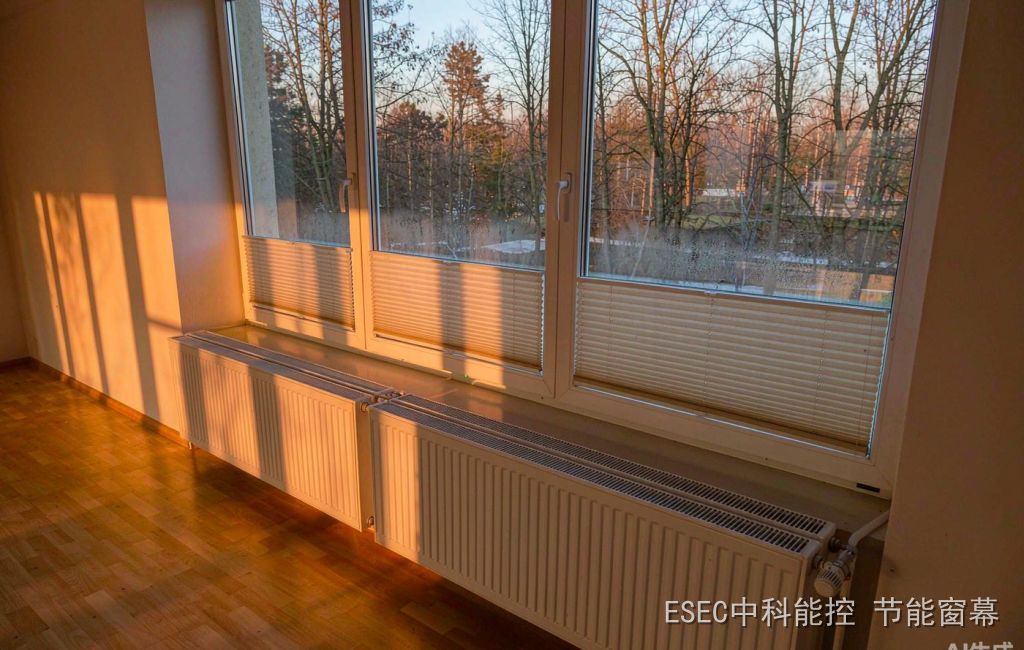
Every heating season brings the same scene: the radiator is hot to the touch, the thermostat reads well above 20°C, yet anyone seated by the window still feels a chill on their back. Some blame leaking windows, others suspect undersized radiators. There is a third reason, hidden in the radiator’s own location — why has it always sat under the window? Chinese HVAC design code states this explicitly, and understanding it explains the “cold air curtain” that circulates by the glass, and why the window seat stays cool even with the heating on.
1. Not a habit but a code requirement: radiators under exterior windows
Placing radiators under windows is written into GB 50736-2012, Design code for heating ventilation and air conditioning of civil buildings. Clause 5.3.7 says radiators shall preferably be installed under exterior windows below the sill, with wall mounting allowed only when piping makes it impractical; radiators must not be placed in entrance vestibules between two exterior doors, and radiators in stairwells should be allocated to the lower levels. The commentary explains why: a radiator under the window sends a rising convective warm airflow that blocks the cold air descending from the glass, so the air passing through occupied zones feels warmer and more comfortable. If the radiator sits on an interior wall instead, colder air flows through the occupied area, comfort drops, and walls collect more dust. In short, under the window is the position assigned to the radiator — an intercept post where rising warm air meets the cold current sliding down the glass.
2. How the “cold air curtain” turns
A heated window keeps “cooling” the room all winter. How cold is the glass inner surface? Estimate it with the formula in clause 3.4.16 of GB 50176-2016: surface temperature = indoor temperature − (inner surface heat transfer resistance ÷ total assembly resistance) × (indoor−outdoor temperature difference), with the inner surface resistance taken as 0.11 m²·K/W. For a typical northern heating day — 20°C indoors, −5°C outdoors, window U-value 2.8 W/(m²·K), total resistance about 0.36 m²·K/W — the glass inner surface lands at roughly 20 − (0.11 ÷ 0.36) × 25 ≈ 12°C. Room air is 20°C; the glass face is 12°C. That 8-degree gap is where every window-seat story begins.
Air touching this cold face cools down, becomes denser, and slides down along the glass; at floor level it spreads into the room, gets reheated as it passes the radiator, rises toward the ceiling, cools again, and returns — a closed vertical convection loop. Because the descending leg always hangs along the glass like a curtain, engineers call it a downdraught or cold air curtain. Anyone seated by the window sits inside this curtain: convective heat loss to moving cold air feels far worse than the same temperature in still air.
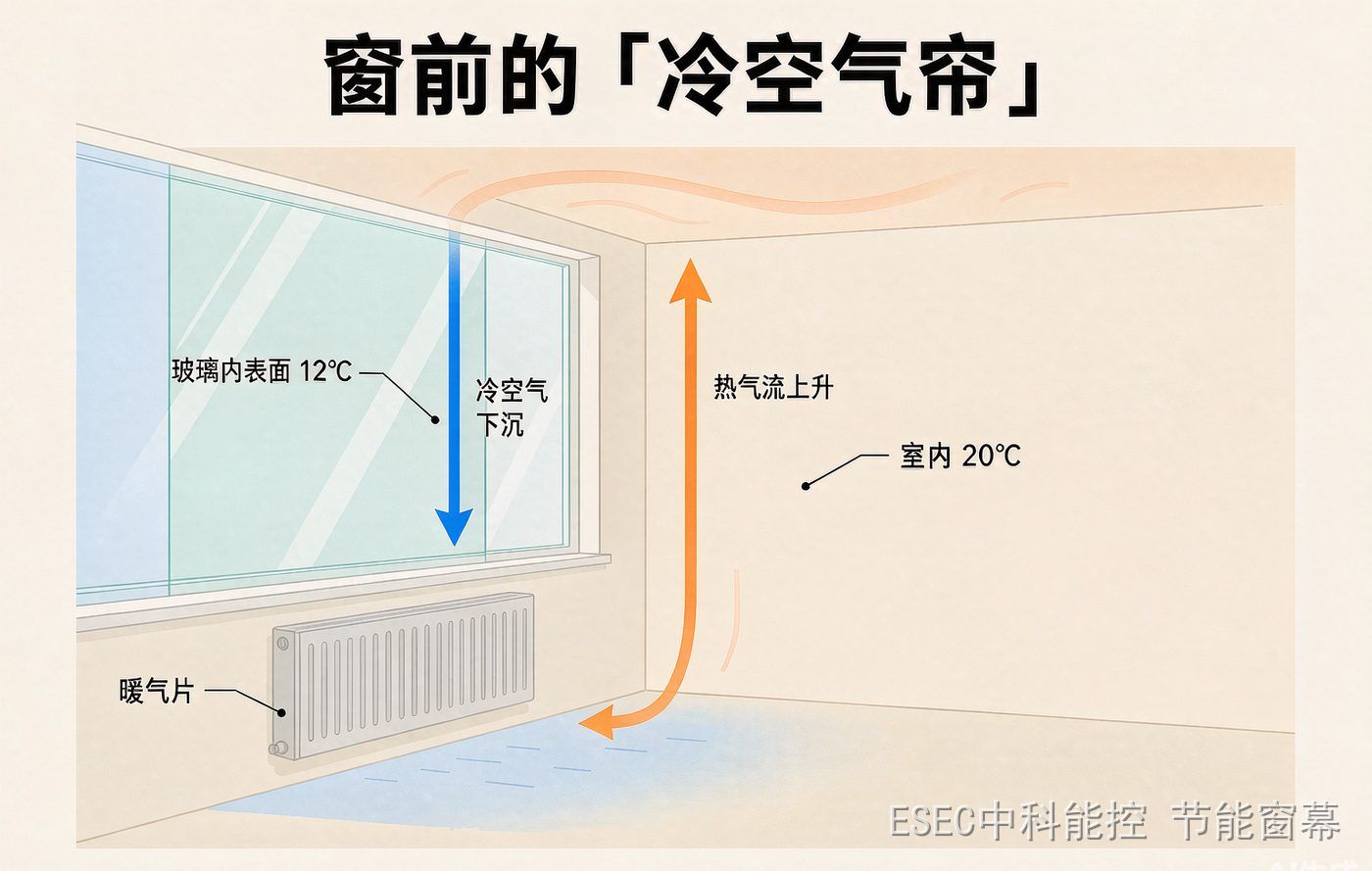
ISO 7730 puts numbers on this discomfort source: radiant asymmetry from a cold vertical surface should stay within 10°C, and the vertical air temperature difference between ankle and head within 3°C. A 12°C glass pane facing an occupant can quietly break both limits even while the room thermostat reports “compliant” — the gap between the thermometer and the body.
3. The radiator blocks the airflow, not the glass’s cold face
Here is the division of labor: the radiator handles airflow, not glass temperature. Its rising warm plume pushes the descending cold current back and mixes it into the room — that is the convective half of the problem. But the glass surface temperature is fixed by the window’s U-value and the indoor–outdoor temperature difference; no amount of radiator output changes how cold the pane itself is. The cold face remains, and nobody is assigned to the radiant half: the body keeps radiating heat toward the cold glass, which is why the window seat feels cool even beside a hot radiator in a compliant room.
The heating season adds a second change: dry air. Air entering at −5°C and 60% relative humidity, heated to 20°C with no moisture added, drops to roughly 12% RH in theory; with indoor moisture sources it typically settles at 20–30%. Lower humidity means less condensation on the glass — many people read “the windows stopped sweating” as an improvement, when in fact the room simply got drier and the glass is exactly as cold as before. Dryness and cold arrive together at the window seat, and comfort only gets worse.
4. Three ways to waste a perfectly good radiator
1. Wrapping it in a decorative cover
Clause 5.3.9 of GB 50736-2012 requires exposed installation; where a cover is unavoidable it must provide a proper airflow path and sufficient open area. The commentary is blunt: enclosed radiators lose a large share of their output, while the air trapped inside the cover becomes far hotter than the room and drives up heat loss through the wall behind it. As a further detail from the commentary, a non-metallic paint on the radiator surface yields about 10% more output than a metallic one.
2. Blocking the plume with cabinets and sofas
The loop runs: sink along the glass, spread over the floor, reheat at the radiator, rise. Put a tall cabinet, a mattress, or a row of storage boxes in front of the under-window radiator and the rising channel is choked; warm air detours sideways, the interception weakens, and the cold downdraught spreads even further into the room. The empty strip below a window sill is not wasted space — it is the loop’s working face.
3. Letting long curtains drape over the radiator
Heavy curtains that hang past the sill and over the radiator trap warm air between fabric and glass: the room gets little heat while the fabric bakes. This is the winter version of the “curtain smothering the window” problem covered before. Draw curtains at night by all means, but keep the hem above the sill and leave the radiator’s path clear.
5. Can the window seat be fixed without touching the radiator or the glass?
Putting the sections together, the chill splits in two halves: the airflow half is the radiator’s job — as long as its path stays open; the cold-surface half has no assigned guardian, because glass temperature follows from the window’s thermal performance. You either replace the glass or add thermal resistance on the room side.
Re-glazing is a heavy intervention for existing buildings, so the second path exists: install a shading screen parallel to the glass on the interior side. When lowered, the screen forms a stationary air buffer between glass and fabric; the 12°C cold face is pushed to the outside of the buffer, the surface facing occupants becomes the warmer inner side of the screen — radiant asymmetry drops — and the sinking cold air is held behind the screen instead of spreading across the floor. ZKNNK’s insulating translucent shading screen, for example, offers third-party tested shading rates of 88%, 95%+, and 99% with B1 flammability-rated fabric; retracted by day it restores view and daylight, lowered after sunset it catches the coldest hours — the “up by day, down by night” rhythm naturally matches the radiator’s schedule.
Honest boundaries: the screen does not move the radiator, does not add output, and does not replace humidification or ventilation. It treats “the cold from the glass side,” not “the heat of the air.” If the real problem is leakage — a felt draft rather than a cold face — fix the seals first, then talk comfort.
6. A four-step window-seat self-check for the heating season
Step 1, touch the glass. Press the back of your hand lightly against the glass (or scan it with an infrared thermometer) and compare with the room thermometer. Within 5°C is normal; a gap above 8°C marks that window as the source of a cold air curtain.
Step 2, read the airflow. Hold a thin strip of paper by the window: if it slides down along the glass toward the floor, the downdraught is strong; if you can feel an actual draft, investigate the seals first.
Step 3, check the radiator. Is its path blocked by a cover, a cabinet, or a curtain? Is the thermostatic valve being fooled by hot air rising from the unit itself?
Step 4, test asymmetry. Sitting at the usual workplace, face one palm toward the window and one toward the room for a few seconds each: if the window-facing side feels clearly cooler, radiant asymmetry is over the comfort limit and the glass needs its buffer.
FAQ
Q1: The radiator is roaring hot and the room temperature is compliant — why is only the window seat cold?
Two overlapping causes: cold-surface radiation (the glass inner surface is cold, and the body radiates toward it) and either a downdraught or seam leakage. Use the four-step check to tell “cold face” from “leak”: paper sliding down the glass means the loop; a felt draft means leaks. Add a buffer for the former, fix the seals for the latter.
Q2: Do rooms with underfloor heating still get a cold air curtain?
Floors in underfloor-heated rooms are warm, so sinking air is reheated the moment it lands and the loop is much weaker — one reason underfloor heating feels so even. But in rooms with full-height glazing, the tall, long glass surface still produces downdraughts in its upper section, and window-side workstations still feel it.
Q3: With the screen lowered, will it block the radiator’s heat?
No. The fabric hangs on the interior side of the glass and stops above the sill, while the radiator sits on the wall below the sill — the rising warm plume’s path lies outside the fabric, and the loop continues. Lowering the screen blocks the cold from the glass direction, not the heat from the radiator direction. Retracted by day, it also lets solar gain straight in — a free heat source alongside the heating system.
Related reading:
- “The radiator roars but the window seat stays cold”: a curtain-wall air-leakage investigation
- Same building, different windows, different winters: why window comfort varies floor by floor
- 26°C or 24°C on the thermostat? The glass beside you decides how it feels
- Winter ventilation: ten minutes wide open beats a cracked window all day
- Drawing the curtains makes the glass sweat more: airflow is the third variable of condensation
本文由Zhongke Energy Consumption Control (Beijing) Technology Co., Ltd.整理发布。Zhongke Energy Consumption Control (ESEC)专注于隔热透景遮阳Window Curtain的研发与应用,为既有玻璃幕墙与外窗提供不动玻璃、不改立面的室内侧节能遮阳Solution。产品遮阳率经第三方检测分88%、95%+、99%三档,面料燃烧性能达B1级。Learn More:www.zknkkj.com。