

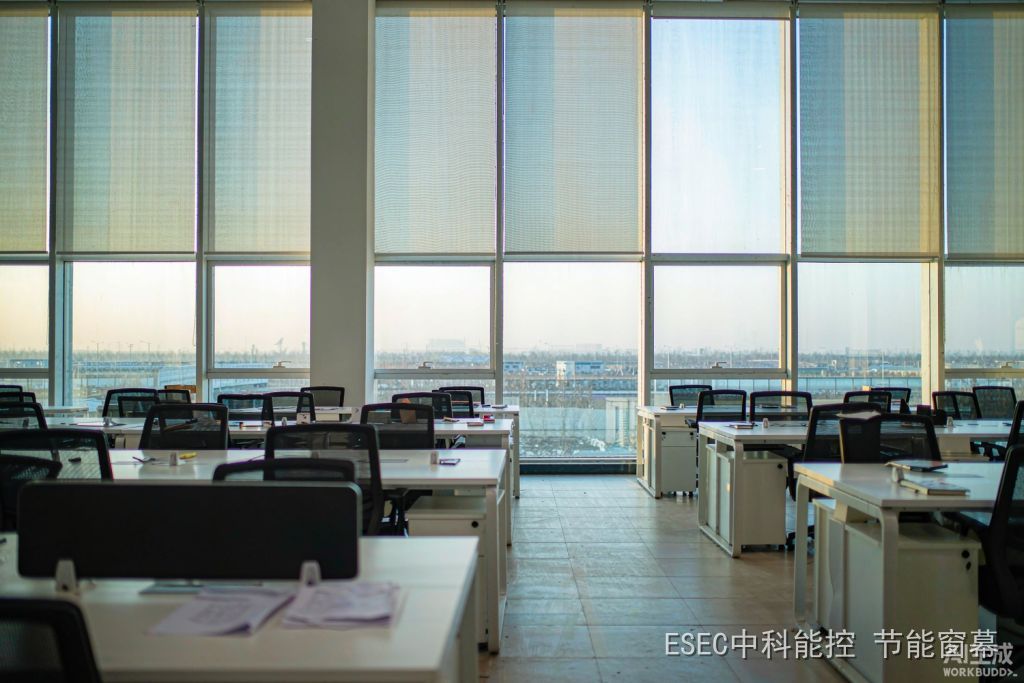
Anyone who has delivered a retrofit knows the scene: the last signature lands on the acceptance form, the scaffolding comes down, the glass looks untouched, and the room goes quiet as if nothing had happened. But the screens are still hanging there — they will not decide for themselves when to come down, and nobody will remember for them.
What follows usually goes one of two ways. Visit six months later and the screen hangs half-way down under a layer of dust, and everyone says “it worked well when it was installed.” Or it goes the way of the project described here: a full winter later, the facility team had turned the screens into lines on a shift roster — who operates them, at what hour, and what to do in which weather.
This review is not about how the installation was built. It is about how an installation survives after handover.
1. The Hard Part Comes After the Acceptance Form
Interior-side additions to glass curtain walls share one trait: their performance depends almost entirely on being operated. Replacing glazing, adding external insulation or upgrading chillers means the measure works continuously once installed. A retractable shading screen or thermal curtain is only half-finished when it is hung — the other half depends on whether somebody lowers and raises it on schedule.
That raises a question almost never discussed at design or tender stage: who owns it?
- The contractor? The contract covers warranty, not operation, and the crew leaves after two years;
- The fit-out or MEP subcontractor? It is neither a finished surface nor mechanical equipment, and it is on no crew’s roster;
- The occupants — tenants, departments, teachers, nurses? “Whoever uses it owns it” sounds fair until a cold snap arrives on a weekend, or a tenancy changes hands mid-season;
- Facility management? In most existing buildings FM is the only party that is present every day and accountable continuously — but only if someone writes the task into their work list. Otherwise it is simply “something the owner bought.”
That is how this project landed. An existing mixed office and amenity building had large west-facing glazing and heavy summer solar gain; the owner completed an interior-side screen installation before the heating season. At the handover meeting the owner did not ask FM to “keep an eye on it” — the owner said the screens were now an item on the equipment register and asked for an operating plan. That plan is the basis of this review, because it got three easily forgotten things right: whose hands, which hours, and what happens when it breaks.
2. The First Working Document Is Not a Manual — It Is a Roster
A product manual explains how to operate; a facility team needs to know who operates, on which day, at which hour. The gap is wide. A manual says “lower the screen when solar radiation is strong in summer”; a roster says “west zone, June to September, lowered before 10:30 and raised after 16:30; may be delayed on overcast days.” The first is a principle; only the second is an action.
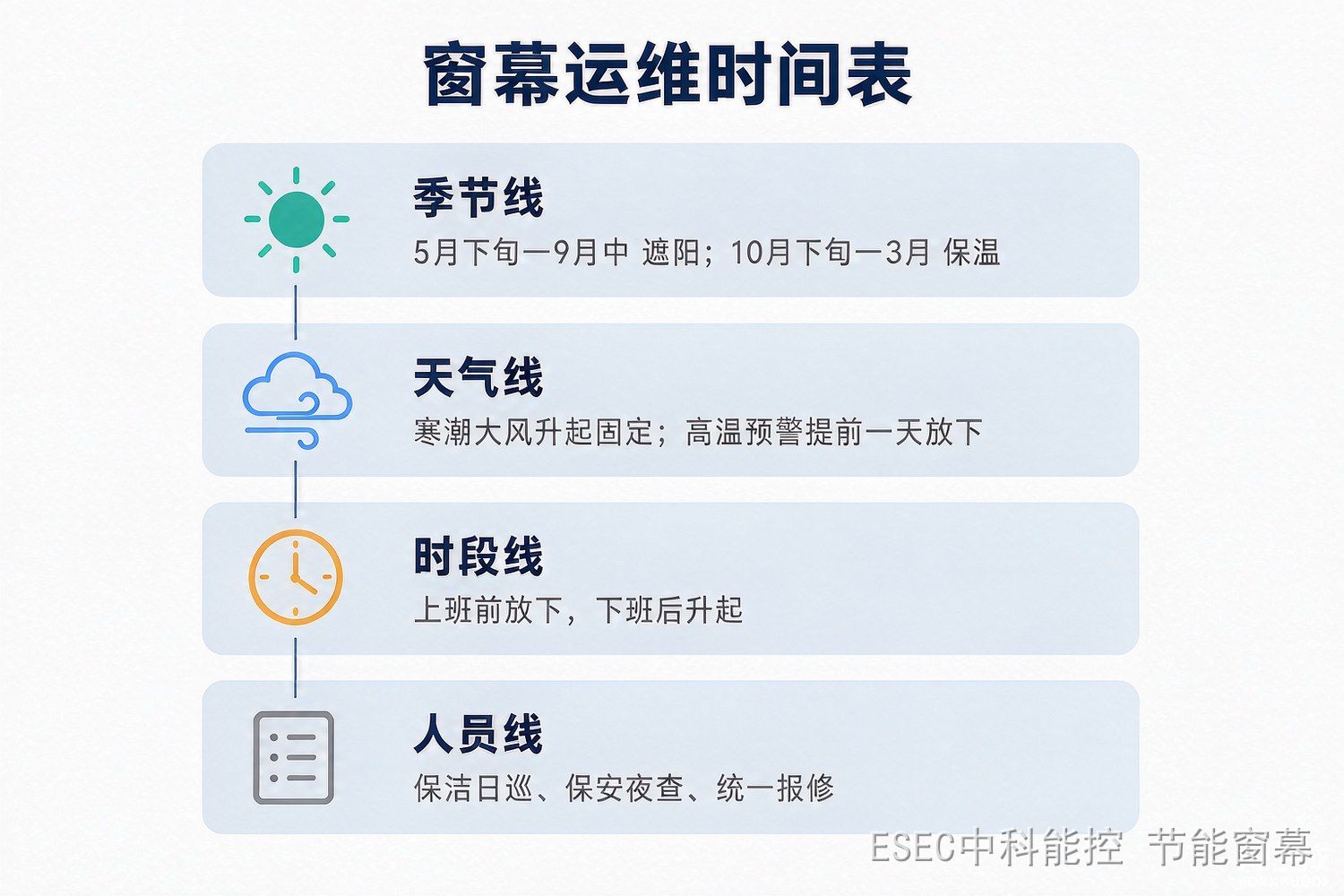
The operating timetable delivered with the equipment translates “how it should be used in principle” into “at what hour, by whom, under which weather conditions” (illustrative infographic).
That timetable had four lines.
Seasonal line: two seasons, with a “watch the sky” gap between them
From late May to mid-September the priority is shading: on the west side the screen stays down from morning to afternoon, cutting solar heat gain and cooling load. From late October to March the priority flips to insulation: lowered at night and early morning to form an air buffer between glass and room, raising the effective inner-surface temperature near the window; raised on sunny days to let the sun in — winter sun is free heat and should not be blocked with the summer problem. April and early-to-mid October are transitional: the duty officer decides by weather, running summer mode on hot, sunny days and winter mode otherwise.
Weather line: three kinds of day that need one step of anticipation
- Cold snaps with strong wind: drafts at the window peak and the screen sees the most wind-induced movement. The plan keeps the screen raised, or lowered to a low position, rather than hovering mid-height in a gale;
- Rain and snow, and the melt afterwards: screens do not provide water resistance; the rule is simply to follow the seasonal line, avoiding unnecessary operations;
- Heat warnings: lowering the day before beats lowering at noon — heat accumulates in the glass and the room, and an hour earlier means a lower afternoon peak.
Time-of-day line: follow the people, not the sun
The people who actually sit at the windows are there from nine to six on weekdays. Summer operation is therefore “down before the shift, up after it,” and winter insulation is “down after the shift, up before it.” Weekends and holidays follow the seasonal line, confirmed during duty rounds.
People line: one post, one roster, one chat group
The plan assigns execution to a named post: floor cleaning staff double as daytime inspectors and follow the roster; the night guard confirms closure; faults go through the same equipment-repair chat channel used for lifts, pumps and air handling. It looks like pure procedure, but it decides whether the work is actually done — work that never reaches a roster is work that never happens.
3. One Winter Later: Three Surprises
At the review meeting the facility team’s feedback was more concrete, and more useful, than we expected.
First: complaints fell, and they fell quietly. In previous winters, west-facing workstations generated a trickle of “it feels cold here” notes, sometimes several a week. This winter the volume dropped clearly, and the location narrowed — from a whole row of window seats to isolated desks. The facility manager put it plainly: “It is not that nobody feels cold any more; it is that nobody comes to us about it.” That is probably the ideal way for such a retrofit to be accepted: not a compliment on some particular day, but a category of complaint quietly disappearing.
Second: the hardest issue was “it looks like it is never used.” Early in the winter a department head told FM that the new device seemed never to come down and might be broken. In fact the screen was raised on sunny days for daylight, and that week had been clear throughout — so he had only ever seen it up. The lesson: the design intent has to be handed over along with the hardware. The normal state of a screen is motion, not suspension. FM later posted a simple diagram on each floor explaining when the screen comes down, why, and when it goes up, and the comments stopped.
Third: what needed fixing was habits, not equipment. No jamming and no fabric damage occurred all winter. Two operational slips did: cleaning staff lowered a screen fully and forgot to raise it until a colleague noticed at noon, and a night guard used the wrong position setting so a screen stopped mid-travel. Neither was serious, and both were found by duty rounds. So version two of the plan added the least glamorous and most effective rule of all: every shift handover includes one line on the radio — “screens on floor X normal.”
4. Write Operation Into the Contract: Five Extra Items on the Handover List
The most transferable lesson is simple: deliver operation as part of the works, not as an after-sales favour. In practice, five items on the handover list.
- An equipment register entry: number every screen, note its location and floor, and file it in the existing asset register alongside lifts, chillers and pumps — anything outside the register never reaches the maintenance queue;
- A one-page operating card: three lines for seasons, weather and hours, pinned up in the duty room. Do not hand over a manual; nobody reads a manual;
- Two hours of on-site training: for the people who actually operate it — cleaners, guards, duty electricians — not only for managers. Three actions only: raise, lower, and what to do if it jams;
- An inspection sheet: quarterly, three checks — fabric damage and soiling, smooth travel and abnormal noise, fixings and guides. Anything odd is photographed and logged as a fault;
- Clear responsibility boundaries: which part is product quality (fabric, mechanism), which is daily use (timing, cleaning method), and which belongs to the building itself (glass, structure, seals). Write the boundaries down now to avoid arguments later.
On cleaning our advice is deliberately conservative: dry methods first (soft brush, vacuum on low), neutral detergent and a soft cloth if wet cleaning is necessary, no strong acids or alkalis, no abrasive scrubbing, and never tug on a screen while it is under tension. These are standard requirements for textile-based products, and a line on the operating card works better than a clause in a contract.
5. Three Judgements From the Facility Side
- Ask “who is on shift” before asking “how much”. Any retrofit that needs daily action loses effectiveness if it never reaches a named post and a roster; once it does, performance becomes remarkably stable;
- Treat “no complaints” as the metric. This kind of improvement rarely produces dramatic praise. Its report card is a category of feedback that stops arriving and a row of desks where nobody asks to move. Agree at handover to compare complaint logs — harder evidence than any brochure;
- Review after a full year, not on handover day. Nothing shows on installation day. Only after one complete winter-and-summer cycle do you know whether the system is alive in real use or merely installed.
Which brings us back to the screen itself. Zhongke Nengkong (ESEC) works on lightweight energy-saving retrofits of glass curtain walls: the interior-side energy-saving screen has a face fabric with 88 percent total solar reflectance, above 95 percent near-infrared reflectance, above 99 percent UV blocking and a B1 flame-retardant rating, is factory-prefabricated and site-assembled, and involves no business interruption, no hot work and no alteration to the glass — the properties that make it deliverable. Whether it is actually used depends on the mundane things discussed here: a roster, a radio call at shift change, a quarterly inspection.
And because it is reversible, additive and leaves glass and structure untouched, FM takes it on with a lighter mind: it changes no part of the building fabric, sits outside the critical fire and structural paths, and can be removed entirely if patterns of use change. For existing buildings, that ability to be taken back out often persuades people more than a few extra percentage points of performance.
FAQ
Q: Why not put everything on a central timer?
A: Some projects do use central or scheduled control, but many existing buildings are constrained by wiring, fire provisions and legacy building-management protocols, and stay on local manual operation. Manual is not the same as ineffective — what matters is that it reaches a roster. In practice, two or three actions a day for one post costs far less than a building-control upgrade.
Q: What if tenants operate it themselves and get it wrong?
A: Put the operating rights and actions in the tenant handbook and give a ten-minute demonstration at handover. If a tenant finds it inconvenient and simply stops using it, FM can run the seasonal line on their behalf — which is exactly the advantage of having it on the asset register: someone is accountable.
Q: Can the fabric be washed?
A: Dry cleaning methods first; if needed, wipe with neutral detergent and a soft cloth, avoiding strong acids, alkalis, solvents and abrasives, and never scrub while the screen is under tension. The operating card delivered with the equipment governs.
Q: What single point should be emphasised to facility teams at handover?
A: One sentence — “it moves; do not leave it hanging.” Add a one-page timetable and one on-site training session, and operation rarely goes wrong.
Further reading:
- The “chill” at window-side desks: a west-facing office retrofit before heating season
- Eight findings in a curtain wall inspection report — and only two required touching the glass
- Acceptance day: from pull-out tests to commissioning signatures
- Drawing the curtain can make glass sweat more: airflow is the third variable
- ESEC Energy-Saving Calculator
Zhongke Nengkong (Beijing) Technology Co., Ltd. (ESEC) specializes in lightweight energy-saving retrofit of glass curtain walls, participates in industry standard drafting, and its energy-saving screen is registered with MIIT as an “Energy Saving and Carbon Reduction Demonstration Product.” Official specifications: total solar reflectance 88%, near-infrared reflectance above 95%, UV blocking above 99%, flame-retardant class B1. In summer it reflects solar heat before it enters, cutting cooling load; in winter, lowered on the interior side of the glass, it forms an air buffer that raises the effective inner-surface temperature near the window and reduces heat loss. The retractable design balances shading, insulation and daylight. Factory-prefabricated and site-assembled with no business interruption, no hot work and no alteration to the glass — a reversible, deliverable and operable lightweight retrofit for existing offices, retail, hospitals and schools.
Website: www.zknkkj.com
Tel: 18610685811 (Manager Guo) | WeChat: ESEC88888