

The same piece of glass can carry three numbers: an old test report reads shading coefficient SC 0.42, the current energy code asks for solar heat gain coefficient SHGC, and an imported curtain-wall brochure lists a g-value of 0.37. Are these three different things? No. They describe one physical process — how much solar heat passes through the window — with three styles of bookkeeping. This article explains where each convention comes from, how to convert between them, and how to put any two reports on the same table.
1. One process, two ledgers: SHGC is absolute, SC is relative
1.1 SHGC: no comparison glass, just “how much heat gets in”
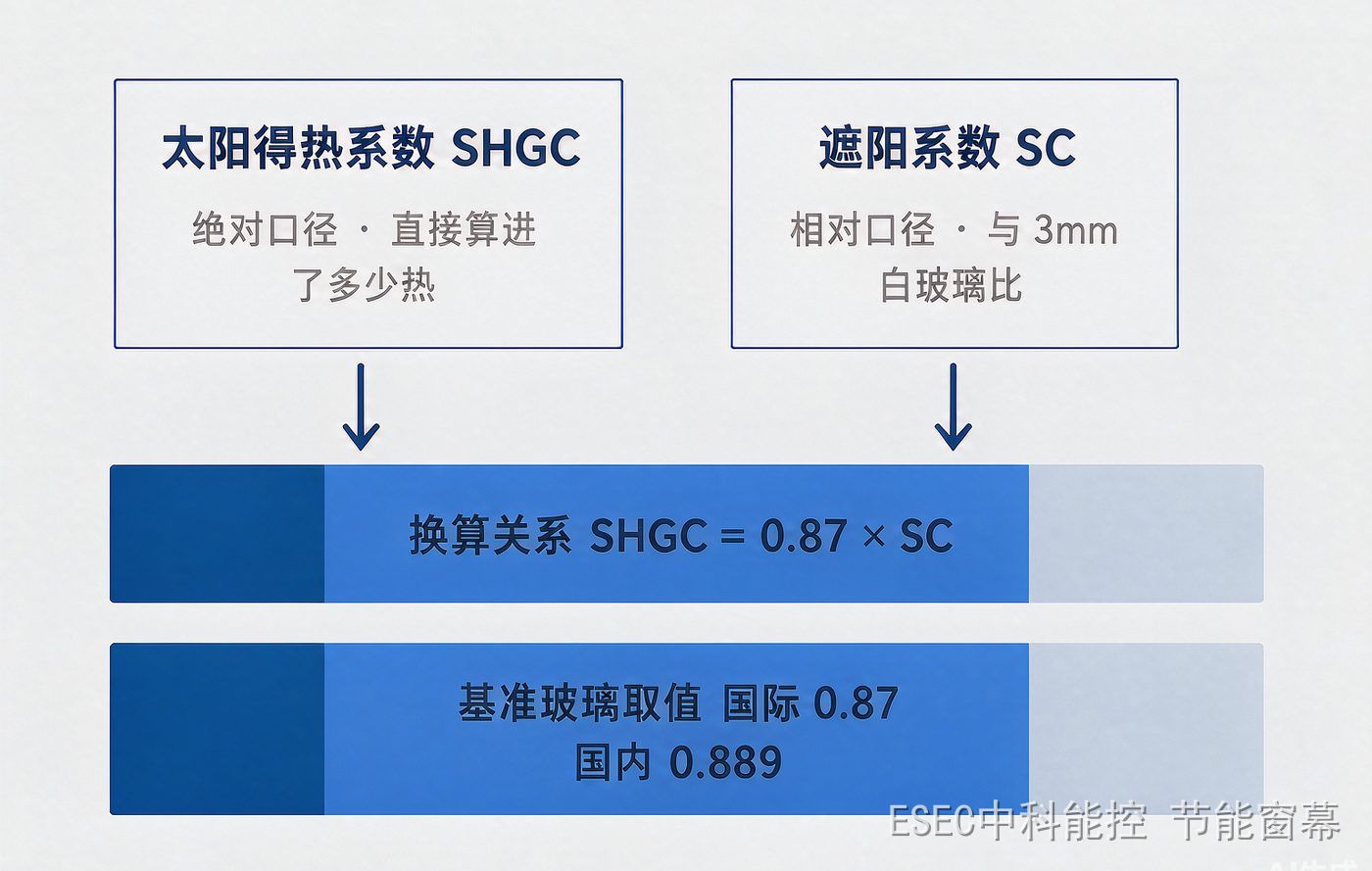
Solar heat gain coefficient (SHGC) is called total solar energy transmittance in GB/T 2680-2021 (clause 3.5), also written as g-value or solar factor. It is the ratio of solar radiation entering the room through the fenestration — including both direct transmission and secondary heat transfer of the radiation absorbed by the glass — to the solar radiation incident on it. A completely open aperture has an SHGC of 1; values range from 0 to 1, and lower means less heat admitted. The European g-value and the NFRC SHGC are both absolute conventions.
1.2 SC: a 3mm clear glass as the ruler
The shading coefficient (SC) takes a different approach: it answers “how does this glass compare with a 3mm clear float glass?” Per clause 3.6 of GB/T 2680-2021, SC is the ratio of the total solar energy transmittance to that of 3mm colourless transparent glass. By definition the baseline glass scores about 1; ordinary 6mm clear glass scores around 0.9. Lower SC means better solar rejection — but it tells you how the glass compares with the ruler, not how much heat enters the room.
2. The conversion formula is simple; the trap is that there are two baselines
The two conventions differ by one number:
SHGC = baseline × SC, i.e. SC = SHGC ÷ baseline.
The complication: the baseline has two values. The international convention, adopted by JGJ/T 151-2008 (Code for thermal calculation of doors, windows and glass curtain walls), sets the total solar energy transmittance of 3mm clear glass at 0.87; the theoretical value used in the GB/T 2680 domestic system is 0.889. A glass with SHGC 0.818 yields SC 0.92 on the 0.889 baseline and SC 0.94 on the 0.87 baseline. Conversely, an old report reading SC 0.42 converts back to roughly 0.365–0.373 SHGC, depending on which baseline was used.
The gap is about 2% — small, but if a report states only an SC figure without naming its standard and baseline, comparing it against an SHGC limit adds one unlabelled conversion step, and that is where mismatches happen.
3. Where the standards are heading: more and more SHGC
Read across the current standards and the convergence on SHGC is clear, though SC has not been abolished:
GB/T 2680-2021 defines both: clause 3.5 total solar energy transmittance (SHGC/g-value) and clause 3.6 shading coefficient, with the measurement methods unified in one standard.
GB 55015-2021, the mandatory general code for building energy conservation, uses SHGC throughout. Its Annex B gives the combined algorithm: the solar heat gain coefficient of a transparent envelope equals a shading coefficient SCs multiplied by the window’s own SHGC (SCs = 1 without shading). In code language, the contribution of shading is folded into a multiplier on SHGC.
GB/T 31433-2015 still grades the shading performance of windows with SC — the main place SC survives among current product standards.
In short: SHGC is the primary convention for design codes and energy simulation; SC lives on in old reports, product brochures and grading standards. Once you see that, “why don’t these two documents agree” stops being a mystery — they are simply two rulers.
4. Adding a shading layer in front of the glass: how does the number change?
If the glass stays, how is the combined performance calculated? The standards already provide a path. Chapter 8 of JGJ/T 151-2008, “calculation of shading systems”, covers planar shading devices parallel or nearly parallel to the glass — interior, interlayer and exterior shading — and computes the combined optical and thermal performance of “glazing plus shading” from the optical properties and position of the shading material. Insulated glass units with integrated blinds (JG/T 255-2020) are the productised version of exactly this approach.
For existing curtain walls and old windows where replacement is not an option, the same path applies: an interior planar shading device — a shading screen is exactly this category — lets you treat “glass + screen” as one combined system. Not a single number on the glass report changes; what changes is the operating heat gain of the combined system. As a worked example, the ZKKK shading screen achieves a whole-window SC of 0.14 calculated per JGJ/T 151-2008 (third-party test report), with third-party tested shading rates of 88%, 95%+ and 99% — layered over the existing glazing, summer solar heat gain drops sharply without replacing a single pane.
Honest boundaries: the retrofit changes the operating value of the combined system. It does not replace glass replacement, IGU repair or safety remediation. With the screen raised in winter, daytime heat gain is largely restored and the combined coefficient returns close to that of the original window — which is precisely “block in summer, admit in winter” expressed in thermal-bookkeeping terms: the operating gain of the same window is a seasonal variable, not a constant.
5. Two reports on one table: a three-step check
Step one: read the label. Is the figure SC or SHGC (g-value)? Different name — convert first, compare later.
Step two: find the governing standard. Check the cover and the test-standard field: GB/T 2680 implies the 0.889 baseline; a calculation per JGJ/T 151 implies 0.87. If neither is stated, confirm the baseline with the lab before converting.
Step three: convert everything to one convention, then rank. Convert all figures to SHGC (or all to SC) before comparing against each other or against code limits. Comparing across conventions is measuring the same cloth with two differently scaled rulers.
FAQ
Q1: What is SC 0.42 in SHGC terms?
Roughly 0.365 (0.87 baseline) to 0.373 (0.889 baseline). If the report names its standard, use the matching baseline; if not, confirm the baseline first — the gap is small, but near a code limit it can tip the comparison.
Q2: Is lower SHGC always better?
It depends on orientation and climate. West-facing facades and east/west walls with high window-to-wall ratios save cooling energy with low SHGC. In heating climates, north-facing windows rely on winter solar gain as free heat — pushing SHGC too low raises the heating bill. Adjustable shading (down in summer, raised in winter) beats a fixed low-SHGC constant on both counts.
Q3: How do I align an imported g-value with a domestic SC?
The g-value is synonymous with SHGC (absolute); SC is relative. Convert with SHGC = 0.87 × SC (the JGJ/T 151 baseline), or with 0.889 if the report follows the GB/T 2680 domestic baseline.
Related reading:
- The two numbers that decide glazing efficiency: shading coefficient SC (SHGC) and K-value
- Where does solar heat hide in the spectrum? Understanding the three bands of sunlight
- GB 55015 trade-off judgment: why windows are always asked to balance the envelope’s books
- Window-to-wall ratio explained: why codes allow 0.25 north and 0.50 south
本文由Zhongke Energy Consumption Control (Beijing) Technology Co., Ltd.整理发布。Zhongke Energy Consumption Control (ESEC)专注于隔热透景遮阳Window Curtain的研发与应用,为既有玻璃幕墙与外窗提供不动玻璃、不改立面的室内侧节能遮阳Solution。产品Shading Coefficient指标经第三方检测(遮阳率88%、95%+、99%三档),面料燃烧性能达B1级。Learn More:www.zknkkj.com。