


From mid-to-late September, heating bills start appearing in cities across northern China. For a household in a twenty-year-old block, the notice usually comes in one of two forms: “floor area x yuan per square metre”, or “base charge plus metered charge”. The second form has become more common in recent years, and it raises a question rarely asked before: why can two flats of identical layout in the same building differ by three or four hundred yuan?
The answer is not in the radiator. It is in the window. This article sets out the metering line: where the policy has reached, how a metered charge is calculated, how heat is apportioned through a building, and why the window turns out to be the most changeable item in the whole sum.
1. From Area to Heat: A Long Policy Line
Treating heat as a commodity and charging by consumption is not a new idea. In 2003, the then Ministry of Construction and seven other departments issued guidance on piloting heating system reform, which for the first time set out systematically the end of welfare heating and the commercialisation of heat, alongside the progressive introduction of metered billing. Three years later the State Council decision on strengthening energy conservation listed metered heating among the priority programmes, and the Energy Conservation Law, as revised and in force from that period, states in Article 38 that the state shall take measures to introduce, step by step, household metering and heat-based charging for buildings on central heating.
After 2010 the line became a series of technical documents. The measures for heating metering in civil buildings require metering and temperature controls in new buildings and in existing buildings that have completed energy retrofits. The technical specification for heat metering, JGJ 173, sets out the recognised routes — on-off time and area method, heat cost allocators, household heat meters, temperature-area method — one by one. Successive joint circulars pushed metering reform forward, and northern cities introduced two-part tariffs splitting the bill into a base charge by area and a metered charge by heat.
The most recent addition is the three-year action plan on urban heating for 2026 to 2028. Under the heading of finer system management, it calls for intelligent sensing, control and metering to be extended to heat sources, networks, substations and buildings, in step with the renewal of ageing pipework; it also requires existing-building energy retrofits to be advanced and encourages support for replacing household radiators, doors and windows in older estates. Metering and envelope improvement are advancing on the same line, and they meet at the level of the building.
2. How a Metered Charge Is Actually Calculated
Table one: splitting the two-part tariff
In almost every city that has adopted metered billing, the heating bill has two parts:
- Base charge (also called fixed or capacity charge): levied by floor area or heated area, typically 30 to 50 per cent of the total, with the exact share set by the municipal pricing authority. The rationale is heat transfer: even a household that shuts its valve completely receives heat from its neighbours through walls and floors, and the capacity the utility must keep available for the building does not disappear.
- Metered charge: actual heat consumed (kWh or GJ) multiplied by the metered heat price.
The base-charge share decides how much a careful household can actually save. Set it too high and the marginal reward for turning a valve down is diluted; set it too low and the utility cannot recover its fixed costs. That is why the ratio differs from city to city.
Table two: from a meter reading to an apportioned share
A household’s heat is rarely read off a single meter. In older buildings two approaches dominate:
Household heat meters — one meter on each dwelling’s flow pipe, measuring directly. The fairest in principle, but it requires a per-dwelling loop. Converting an old single-pipe series system is expensive, and the entry pipe often offers nowhere to fit a meter.
Heat cost allocators — one allocator on each radiator, recording how hard that radiator has worked, with the building’s measured total heat apportioned at year end. No pipework changes, no risers touched; this is the route most used in older estates. The trade-off is that it measures an apportionment basis rather than an absolute quantity, so the allocation factors are recalculated each year.
The specification also allows on-off time and area methods and temperature-area methods, each with its own conditions. Whichever route is used, the arithmetic ends in the same sentence: your metered charge equals the heat apportioned to your flat multiplied by the metered heat price.
Table three: the inter-flat heat transfer nobody talks about
This is the least discussed and most consequential part. Once flats are metered, a household that turns its valve right down does not become a detached house: heat from the flats above, below and beside it still comes through the internal walls and floors. The familiar result is a flat with the valve shut still sitting at 16 to 18 degrees, while the neighbour heating normally must burn a little more to hold 20.
That is the physical reason the base charge exists, and it is also why some cities require a proportion of the base charge to be paid for empty flats, at rates set locally. Understanding this is the precondition for understanding what follows.
3. Why the Window Is the Most Changeable Line in the Sum
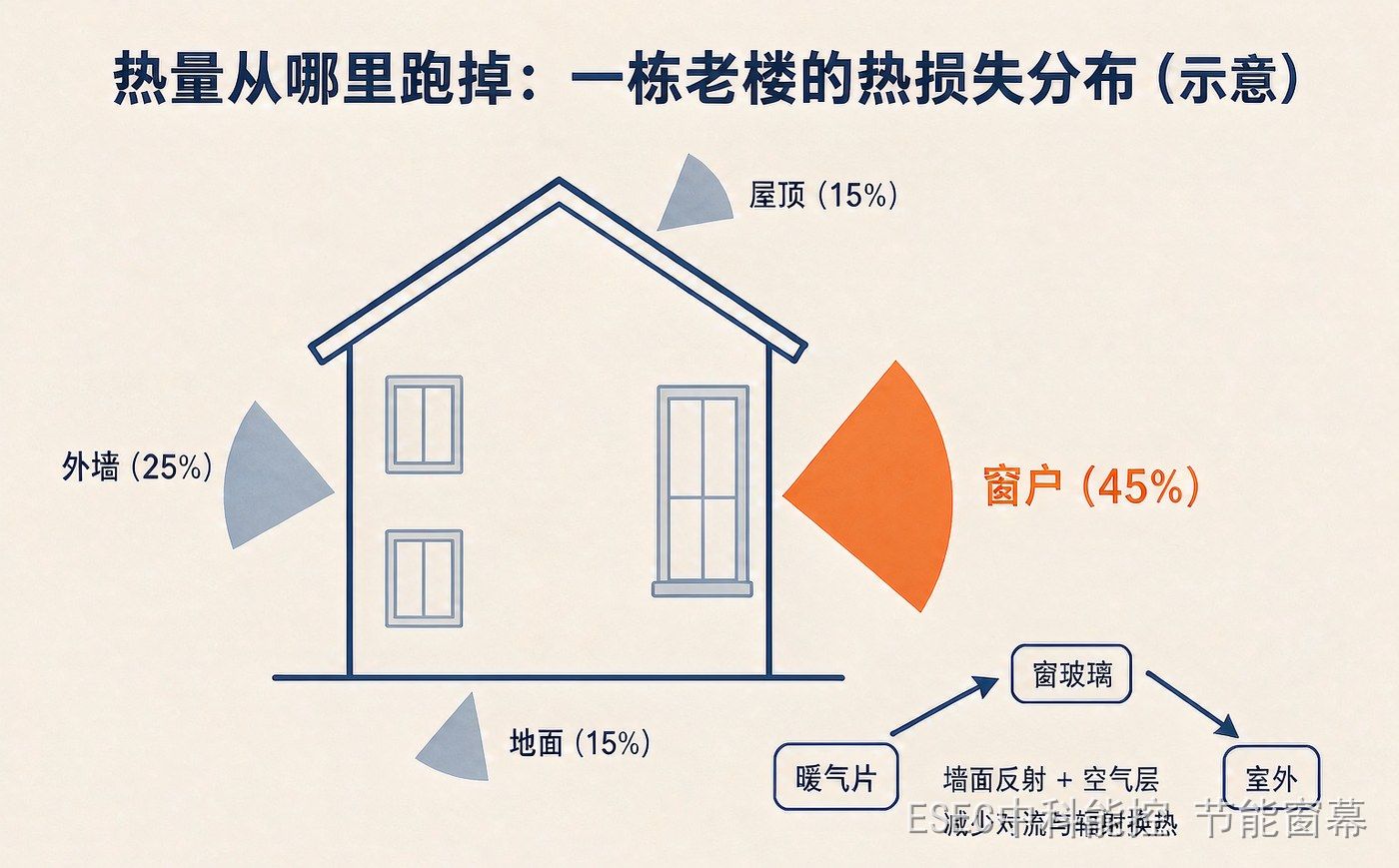
Where an older building loses its heat (indicative diagram; actual figures should come from measurement)
Break a building’s heat loss down and it divides between walls, roof, floor and windows. Windows occupy the smallest area — the window-to-wall ratio of a dwelling is usually between 0.2 and 0.4, less than a quarter of the wall area — yet they are usually the largest loss per square metre. Three physical reasons:
- Glass conducts. Ordinary double glazing has a U-value around 2.5 to 3.0 W/(m2K), while a 240 mm brick wall with insulation can reach 0.4 to 0.6. For the same temperature difference, each square metre of glass loses five to seven times as much heat as the wall.
- Air moves at the window. The inner glass surface is pulled cold by the outside, the air against it cools and falls, and a continuous downdraught carries heat towards the glass. This is why radiators sit under windows, and why the window edge always feels colder than the middle of the room.
- Joints leak. Between frame and opening, and between sash and frame, an older window is rarely airtight. Infiltration is pure heat loss: it never appears in the metered figure, but it is paid for all the same.
Together these point to a practical conclusion: in a building whose walls have already been insulated but whose windows have not, the gain from ever-finer metering is far smaller than the gain from lowering that window’s heat transfer. The first only cuts the same cake more precisely; the second makes the cake smaller — and only when the denominator falls does the heat apportioned to each flat really fall.
4. Three Places Metering Reform Stalls
First: meters installed, arithmetic never settled
Some estates have meters and thermostatic valves, yet billing reverts to area. The obstacle is rarely hardware but the allocation rule: a base-to-metered ratio that was never explained, allocation factors adjusted each year without publication, and no clear refund mechanism when rooms fall below the required temperature. The hard part of metering reform is writing the rule down and applying it year after year.
Second: metering only looks good if the building is good enough
In a poorly insulated, leaky building, metering tends to look worse the more precisely it is done. Households turn valves down to save money, rooms drop to 16 degrees, complaints follow, and the utility raises flow temperatures to hold the required indoor temperature, so energy use goes up. That is why metering reform documents across the country list energy retrofit of existing buildings as a precondition: improve the building first, then metering means something.
Third: treating heat consumed as a substitute for comfort
The purpose of metered charging is to turn saved heat into saved money, and it rests on an assumption: energy is saved while the required indoor temperature is maintained. If a household’s only choice is to close the valve, be a little colder and pay a little less, the sum has become comfort traded for cash — the opposite of the policy’s intent. What should emerge is the same room temperature for less heat, because the envelope got better.
5. What Happens to the Sum When the Window Is Fixed
For the household: the metered half of the bill finally has room to fall. With comparable insulation, a lower window U-value and a weaker downdraught mean less heat is needed to hold 20 degrees. The base charge does not move; the metered part shrinks; the total follows. The effect is most visible where the base-charge share is low.
For the utility: lower building heat demand means a substation can serve more area, or achieve compliance at a lower flow temperature, relieving both network and source capacity. This is the practical reason the current action plan treats building-level metering and envelope retrofit in the same section.
For the retrofit route in existing housing: replacing windows is the most direct measure and also the most disruptive — openings have to be altered, rooms taken out of use, facades and appearance handled; in an older block it is rarely achievable throughout. Fitting a heat-insulating transparent shading screen on the interior side is the compromise more owners and property teams are choosing: no work to the opening, no glass replacement, no loss of daylight or view, one layer of thermal resistance added inside the glass, reflecting solar heat out in summer and holding indoor heat in during winter. It is not a full substitute for new windows, but in older estates where replacing every window is simply not going to happen, it is often the only step that actually gets built.
6. A Checklist for Households Before the Season Starts
Ten minutes with these five points is worth more than arguing about who feels colder in the group chat:
- The billing rule: the current local ratio between the base and metered charges, and the proportion payable for an empty flat. Together these set the room for saving.
- The apportionment method: household meters, heat cost allocators or on-off time and area; and whether the annual factors are published.
- The window: single glazing, double-glazed unit or Low-E unit; whether there is a noticeable draught or cold airstream at the edge; whether the seal between frame and opening is intact.
- The room temperature: on the coldest days, read a thermometer half a metre from the window at 1.1 metres above the floor — the position that best shows heat being taken by the glass.
- The make-up of last year’s bill: separate the base charge from the metered charge. That is where you see which half still has room.
One boundary, stated plainly: a shading screen deals with the thermal side of the glass. It does not stop draughts (that is seals and hardware), does not replace window replacement, and does not change the apportionment rule. Its role in this sum is modest and concrete: reduce, somewhat, the heat that has to be burned in the first place — and leave the rest to the rules and the meter.
FAQ
Once billing is by heat, can I stop paying by shutting the valve?
No. As long as the building is heated, the base charge is normally still payable by area at the locally set proportion, and inter-flat transfer means a shut valve never delivers zero heat. Check the current local metering document for the ratio and for how empty flats are treated.
Can an older building with no per-flat pipework be metered?
Yes. Single-pipe series systems generally use heat cost allocators: an allocator on each radiator, with the building’s total heat apportioned accordingly. No risers need altering, which is why this is one of the most common routes in older estates.
I have thermostatic valves, so why does the room swing hot and cold?
Usually hydraulic imbalance. When one side of a system closes its valves, flow redistributes and radiators elsewhere run over or under. Metering projects normally need hydraulic balancing alongside the valves; valves without balancing often make things worse.
How much can improving the window save on the bill?
Three things decide it: the window’s share of the envelope area, the U-value of the existing glass, and the base-charge share. The larger the glazed area, the thinner the existing glass and the lower the base charge, the more visible the effect. Any figure should come from measured consumption rather than a generic ratio.
About Zhongke Nengkong: Zhongke Nengkong (Beijing) Technology Co., Ltd. develops heat-insulating transparent shading screens for building glazing: reflecting solar heat in summer with 88% heat insulation, 95%+ infrared and 99% UV blocking; adding a thermal resistance layer indoors in winter to reduce heat loss and lift the inner glass surface temperature. The fabric achieves class B1 fire performance, retracting by day and lowering at night, suitable for interior-side energy retrofitting of residential and public buildings.