

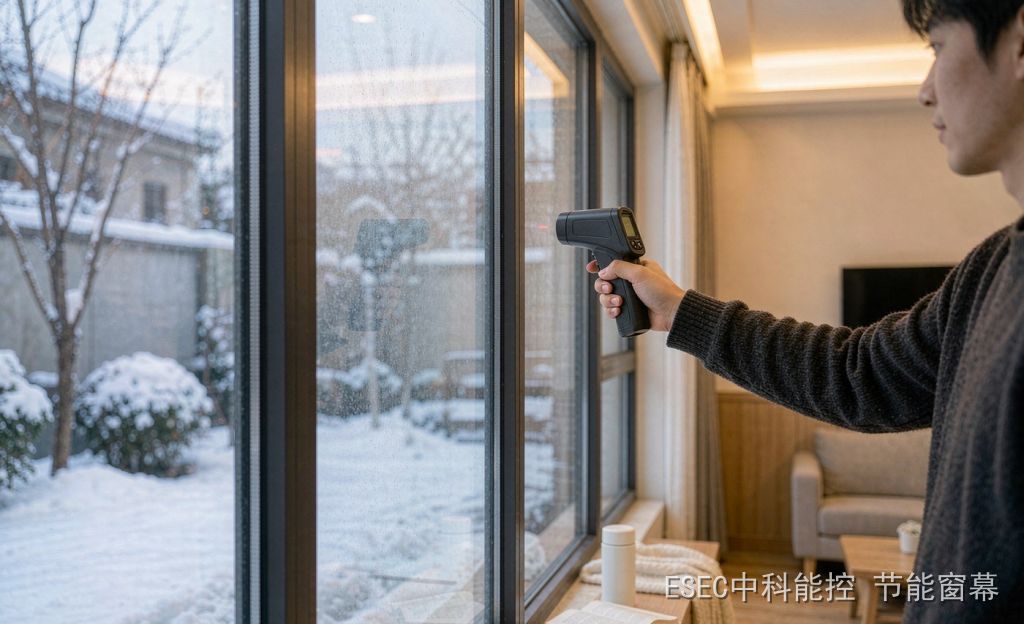
As soon as the heating comes on, the window becomes the most complained-about spot in the house or office: “the glass is cold”, “there is a draught here”, “it is several degrees colder than the rest of the room”. Ask how many degrees, though, and most people cannot say — they rely on the back of a hand, a cheek and a feeling. The feeling is not wrong; it just cannot justify a budget, compare two options, or tell you whether this winter is any better than last. This article gives a four-step check you can finish in ten minutes: touch the glass, get a surface temperature, compare it with the dew point, then decide whether to act. No equipment sales, no professional credentials required.
1. Why “the window feels cold” Is Worth Quantifying First
Winter discomfort at the window is usually three things stacked: a low inner glass surface temperature (radiant cold), cold air sinking down the glass (draught), and air infiltration through gaps. The remedies are completely different — the first two are thermal, the third is sealing — and “the curtain did not help” is usually a thermal solution applied to a sealing problem, or the other way round. Without separating them first, money tends to go to the wrong place.
More practically: once you have numbers you have a comparison. Two readings from the same window, before and after, persuade better than any adjective; and when prioritising a budget, “which windows first” also has to start from a number. This is not laboratory thinking — it is common sense before spending.
2. Step One: Touch the Glass for a Qualitative Read
Put the back of your hand against it (briefly — cold metal frames can grab skin) and sort the feeling into three buckets:
- Distinctly icy, as if the glass is pulling heat out of you: the inner surface is likely more than ten degrees below room air, radiant cold is significant, and nobody will want to sit there.
- Cool but not painful: lower than it should be, but usually in the range where adding one layer makes an obvious difference.
- Close to room temperature: the glass is basically fine. If the spot is still cold, look for air — gaps, hardware, seals, and the airflow near the sill.
There is also a free temperature signal: look for condensation. Water on the inner face, puddles on the sill or a white ring around the edge mean the surface has already dropped below the indoor dew point — harder evidence than a hand. Conversely, perfectly dry glass does not prove it is warm; it may simply mean low humidity pushed the dew point down. So after the qualitative read, you still need a number.
3. Step Two: Get an Inner-Surface Temperature — Do Not Mix Up the Tools
The same word “temperature” means different things on different instruments, which is where many on-site arguments come from:

What each of the four common instruments measures, and its one-line limitation (diagram)
Contact measurement: a number, but only at one point
Stick a probe or a patch thermometer on the glass, wait a few minutes for the reading to settle — cheapest, and hardest to argue with. The cost is contact, a single point, and the fact that the centre of the pane is usually the best-looking number, while the real trouble sits at the edge and the frame where the cold bridge is (we did the arithmetic in our piece on the edge cold bridge). Do this: one reading at the centre, one about five centimetres from the edge — record both.
Infrared gun: fast, but pointless if the emissivity is wrong
One second per shot makes it the standard field tool — and the easiest to get wrong. An IR thermometer infers temperature from the radiation the surface emits, so it must know the surface emissivity. Plain clear glass sits around 0.84 (also the working basis for testing and conversion in GB/T 2680), while most guns ship with a default of 0.95: measuring glass on the default gives a biased reading. Add the fact that glass is semi-transparent, so background radiation (sky, the building opposite, indoor walls) leaks in, and the number wanders. Three actions cut the error: set the emissivity to match glass, aim perpendicular to the pane, and take three to five readings at the same spot and average. Never measure through a curtain or a film of water.
Thermal camera: distribution, not a single point
Its value is not “more accurate” but “more complete”: in one look you see which part of the glass is coldest, how much the frame perimeter drops, and whether the sill or the wall corner has a thermal bridge. Shoot one image before a retrofit and one after; two images side by side explain more to people who were not there than any table. Price and data handling are the downsides — it belongs to the engineering or facility side, not every household.
Thermo-hygrometer: it does not measure glass, it sets the ceiling
A thermo-hygrometer measures air, yet it is often treated as a “glass thermometer” — the most common misreading. Its real job is to give the dew point: at the current indoor temperature and relative humidity, the glass surface temperature below which condensation starts. Used together with step three, your surface-temperature number immediately means something.
4. Step Three: Turn Numbers into Conclusions — Condensation Risk and the Gap
With two values (indoor air temperature and relative humidity), the dew point follows from the algorithm in JGJ/T 151-2008, the Chinese code for thermal calculation of windows, doors and curtain walls, using a = 7.5 and b = 237.3. Common conditions can simply be looked up: at 20°C indoor air, the dew point is about 1.9°C at 30% RH, about 9.3°C at 50%, and about 12.0°C at 60%. In other words, in a room at 20°C and 60% RH, any glass surface below 12°C will run with water — and a pane with a U-value of 2.8 W/(m²·K) at an outdoor −5°C sits at roughly 12°C on its inner face (estimated with an internal surface resistance of 0.11 m²·K/W). That is the arithmetic behind “the glass never dries”.
The second use of step two is the gap: inner glass surface temperature minus indoor air temperature, the most intuitive indicator of how a window behaves thermally. The bigger the gap, the faster that pane sheds heat and the more it “sucks” from the room. In the same room at the same moment, east versus west, single versus double glazing, with or without a screen — all can be ranked on this single difference. Easier to grasp than a U-value, more reliable than a feeling.
One clarification: this gap is not a U-value and cannot be converted into energy consumption. It is a clinical thermometer for the site, not an audit report. Energy and savings calculations follow a different method and set of measurements (we discussed the “do not mix two numbers” trap in our piece on SC versus SHGC).
5. Step Four: Three Outcomes, Three Different Actions
Case one: small gap, no condensation — do not add anything yet
If the surface is only a few degrees below room air and never condenses all winter, the glass already passes. If the spot still feels cold, check air and seals first: can a sheet of paper slip through the gap, is the hardware loose, has the weatherstrip hardened (see our pieces on leak investigation and hardware and airtightness). A shading screen will not fix a leak.
Case two: obvious gap, damp edges — add a layer on the indoor side
This is the classic fit for an interior shading screen: the glass is intact and airtight, it simply lacks thermal resistance. Lowering a screen on the indoor face at night adds a layer of resistance to the coldest surface, lifting its temperature and reducing edge condensation. Retracted by day so daylight is untouched — and that is exactly where it differs from film or new glazing: replacing glass means downtime, cradles and façade approvals; film changes solar radiation, not night-time insulation. Three tools, three different jobs; none of them does everything.
Case three: heavy condensation, failed unit — repair before anything else
If the sealed unit has fogged internally or the laminate has gone white, that is a failed seal, not a thermal-resistance problem (see failed insulating glass units). Any screen at that point only hides the symptom; replace or repair the unit first, then consider extra insulation.
6. A One-Page Record Sheet
Turn the four steps into a table, one row per window, filled once before and once after. Six columns are enough to support an internal proposal:
- Location (room / orientation / floor)
- Inner glass surface temperature (centre and edge)
- Indoor air temperature and relative humidity at that moment
- Calculated dew point and the condensation verdict
- One line on feel and visible condensation
- Date (several rows on the same day are fine — they show time-of-day differences)
Start with the ten most-complained-about windows in the building, sort them by the size of the gap, and you get a better action order than intuition. No expert needed: one IR gun, one thermo-hygrometer, one sheet of paper, one weekend.
FAQ
Is an infrared gun accurate on glass?
With the emissivity matched, the gun aimed perpendicular and several readings averaged, it is good enough for judging temperature differences and condensation risk — but not as a basis for measuring energy savings. Plain glass has an emissivity of about 0.84 while most guns default to 0.95, and semi-transparent glass admits background radiation, so uncorrected readings drift noticeably.
Why is the inner glass surface so much colder than the room?
Because glass is a thin layer with very little thermal resistance: room heat passes through it quickly to the outdoors, pulling the inner surface towards the outdoor side. How big the gap gets depends on the window U-value, the outdoor temperature and the indoor heat-transfer conditions — which is why whole-window U-values, not glass thickness, are used for comparison.
Does condensation mean the window is defective?
Not necessarily. The criterion is simply “glass surface below the indoor dew point”, which high humidity, low room temperature or low thermal resistance can each cause. Calculate the dew point, then compare it with the glass temperature, and you can tell whether it is the glass, the humidity, or both.
Do I need qualifications to do this?
No. The four steps are on-site qualitative judgement and side-by-side comparison with off-the-shelf instruments. Retrofit approval, acceptance and savings verification still require testing and calculation by an accredited body under the relevant standards.
Further Reading
- The same building, different windows: why window comfort changes with floor level
- 26°C or 24°C? It is often the glass, not the air temperature, that decides comfort
- Why radiators sit under windows: the cold downdraught explained
- Where the water on the sill comes from: three numbers to work out your glass dew point
- Where the sun’s heat hides: reading the three bands of the solar spectrum
About Zhongke Nengkong: Zhongke Nengkong (Beijing) Technology Co., Ltd. develops heat-insulating transparent shading screens for building glazing: reflecting solar heat in summer with 88% heat insulation, 95%+ infrared and 99% UV blocking; adding a thermal resistance layer indoors in winter to reduce heat loss and lift the inner glass surface temperature. The fabric achieves class B1 fire performance, retracting by day and lowering at night, suitable for interior-side energy retrofitting of residential and public buildings.