

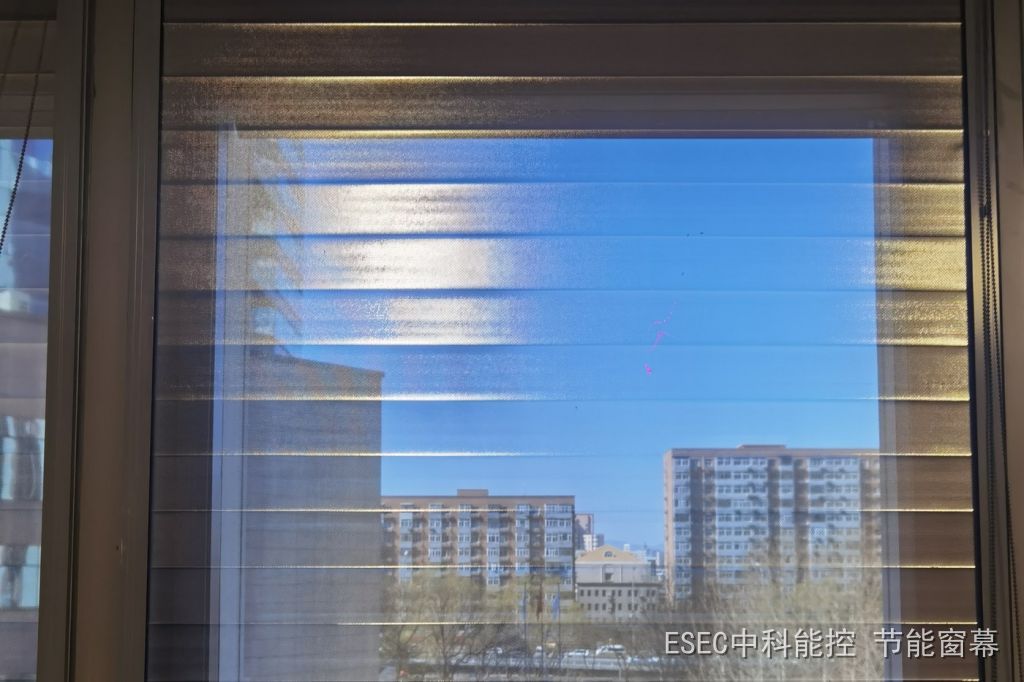
When glass arrives on site, the interlayer usually gets one question: will it fall out if it breaks?
Right question, a third of the answer. A laminated interlayer — the film sandwiched between two panes — carries three jobs at once, and those jobs often pull in opposite directions: make it thicker, make it softer, make it block the sun. Each demand tugs somewhere else. This article takes the interlayer on its own, and explains the thing that puzzles many owners of existing buildings: the glass is not bad, so why is the room still hot?
1. Start with structure: glass processing only has a few kinds of addition
1.1 Coating, cavity, interlayer: three additions in three places
Raw float glass is just a pane. Processing adds something, and the additions fall into a few categories: coatings sit on a surface, one or more layers of metal or metal oxide, and manage radiation (how the silver layer in Low-E works has its own piece); a cavity sits in the middle, two panes held apart with a sealed gas layer, managing conduction and convection (triple glazing versus vacuum glass is a comparison of how that gap is stacked); a laminated interlayer also sits in the middle, but fills the gap with a polymer rather than gas — two panes bonded into one unit.
The three do not replace each other. The familiar facade build-up of laminated plus insulating glass puts the lamination on the outer side for safety and sound, leaves the cavity to manage heat loss, and coats the inner pane with Low-E for radiation. In a budget, these are three separate line items.
1.2 Remember one number: 1.52
A standard PVB film is 0.76 mm. One layer between two panes is 0.76; two layers are 1.52. In practice people say “1.52 laminated” rather than “two plies of PVB”, so this number appears on drawings and quotations nearly as often as glass thickness.
There are several film families: PVB is the traditional mainstream — flexible, acoustically good, available in colours; SGP is stiffer and stronger, often specified for structural or load-bearing positions such as glass balustrades and point-fixed glazing; EVA has a lower processing threshold and appears in interior partitions and small runs. Density, modulus and weathering differ, and so does price. For an owner without a materials background, the practical rule is to treat film thickness and film type as parameters to check right next to glass thickness.
2. Job one: safety — the interlayer governs what happens after the break
2.1 Tempering and lamination are not the same thing
The most common mix-up is assuming tempered means safety glass. Tempering raises strength and makes breakage produce small dice-like fragments (spontaneous breakage has its own article), which are less likely to cut — but the whole pane can still fall away. Lamination delivers post-break integrity: the glass may crack, but fragments stay bonded to the film instead of flying or dropping.
The acceptance criteria therefore differ completely. Tempering is judged on fragment pattern and breakage risk; lamination on retention after impact. Most facade practice uses both — tempered and laminated — to get strength and to keep the assembly in place.
2.2 The mandatory requirements: three lines cover most of it
Where safety glass is required is set out in JGJ 113-2015, the technical code for application of building glass, and in the 2003 regulation on safety glass in buildings. The clauses quoted most often: window glass in a single piece larger than 1.5 m²; glass whose bottom edge sits less than 500 mm above the finished floor (some texts cite 900 mm above a standing surface — the two address different locations, one a window, the other a walkable surface); outward-opening windows on the seventh floor and above; inclined glazing, skylights and roof lights; interior partitions, bathroom enclosures, glass balustrades and atrium rails; public building entrances and lobbies. Curtain wall glazing generally falls inside safety glass scope as a whole.
One more that gets missed: JGJ 113 tabulates maximum permitted areas for non-tempered glass. Framed float glass at 6 mm nominal thickness is generally limited to 0.9 m²; at 8 mm, 1.8 m² (see Table 7.1.1-2 of the code). Exceeding those areas without tempering or lamination leaves very little room for argument if something fails.
3. Job two: sound — the interlayer is the only damper in the assembly
3.1 Why traffic noise dulls when a film goes in
Insulating glass manages conduction and convection; its ability to stop airborne sound has a ceiling. With only gas and an aluminium spacer between the panes, a sound wave easily sets both panes moving together. A polymer interlayer damps that: it converts vibration into heat, closing off part of the resonance path.
The difference is easiest to hear at low frequency — passing traffic, buses, heavy trucks. High frequencies can be handled with thickness and pane count; low frequencies are stubborn. At comparable thickness, laminated insulating glass generally has the advantage in the low band, which is why homes facing a main road often end up with laminated insulating glass rather than a thicker cavity.
3.2 The asymmetric rule of thumb
Two panes of identical thickness tend to resonate in the same band. Designers deliberately mismatch them — 6 mm outside, 8 mm inside, for example — to shift the resonance frequencies apart, and a laminated build-up flattens the curve further. On a drawing this is a difference of one number, but changing it later means changing the whole build-up, which makes it one of those parameters that must be right the first time.
4. Job three: solar heat — where the interlayer is most often described wrongly
4.1 A clear film does almost nothing about solar gain
PVB is transparent to visible light and does not selectively handle the near-infrared part of the solar spectrum. A standard clear laminated unit has a shading coefficient close to that of an equivalent clear insulating unit: the heat that would come in still comes in. Expecting a clearer, warmer room simply because a film was added is a common misconception.
Two things do change the gain. First, a tinted or additive-loaded solar-control film — PVB can be made grey, green or blue, and can carry infrared-absorbing components. Second, a coating on the glass itself (solar-control coating, Low-E). The first costs visible light and dims the room; the second pushes reflectance up, and the facade starts looking like a mirror from outside.
4.2 One conversion you cannot avoid
Total solar energy transmittance, g, is roughly the direct solar transmittance plus the secondary heat transfer inward after absorption. An absorbing interlayer lowers direct transmittance, but the absorbed energy heats the glass, so the inward secondary flow rises — and the sum improves less than it appears to. The SC versus SHGC baseline conversion makes the same point for coatings; with films the mechanism is identical.
That is why transmittance alone is not a specification: light and heat are two separate accounts. Some glass looks impressively dark and still measures a high g, because the heat was simply routed in another way.
5. How the three jobs collide
Put together, the trade-offs become visible. Safety usually wants thicker lamination and stiffer film, which adds weight and pushes the profile and hardware up. Sound wants damping and mismatched panes, again weight and cost. Solar control wants functional film or coating, which costs transmittance and view. A clear view makes every other requirement give ground.
Worse, the interlayer can stand on the solar-control side — but by absorbing and reflecting, not by reducing heat transfer. It contributes almost nothing to U-value: that number is about conduction and convection through glass and frame. Going from 0.76 to 1.52 mm of film barely moves U; what moves U is the cavity, the gas inside it, and the emissivity of the coating.
One widely repeated claim deserves a qualifier: argon filling lowers U by about 0.2 to 0.3 W/(m²·K). That magnitude broadly holds at a fill rate in the high eighties and a cavity of 12 mm or more — but only where there is already an insulating cavity and a low-emissivity coating. With a thin cavity or no Low-E, the benefit shrinks. Numbers should travel with their conditions.
6. What this means for an existing building
For a building already standing, with its glass installed and in use, the conclusion is blunt: whatever the interlayer delivers in safety, sound and possible solar control is fixed inside that pane. Changing it means either replacing the glass or working on the room side.
The cost of glass replacement is covered elsewhere (the replacement chain): downtime, lifting, sealing, curing, colour matching — none of it optional. Fitting a retractable screen on the interior side touches none of the glass parameters. It manages convection and radiation at the inner surface: solar radiation lands on the screen, part of it reflects back out (Zhongke Nengkong screens reflect around 88% of solar heat and reject 96.5% of near-infrared), 28% visible light transmittance keeps the view, and SC 0.14 (JGJ/T 151-2008) reduces the solar gain entering the room to a fraction of what the bare glass admits.
The boundary has to be stated just as clearly: a screen does not change the interlayer, does not change U, and does not change sound insulation. If the complaint is traffic noise from a main road, the conversation belongs to lamination and asymmetric panes, and a screen will not help. If the complaint is that the west facade turns into an oven at three in the afternoon, the conversation is about solar gain — and that is the segment a screen manages.
Clear division of labour is what keeps you from buying the wrong thing.
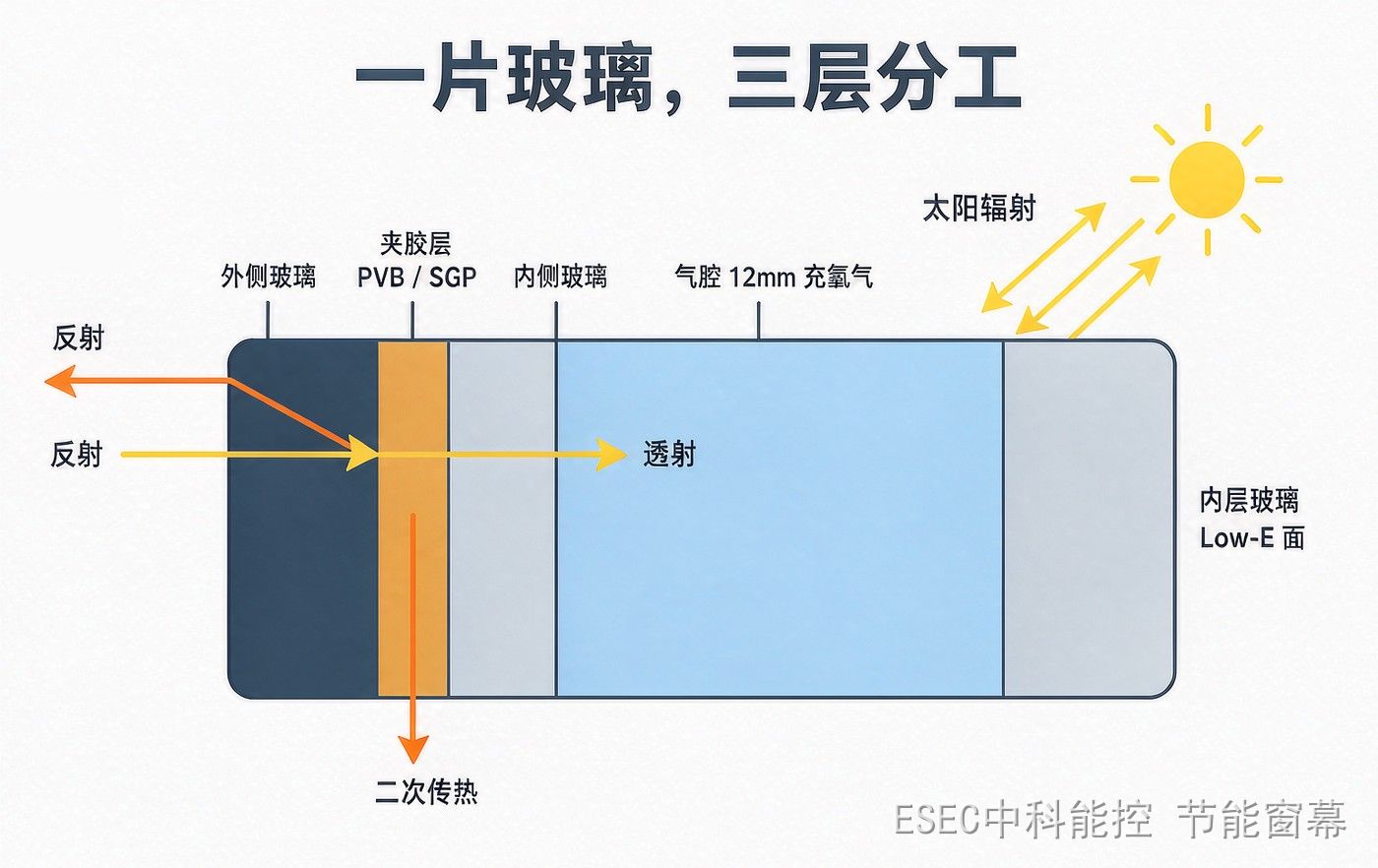
Three jobs in one pane — interlayer, cavity and coating each cover one segment, and none substitutes for another.
7. Four questions that come up
7.1 Is thicker lamination always better?
Not linearly. Thickness helps impact retention and sound, but adds weight, cost and load on profiles, and the return flattens past a point. Ordinary projects should build to the code minimum plus the actual safety class; high-rise, large-format and exposed positions add margin. Blanket over-specification is not the same as good design.
7.2 Does laminated glass yellow over time?
PVB exposed to long-term ultraviolet can discolour, particularly at edges with poor sealing. That is why edge sealing and edge sealant on facade laminated glass matter — they are not decorative, they are the film’s first line of defence. SGP holds up better to weathering but costs more, and is usually reserved for structural positions.
7.3 If laminated glass breaks, can one pane be replaced?
No. The film bonds the two panes into one unit; if either breaks, the whole assembly must be replaced. That is precisely why replacement is more disruptive on laminated facades — you are not swapping a pane, you are swapping a unit.
7.4 For a west-facing existing building, what should be looked at first?
The g-value (or SC) of the glass, then window-to-wall ratio and orientation. If g is high and the facade faces west, changing the glass is the root fix; if the glass cannot be touched, the room side is the only lever. Conversely, if g is already low — a solar-control coating is in place — and the room is still hot, the problem is more likely internal gains and ventilation, and spending on glass or shading would be wasted.
8. In closing
The difficulty with glass is not that any single technology is exotic. It is that every pane carries four lines at once — safety, sound, thermal performance and view — and they compete. The interlayer is one of those lines, and because it is invisible it is the one most easily treated as optional.
Next time a glass specification lands on the desk, ask four questions in order: where safety glass is required, how thick the lamination is and which film, how deep the cavity is and whether it is gassed, and what the g-value and visible transmittance actually are. Once those four are answered, the price starts to make sense.
Zhongke Nengkong (Beijing) Technology Co., Ltd. makes heat-insulating see-through shading screens fitted on the room side of glazing: solar heat reflection around 88%, near-infrared rejection 96.5%, UV rejection above 99%, visible light transmittance 28% (GB/T 2680 test report), shading coefficient SC 0.14 (JGJ/T 151-2008), colour rendition above 92%, and B1 fire performance for the fabric (GB 8624-2012). No glass removal, no facade change, fully retractable — suited to interior-side energy retrofits of residential and public buildings. To have the solar gain at a specific window checked, send us the parameters.