
On October 31, 2026, CITIC Tower officially launched its first ESG report at the International Hall on the 3rd floor of CITIC Tower. Guorui Guo, General Manager of Zhongke Energy Consumption Control, was among the guests invited to attend.
The report sets out a complete operational efficiency pathway for a supertall building, built on figures such as 650,505 information control points, a measured chiller COP of 6.61, and a 10.2% five-year reduction in energy consumption per square meter. As a technology provider focused on building envelope energy efficiency, our interest lies in the question behind those numbers: once operational optimization has been taken to the centimetre level, how should the envelope baseline be calculated?
1. October 31: the first ESG report goes live
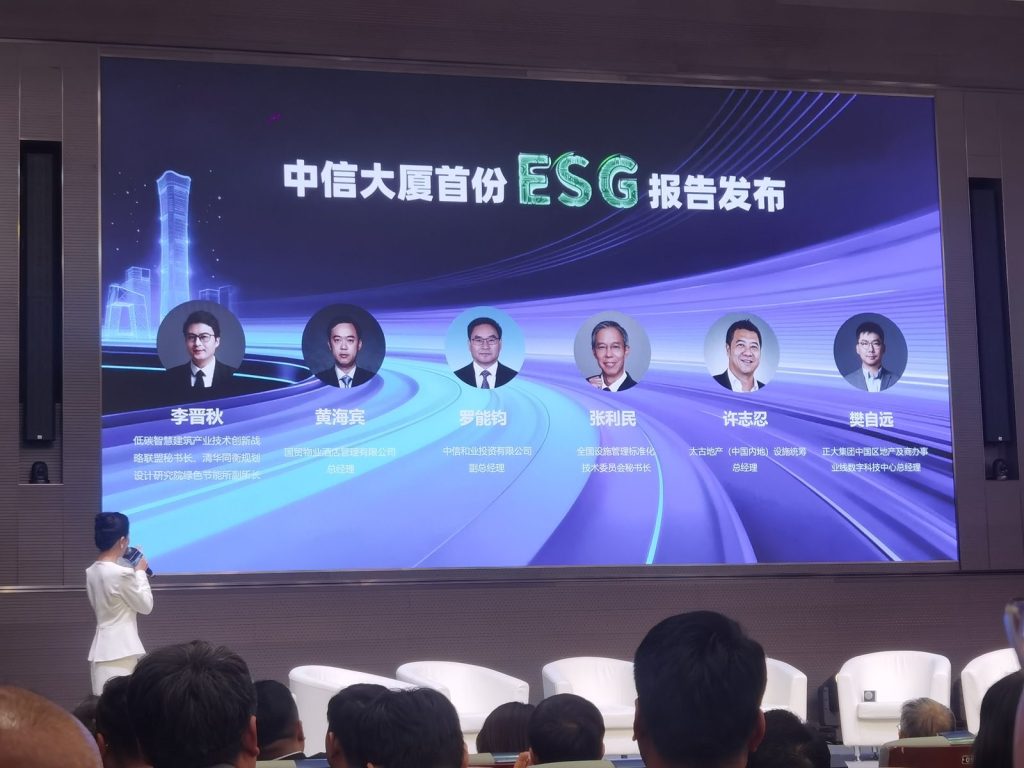
The main screen on site carried a bilingual title: CITIC Tower First ESG Report Official Launch. The keynote page was titled “The Green Answer of a Skyscraper – CITIC Tower ESG Operations, Innovative Practice and Benchmark Value,” marked with the year 2026. The report, published in October 2026, records 2025 operational practice – and answers a continuous question: the green of a supertall building is not the result of one retrofit, but an answer operated year after year.
The launch screen listed six guests with their titles: Li Jiqiu (Secretary-General of the Low-Carbon Smart Building Industry Technology Innovation Strategic Alliance, Chief Architect of Tsinghua Tongji, Chief Architect of the Architectural Design and Research Institute), Huang Haibin (General Manager of Deutsche Landmark Tower High-Rise Management), Luo Nengjun (Deputy General Manager of CITIC and Ye Investment), Zhang Limin (Secretary-General of the National Guidelines Management Standardization Technical Committee), Xu Zhizhong (Facilities Executive Director of Swire Properties China) and Fan Zi-yuan (Deputy Senior Marketing Center General Manager of CP Group’s China Real Estate and Hotel Division).
Guorui Guo, General Manager of Zhongke Energy Consumption Control, was invited to attend the event. Around the energy efficiency data disclosed in the report, attendees exchanged technical views on retrofit pathways for existing buildings. Between sessions, Mr. Guo met and photographed with fellow guests in the CITIC Tower lobby.
2. The report breaks “green” into verifiable detail
The first chapter runs on two threads. “Green Leap” extends the chain from end-of-pipe removal back to source circulation: 262,374 kg of waste paper recovered, 194.92 tCO2e of carbon reduction through resource utilization, equivalent to about 39,000 trees; 38,365 kg of waste plastic and 3,098 kg of waste metal; a dedicated 0-5 degrees C cold store for food waste, the first of its kind in the industry, equipped with SGS-certified natural plant-based deodorization. “Smart Evolution” turns the building into a system sensed in real time: 650,505 information control points, 12 primary systems, 63 subsystems, 34,434 pieces of equipment, and 700,000 yuan invested in a big data platform upgrade.
The second chapter, “Green and Low Carbon,” is the skeleton of the methodology, across five threads. High-efficiency plant and system integration: measured chiller COP 6.61, 18% above design requirement; measured IPLV 9.57, 54% above design requirement; 100 lifts with energy recovery, around 50% of energy recovered and reused; LED plus intelligent lighting delivering over 50% lighting-panel savings with time, zone and sensor control; VAV with a 10 degrees C chilled water differential for variable-flow terminal regulation; and building management coordination of chiller plant and auxiliary machines to reduce mismatched system losses. Renewable energy and resource circulation: 8,845,000 kWh of electricity consumed at the 1v level; 92.8 kWp of rooftop photovoltaics saving about 80,000 kWh a year under 24-hour IoT monitoring; 320 cubic metres of rainwater storage for landscaping, car parks and road washing. Energy management methods: around 30,000 metering points connecting consumption, environmental and equipment data, a nine-part energy assessment system supporting diagnosis and verification, and a five-step loop of monitoring, countermeasures, implementation, verification and continuous improvement. Operational optimization cases: VAV control strategy optimization saving 1.8 million yuan a year in energy costs; chiller plant efficiency improvement saving 810,000 kWh in 2024 with a 20% year-on-year rise in COP and about 640,000 yuan saved; heating system optimization cutting heat consumption 9% and hot water pump electricity 20.5%. Five-year results benchmarked externally: energy per unit area falling from 81.96 to 73.60 kWh per square meter, down 10.2% against 2020; total energy per unit area from 20.45 to 16.02 kgce per square meter, down 21.7%; roughly 9.5% below the Beijing Grade A office average of 81.32 and about 39.1% below the 26.3 office benchmark for public buildings; 33% below the average for comparable buildings in Tokyo and 17% below its top-quartile performance, approaching the energy use of parts of the Toranomon Hills office complex; with WELL Platinum, LEED Gold and a Platinum rating under the low-carbon commercial building assessment.
3. The baseline behind the ledger
Almost all of those threads sit on the operational side: equipment efficiency, control strategy, data platforms, running management. That path is complete in itself. But for a supertall building there is an earlier variable: where the heat actually comes from.
Glass curtain walls account for roughly 40% of building energy consumption. China has over 1.2 billion square metres of existing curtain wall, half of it built before 2005 and now awaiting retrofit. Three leak paths are common to that stock: radiant gain through ordinary insulating glass with solar coefficients typically between 0.60 and 0.80; thermal bridging through non-thermally-broken aluminium extrusions, whose conductivity is hundreds of times that of glass; and air infiltration through aged sealant joints, often accounting for 15% to 25% of envelope energy loss in older curtain walls.
ZKNK approaches envelope efficiency as three boundaries treated in turn. The radiant boundary uses a precision radiation shielding material to bring the solar coefficient down to 0.28 while retaining 75.2% visible light transmittance, blocking heat without blocking light. The conduction boundary targets thermal bridging with aerogel insulation of 0.018 to 0.025 W/(m-K), set against the 160 to 200 W/(m-K) conduction path through aluminium frames; because aerogel cannot carry load, sheds powder and wears in slide channels, it can only be built as a composite rail with an aerogel insulating core. The convective boundary relies on the sealed still air cavity between fabric and glass once the curtain is drawn.
4. Why partial retrofit fails
Treating only the sunniest few windows does not work at the envelope level, for three physical reasons. Condensation is displaced rather than eliminated, as water vapour is driven toward the remaining thermal bridges. Savings become invisible on the bill, because energy savings are calculated against the transmission coefficient of the whole facade, which barely changes after partial work. And the cost structure penalises phasing, since scaffolding, cradles and finished-product protection are all charged per mobilization.
The V2.0 approach therefore specifies full-section coverage for non-thermally-broken curtain walls. At the node level, a composite aerogel rail brings the linear transmittance coefficient from about 0.80 down to 0.16 W/(m-K), and the internal surface temperature factor fRsi from about 0.45 up to about 0.66, lifting rail internal surface temperature from roughly 3.6 degrees C to 9.8 degrees C, above the 9.3 degrees C dew point for 20 degrees C and 50% relative humidity in Beijing winters.
5. Two methodologies, one logic
Placed side by side, the report’s disclosure logic and the solution’s verification logic share a method: measure first, benchmark second, optimize continuously. The report compresses energy use from the operational side to 73.60 kWh per square meter; the envelope approach moves that same method upstream, to the envelope itself.
For an illustrative Beijing office calculation: with an original facade K of 3.0 and post-retrofit equivalent K of 1.9, original SC of 0.72 and post-retrofit 0.28, 18,000 heating degree hours, 336 kWh per square meter per year of solar gain, an efficiency factor of 0.5 and COP of 3.0, winter transmission savings come to 19.8 kWh per square meter per year and summer cooling savings to 24.6, totalling 44.4 kWh per square meter per year. For 1,000 square meters of facade that is 44,400 kWh a year, or roughly 38,000 yuan at 0.85 yuan per kWh. These are illustrative figures only: parameters must be re-verified against the project’s climate zone, orientation and actual facade configuration, and the calculation excludes the implicit benefits of comfort improvement, condensation control and extended equipment life.
6. Three converging trends
Data-driven closed-loop management is becoming common industry language rather than the method of benchmark projects alone. The weight of the envelope in the energy ledger is being re-recognized: with curtain walls at roughly 40% of building energy use and over 1.2 billion square metres of existing stock, retrofit shifts from a subsidy application to a long-term investment that enters the operating cost model directly. And thermotechnical safety is becoming a precondition of energy retrofit rather than a by-product: a solution that transfers condensation risk to occupants is not sound engineering.
ZKNK’s technical position is reinforced by its standards role, including participation in JGJ/T 151 and GB 50176, core drafter status for the technical standard on energy saving and carbon reduction retrofit of existing hospital buildings, and applied experience with GB 8624 combustibility classification.
7. Putting the baseline on the table
The release of CITIC Tower’s first ESG report showed the industry a green answer that can be checked line by line: energy per unit area from 81.96 to 73.60 kWh per square meter over five years, total energy per unit area from 20.45 to 16.02 kgce per square meter, measured chiller COP 6.61 and IPLV 9.57, rooftop photovoltaics at 92.8 kWp. What these figures share is that they rest on measurement, accept external benchmarking and leave an interface for continuous improvement.
The envelope baseline works the same way. Its account should not stop at payback period, but land on three verifiable sets of numbers: energy in kWh per square meter per year, thermotechnical safety in psi, fRsi and the dew point line, and buildability in the form of not replacing glass, not dismantling the curtain wall, and one working day per typical space. With all three in place, retrofit stops being a one-off project and becomes a repeatable operational action.
If you have an energy bill in hand or an ongoing energy diagnosis for a building, the calculation tool and contact page on the ZKNK website provide a direct entry point: enter the climate zone, orientation and facade configuration of the project, replace the illustrative parameters with your own, and see what this baseline is worth in your building.
We also welcome specific questions: which orientation of your building gets the worst afternoon sun? Have you encountered condensation shifting to untreated areas after a partial retrofit? How far does the measured transmission coefficient of an existing curtain wall deviate from its design value? These questions have no standard answers, but each one brings the numbers above closer to your own site.
This article is an industry observation by ZKNK based on public industry material and its own technical research, and is not a commitment to energy-saving outcomes for any specific project. Energy figures relating to CITIC Tower are quoted from its publicly disclosed ESG report.