

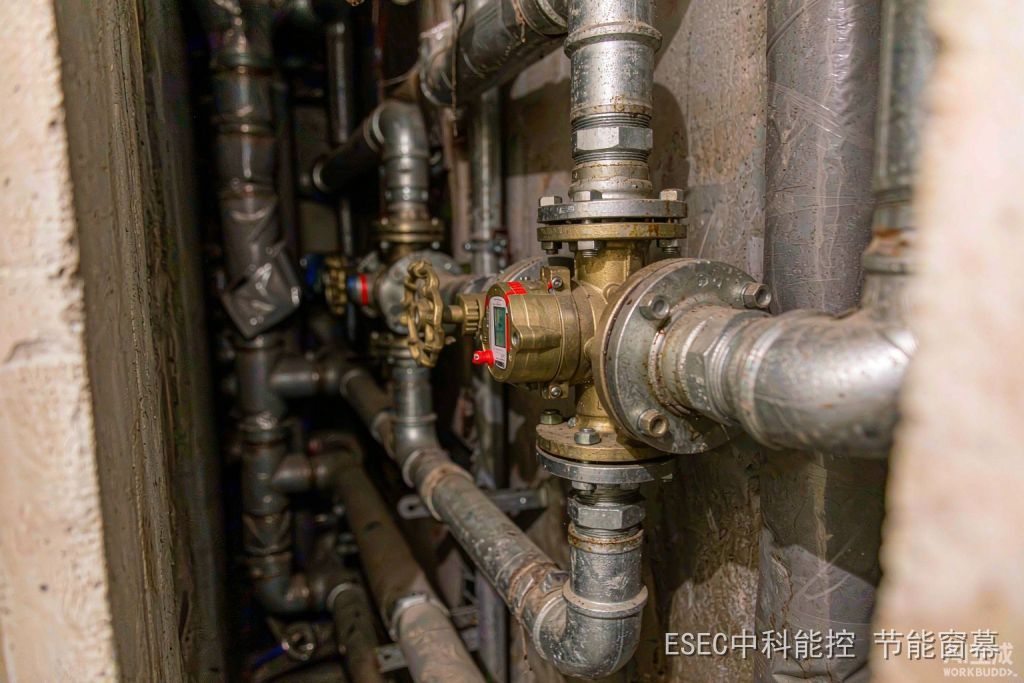
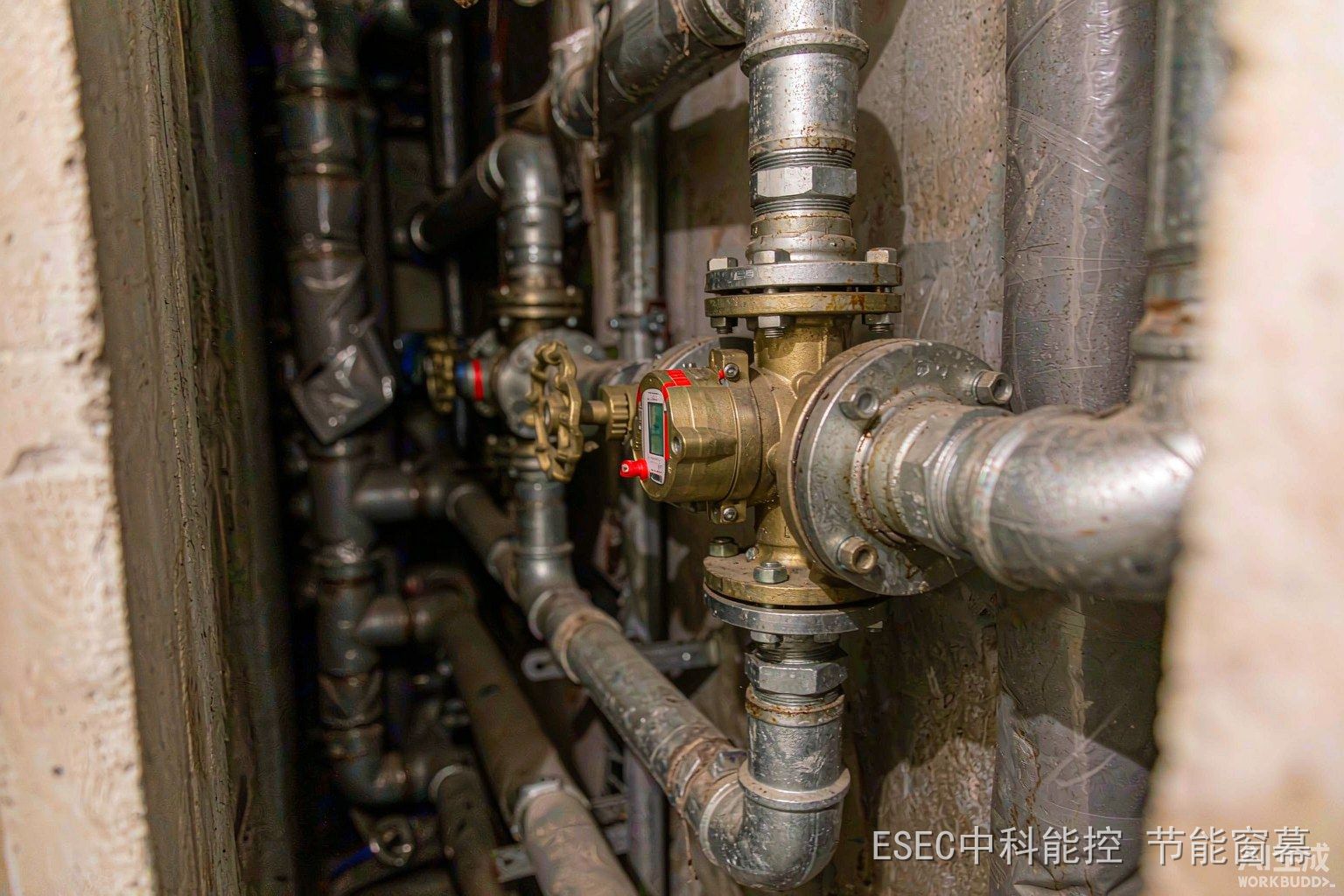
A household heat meter in a residential riser cabinet: under a two-part tariff, every kilowatt-hour recorded on this meter is real money (illustrative image).
The heating-season billing round is here again. Residents in many northern cities may notice a new line in this year’s notices: next to the familiar “per square metre” price, there is now a “per heat” price, quoted not in yuan per square metre but in yuan per gigajoule or per kilowatt-hour. This is not new – the Interim Measures for Urban Heat Pricing (Fa Gai Jia Ge [2007] No. 1195) set out the direction more than a decade ago. But ahead of the 2026-27 heating season, the pace of implementation is clearly picking up, from county-level price documents to official replies to CPPCC proposals.
Why should residents take this seriously? Because once heat is billed by measured consumption rather than floor area, the quality of a building’s insulation stops being an invisible issue and becomes something settled at every seasonal checkout. And the weakest link in the building envelope – the only one that can be strengthened later without touching the structure or replacing glass – happens to be the window.
1. Two kinds of bills: by floor area, or by heat
Most northern cities still bill residents by floor area: heat charge = floor area x unit price, regardless of how much heat is actually used. “Pay by heat” corresponds to the two-part tariff, in which the bill has two components:
- Basic heat price: covers the heat supplier’s fixed costs (network, heat source, operation and maintenance) and is charged by area – payable whether or not much heat is used;
- Metered heat price: covers variable costs (the heat actually burned) and is charged by the heat meter reading – pay for what you use.
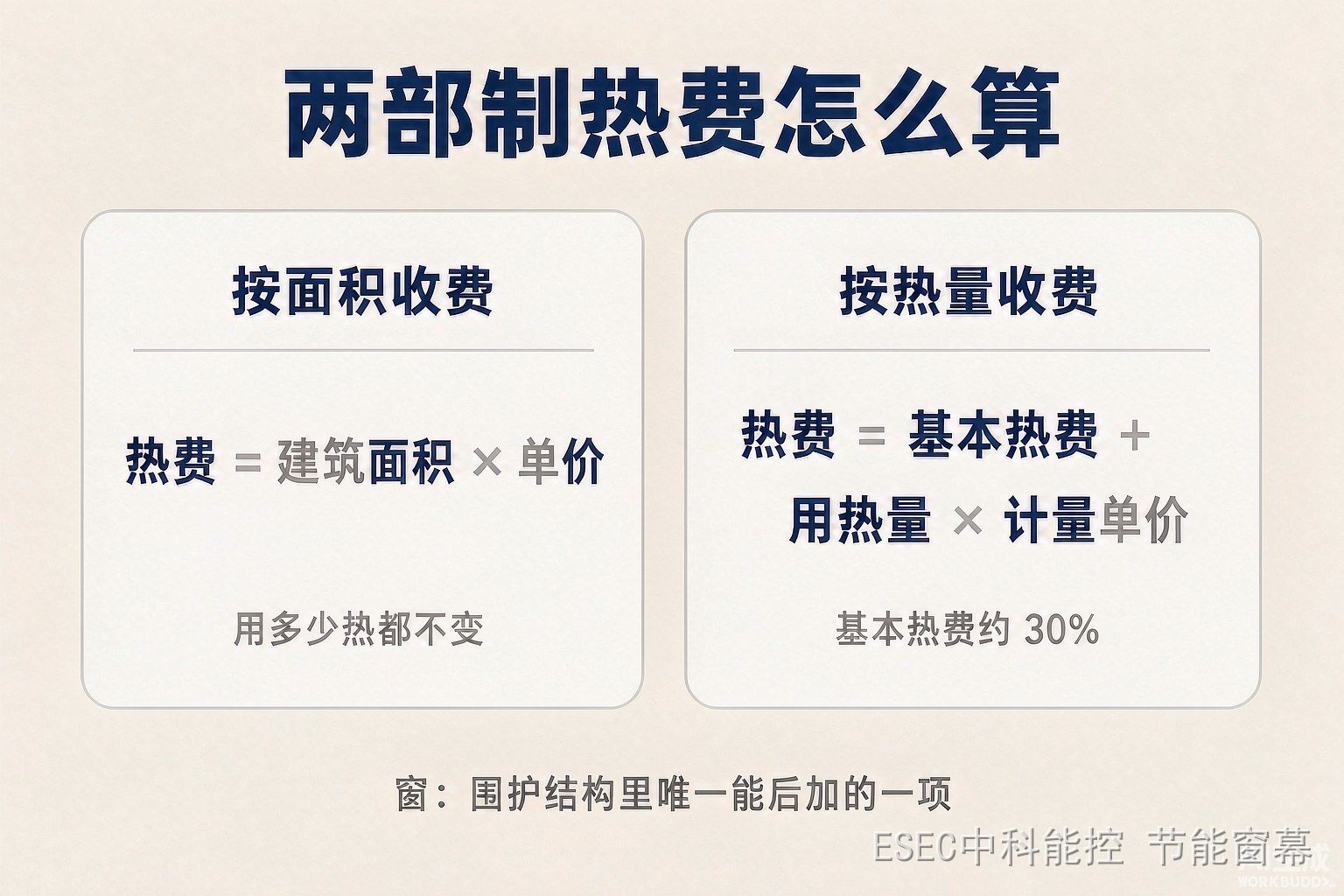
Bill structures compared: billing by floor area versus the two-part tariff billed by heat (illustrative infographic).
The policy basis is explicit. Article 15 of Fa Gai Jia Ge [2007] No. 1195 states that “heat sales prices shall progressively adopt a two-part heat price combining a basic heat price and a metered heat price”, and requires that “new buildings shall install heat metering and control devices simultaneously, while existing buildings, where conditions allow, shall be retrofitted to meet energy-efficiency and heat-metering requirements”. Article 16 allows a transition: buildings not yet ready for two-part billing may continue to be billed by area. Local legislation is more specific: Article 23 of the Shandong Provincial Heating Regulation requires that “where a user has the conditions for household heat metering, the heat supplier shall bill by heat consumed”, and caps the basic heat price – “the basic heat price calculated by floor area shall not exceed 30 percent of the total heat charge calculated by floor area”.
In short: the state sets the framework (a two-part tariff with the basic heat price at 30-60 percent of the total), localities set the details (ratios and settlement rules), and the pace of rollout depends on how widely meters have been installed.
2. Three local samples from just before the 2026 heating season
Reading recent local documents together shows “pay by heat” moving from policy text to actual bills:
- Lantian, Shaanxi: the county’s heat pricing plan (Lan Fa Gai Fa [2026] No. 179) takes effect on 15 November 2026 – the first day of the heating season. Residents billed by area pay 5.80 yuan per square metre per month; billed by heat, 44 yuan per gigajoule (about 0.16 yuan per kilowatt-hour), with metered households on a two-part tariff of 30 percent basic and 70 percent metered;
- Shen County, Shandong: the county’s notice on improving heat pricing sets a resident two-part price of a 5.70 yuan per square metre basic charge plus 0.10 yuan per kilowatt-hour metered. Settlement follows a “refund-only” rule: if the metered bill exceeds the area-based bill, the excess is not charged; if it is lower, the difference is refunded;
- Jiyuan, Henan: in a reply to a CPPCC proposal, the local housing authority disclosed that 6 communities with 1,648 households already pay a “30 percent basic + 70 percent metered” tariff, prepaying in full by area before the season and settling the difference by actual consumption afterwards.
At the same time, another official document describes the other side of the picture: in a July 2026 reply to a provincial CPPCC proposal, the Shaanxi Provincial Development and Reform Commission stated plainly that “the vast majority of provincial capitals in northern China (including all five northwestern provinces) still bill central heating by floor area”. Read together, the conclusion is clear: area-based billing remains the mainstream, but pay-by-heat is accelerating, starting with communities that already have meters. For residents, the date when “heat bills depend on how well your home holds heat” has moved from a distant direction onto the calendar.
3. What changes is not the arithmetic but the incentive
Under area-based billing, heat is an appendix to floor area: the household with leaky windows and the household with upgraded glazing pay exactly the same. Heat saved and heat lost never show up on the bill – so residents have no reason to spend money on windows.
The two-part tariff changes that incentive structure. Roughly 70 percent of the bill – the metered part – corresponds to a physical quantity: the heat your home lets escape. For the same indoor temperature over the same heating season, how much heat escapes depends on the building envelope: walls, the roof, and above all the windows, the thermally weakest element. In other words, once heat is billed by measurement, the window stops being a comfort issue and becomes an operable variable on the bill. Within the envelope, walls and roofs cannot realistically be touched, and glass replacement is costly and disruptive – while the window is precisely the element that can be reinforced later, without touching the structure or replacing glass.
A common misconception is worth clearing up: the basic charge (that 30 percent) is not an arbitrary fee. Network capacity and backup heat-source capability are provisioned by area, and even a household that suspends service keeps receiving heat through party walls and slabs (so-called “inter-dwelling heat transfer”), so the supplier’s fixed costs do not fall – which is why suspended households generally still pay about 30 percent. Conversely, when a neighbour suspends service, your metered bill is likely to rise: the heat you used to “borrow” through the party wall is gone, and your own windows must face the whole winter alone.
4. Where does the heat go? The 18°C promise comes with conditions
Most people know that “indoor temperature must not fall below 18°C during the heating period”, but few notice that the promise is conditional. Article 21 of the Shandong Provincial Heating Regulation reads: where the outdoor temperature is not below the heating system’s minimum design temperature, the building envelope conforms to the heating design codes in force at the time, and the indoor heating system operates normally, the heat supplier shall guarantee that bedrooms and living rooms stay no colder than eighteen degrees Celsius.
The second condition deserves attention: the 18°C promise rests on the assumption that the home’s insulation meets the design standards of its era. This is not just theory. In January 2026, a resident of Shan County, Shandong complained on the People’s Daily leadership message board that indoor temperature was only 15-16°C; the local enforcement authority replied that an on-site inspection had found “old sliding windows, deformed, with poor thermal insulation – indoor temperature dropped under the extreme cold”. When the windows fail the standard, the first breach in the 18°C promise is inside the resident’s own home – and the heat supplier is not liable for it.
The Jiyuan reply points to the same reality at scale: older communities “were built long ago… the buildings themselves never received insulation retrofit, so heat-loss rates remain stubbornly high”. Once such housing enters metered billing, it is usually the first to feel the pressure.
5. Where a thermal curtain fits in a pay-by-heat ledger
The logic of metered billing is simple: metered charge = heat escaped x unit price, so less escaping heat means less money. The most economical way to reduce escaping heat is to work on the weakest element of the envelope – the window. No glass replacement, no structural work: adding a retractable thermal curtain layer on the interior side of the glass reinforces that link.
Zhongke Nengkong (ESEC) energy-saving thermal curtains, for example, use a face fabric with a total solar reflectance of 88 percent, near-infrared reflectance above 95 percent, UV blocking above 99 percent, and a B1 flame-retardant rating. Lowered at night and outside daylight hours in winter, the curtain forms an air-buffer layer on the interior side of the glass, raising the effective inner-surface temperature at the window – less heat escapes through the glazing, and at the same supply-water temperature the room holds on to more of the heat it has paid for. Raised to the cassette by day, the curtain leaves views and daylight untouched. In summer, the same system lowered reflects solar heat and cuts cooling loads, so one installation serves both the winter and the summer ledger.
The boundaries should be stated honestly: a thermal curtain does not replace wall insulation, nor does it replace the metering retrofit of the heating system itself. For households still billed by area, the heat saved will not yet appear on the bill – it appears first as comfort: no more ice-cold window edges, steadier room temperature. But the direction is written into national documents and local regulations, and when a meter is installed in your riser cabinet, the bill will give a straight answer to whether the window was ever reinforced.
6. Three practical suggestions for residents and property managers
- Check how your community bills: read this year’s payment notice for the terms “by heat”, “two-part tariff”, “basic heat price” or “metered heat price”; if your community is already on a two-part tariff, note the basic-to-metered ratio;
- Run a back-of-hand window inspection: after the heating starts, hold the back of your hand near window frame gaps and the inner glass surface; wherever you feel a draught or the glass feels icy, that is where heat – and metered money – is escaping, and where retrofit priority is highest;
- Prefer solutions that leave the glass and structure untouched: window replacement involves demolition and resealing, with high execution risk in occupied buildings; a retractable curtain layer installed on the interior side of the glass is factory-prefabricated and assembled on site, with no relocation and no downtime, and can be completed within the pre-season window.
FAQ
Q: Our community has no heat meters yet – is a window upgrade still worth it?
A: Yes. Better window insulation does not depend on the billing method: it improves temperature stability and window-side comfort, both real under area-based billing. And once the community enters metered billing – which the national measures effectively require over time – the investment immediately starts to “count in money”.
Q: Is a metered bill always cheaper than area-based billing?
A: Not necessarily. Transitional settlement rules such as “refund-only” protect residents, but for a poorly insulated home with unchanged habits, the metered bill can well be higher. That is exactly the point: metering rewards well-insulated homes and pressures poorly insulated ones. Reinforce the window first; then talk about the dividend.
Q: Can the 30 percent basic charge be avoided?
A: No – even households that suspend service must pay it. It corresponds to fixed costs (network capacity, backup heat source) and the physics of inter-dwelling heat transfer, and does not vary with consumption. A thermal curtain works on the other side of the bill: with less heat escaping, the variable part finally has room to fall.
Further reading:
- Six ministries issue the 2026-2028 Urban Heating “Warm Project” Action Plan: windows and doors, the “last metre” of the network, are in the document too
- Window-to-wall ratio, explained: why codes cap north-facing glazing at 0.25 but allow 0.50 to the south
- Why frost forms on glass on clear winter nights – and what it teaches about when to lower or raise a thermal curtain
- Why window-side desks always feel cold in winter: a pre-heating-season retrofit record for a west-facing office facade
Zhongke Energy Consumption Control (Beijing) Technology Co., Ltd. (ESEC) specialises in lightweight energy-saving retrofit of glass curtain walls, participates in industry standard drafting, and its energy-saving thermal curtain is registered with the MIIT Energy Conservation Department as an “Energy Saving and Carbon Reduction Demonstration Product”. Product specifications per the official website: total solar reflectance 88 percent, near-infrared reflectance above 95 percent, UV blocking above 99 percent, B1 flame-retardant rating. In summer the curtain reflects solar heat and lowers cooling loads; in winter, lowered on the interior side of the glass it forms an air-buffer interface that raises the effective inner-surface temperature at the window and reduces heat loss. The retractable design balances shading, insulation and daylight; factory prefabrication and on-site assembly mean no business interruption, no hot work and no alteration to the glass itself – a reversible, deliverable lightweight retrofit for residential, retail, hospital and office buildings with existing curtain walls.
Website: www.zknkkj.com (installation footage and product videos on the homepage)
Tel: 18610685811 (Mr. Guo) | WeChat: ESEC88888